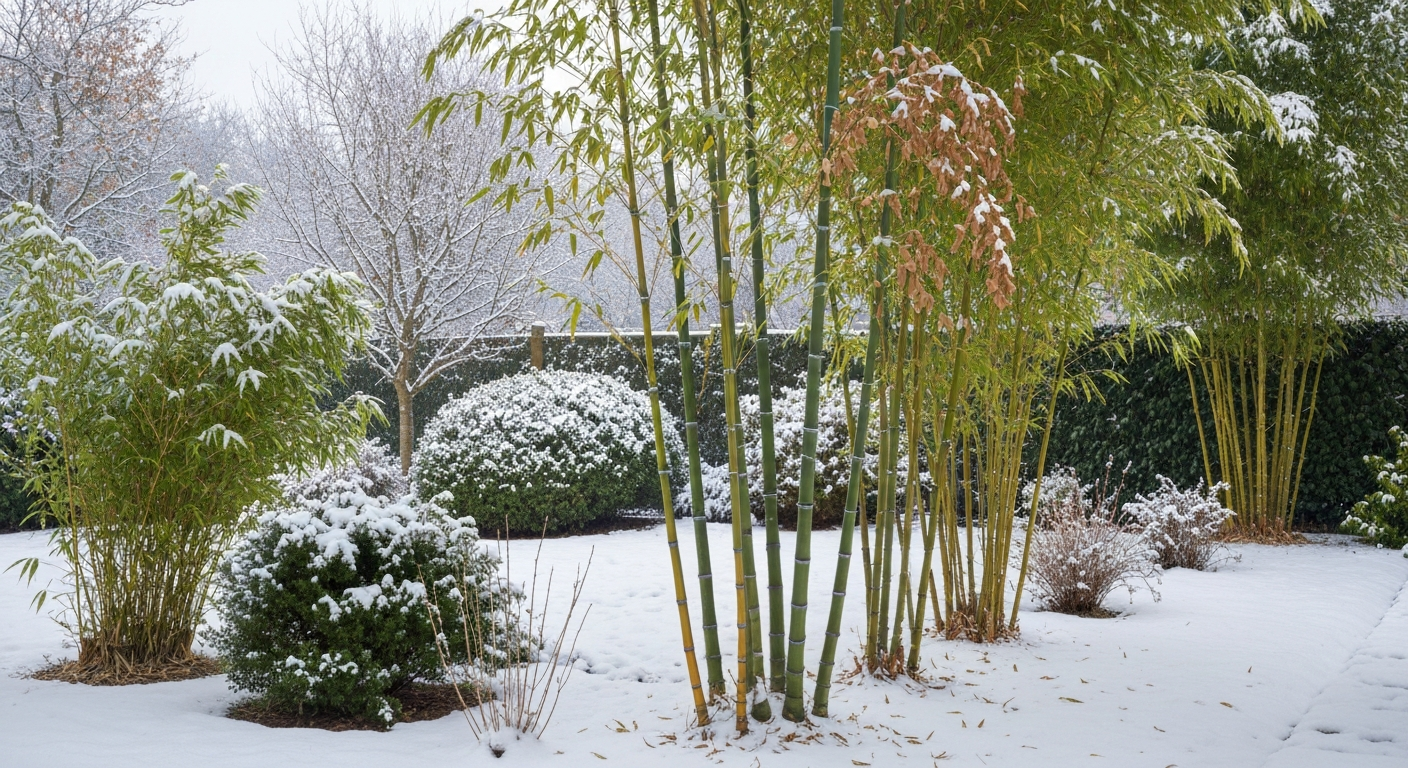
Yes, bamboo can grow in snow, and some species do it remarkably well. Several cold-hardy bamboos survive average annual extreme lows of -20°F (-28.9°C), which puts them solidly in USDA Zone 5. The key is matching the right species to your zone, managing drainage and wind exposure, and understanding that 'surviving snow' often means the top growth dies back while the underground rhizomes stay alive and resprout. Get those three things right and bamboo is a realistic, low-maintenance plant for cold, snowy gardens.
Can bamboo grow in snow? Cold-hardy species, zones, care
Marcus Hartwell
13 Aug 2026
How cold and snow actually affect bamboo
Bamboo responds to cold in two distinct ways depending on how severe and how sudden the drop is: dormancy or damage. When temperatures fall gradually in autumn, temperate bamboos acclimate. Molecular studies in moso bamboo (Phyllostachys edulis) show that cold-responsive gene families, including DREB/CBF transcription factors, dehydrins, LEA proteins, and fatty-acid desaturases, activate during this acclimation window. These genes adjust membrane fluidity and help cells resist ice crystal formation. In plain terms, bamboo given a gradual chill has a chance to harden off, much like any woody perennial.
Damage, rather than dormancy, happens when temperatures drop too fast, stay too low for too long, or come after a warm spell that has broken dormancy early. Cold-hardiness research uses a metric called LT50, the temperature at which 50% of plant tissue dies, and bamboo cultivar studies show LT50 values around -21.7°C for the hardiest selections. That lines up closely with Zone 5 conditions. Below that threshold, even rhizomes can be killed in poorly sited or unprotected plantings.
Snow itself is actually helpful. A persistent snowpack of around 20 cm (about 8 inches) is enough to significantly reduce soil freezing in most temperate locations. This is supported by the review Winter belowground: Changing winters and the perennating organs of herbaceous plants (Functional Ecology review), which notes that about 20 cm of snow often prevents soil freezing and that soil frost depth is inversely related to snow depth and duration. Research on soil frost dynamics confirms that frost penetration depth is inversely related to snow depth and duration, more snow means shallower soil frost, which means warmer rhizome zones. Bamboo growers in snowy climates sometimes get better rhizome survival than growers in cold, dry, snowless climates because the snowpack acts as insulation. If your site gets consistent winter snow cover, that is an asset, not just a hazard.
Clumping vs running bamboo: which handles cold better?
This distinction matters a lot when you are planning for a snowy site, both for survival and for long-term management. Clumping bamboos (primarily Fargesia and related genera) have tight, non-invasive root systems that stay close to the mother plant. Running bamboos (Phyllostachys and others) send out long horizontal rhizomes that can spread many feet from the original planting. In cold climates, that difference shapes both how you protect them and how you contain them.
Clumping bamboos (Fargesia)
Fargesia species are the go-to recommendation for cold and snowy gardens where you want a well-behaved, non-invasive plant. Fargesia rufa and Fargesia murielae and their cultivars are rated reliably to USDA Zone 5 in Missouri Botanical Garden records, meaning they tolerate extreme lows down to -20°F (-28.9°C). They tend to stay evergreen in milder Zone 6 winters and may lose foliage but retain live culms through Zone 5 winters with good siting. Their compact rhizome habit also means you do not need to install root barriers, which simplifies both planting and ongoing care. The trade-off is that Fargesia species are more sensitive to heat and afternoon sun than running types, so they are better suited to partial shade in warmer zones.
Running bamboos (Phyllostachys)
Running bamboos include some of the hardiest bamboos available, and in snowy Zone 5-6 gardens, certain Phyllostachys species are among the toughest landscape plants you can grow. The spread of their rhizomes is often seen as a downside, but in cold climates there is a silver lining: those far-reaching rhizomes tend to stay deep in the soil where they are better insulated from surface frosts. Washington State University Extension explicitly recommends trenching and root barriers for running bamboos in cold sites to keep the planting manageable, and that is good advice. But do not let the containment requirement put you off, established running bamboos in Zones 5-6 can recover from complete top-kill and push vigorous new canes from their rhizome network the following spring.
Cold-hardy species that actually work in snowy gardens
Not all bamboos labeled 'cold hardy' are equal. The table below summarizes the most reliably documented species for snowy, cold-climate planting, based on botanical garden records, university extension recommendations, and cold-hardiness trial data.
| Species | Type | USDA Zone | Extreme Low Tolerance | Notes |
|---|---|---|---|---|
| Fargesia rufa | Clumping | 5–9 | -20°F (-28.9°C) | Non-invasive; stays evergreen in Zone 6; partial shade preferred |
| Fargesia murielae (and cultivars) | Clumping | 5–9 | -20°F (-28.9°C) | Umbrella bamboo; excellent for screening; avoid full sun in hot zones |
| Phyllostachys bissetii | Running | 5–9 | -20°F (-28.9°C) | One of the hardiest running bamboos; documented in Zone 5/6 botanic garden plantings |
| Phyllostachys nuda | Running | 5–9 | -20°F (-28.9°C) | Very cold-hardy; culms medium-sized; good for privacy screens |
| Phyllostachys aureosulcata | Running | 5–9 | -10°F (-23.3°C) | Yellow-grooved culms; confirmed at Stonecrop Gardens in Zone 6a; widely planted in Northeast USA |
| Phyllostachys nigra | Running | 6–10 | -10°F (-23.3°C) | Black bamboo; ornamental; RHS-rated H5 (equivalent to Zone 6 minimum); may need protection at Zone 6 extremes |
| Phyllostachys aurea | Running | 6–10 | -10°F (-23.3°C) | Golden bamboo; RHS H4-H5; reliable Zone 6 performer; less suited to Zone 5 without protection |
For Zone 5 specifically, I would focus on Fargesia rufa, Fargesia murielae, Phyllostachys bissetii, and P. For a focused answer on whether bamboo grows in Zone 5, see our guide titled "does bamboo grow in Zone 5" (internal resource ID 562a40b3-9850-4953-8970-137cfc47adc2). nuda. These are the species with documented survival at the coldest end of the temperate bamboo range. For Zone 6, the list expands considerably, you can add P. Botanical garden records, including Stonecrop Garden planting/collection notes (showing Phyllostachys aureosulcata/bissetii in a Zone 6 garden), document successful establishment of these Phyllostachys species in Zone 6 collections. aureosulcata, P. nigra, and P. aurea with confidence, especially on sheltered sites. If you are working in Zone 5 and Zone 6, those topics are worth exploring in more depth: growing bamboo in Zone 6 and growing bamboo in Zone 5 each have their own nuances around microclimate and timing that go beyond species selection alone.
Reading your site before you plant
USDA zones are a starting point, not the full picture. Zone ratings are based on average annual extreme minimum temperatures, Zone 5 means -20°F to -10°F, Zone 6 means -10°F to 0°F. But within any zone there is enormous variation depending on your specific microclimate, snowpack depth, drainage, and wind exposure. I have seen Zone 6 gardens where bamboo behaves like it is in Zone 7 because of a south-facing slope and a windbreak hedge, and Zone 6 sites where exposed, poorly-drained conditions regularly kill plants that should have survived.
Here is what to assess before choosing your species and planting location:
- Identify your USDA zone and your recorded site minimum (a min-max thermometer over one or two winters is invaluable — it often reveals that your actual low is warmer than the zone average)
- Check snowpack consistency: reliable snow cover of 8 inches or more through winter is a genuine advantage for rhizome protection, since it insulates soil and reduces frost depth
- Assess drainage: saturated soil that freezes creates ice layers and freeze-thaw heave that physically damage rhizomes; avoid low spots, clay-dominated soils with poor drainage, or any area where water ponds after rain or snowmelt
- Identify wind exposure: desiccating winter winds, especially from the north or northwest, cause foliage burn and accelerate moisture loss from evergreen culms even when temperatures are tolerable; a windbreak (fence, wall, or existing shrubs) dramatically improves outcomes
- Look for warm microclimates: south-facing walls, paved surfaces, and sheltered courtyards can push effective hardiness up by a full zone — these are the right spots for species at their cold-hardiness limit
- Note late frost risk: a warm March followed by a hard April frost is more damaging than a steady cold winter, because it catches newly emerged shoots that have broken dormancy
Planting, care, and winter protection for snowy sites
Timing your planting correctly is the single easiest way to give bamboo the best start in a cold climate. WSU Extension recommends spring planting as the top choice, this gives the plant a full growing season to establish its rhizome network before facing its first winter. Early fall planting (6 to 8 weeks before your average first hard frost) also works, but late fall planting is risky because the roots do not have time to settle before the ground freezes.
Soil and drainage preparation
Work compost or well-aged organic matter into the planting area to improve drainage in heavy soils and moisture retention in sandy soils. Bamboo prefers slightly acidic to neutral pH (around 5.5–6.5) and does not tolerate waterlogging at any time of year. If your soil is heavy clay, consider raising the planting area by 6–12 inches or incorporating coarse grit to open up drainage pathways.
Mulching for winter protection
Mulching the root zone is the most impactful single thing you can do to protect bamboo through a snowy winter. WSU Extension recommends 4–6 inches (10–15 cm) of heavy mulch, straw, wood chips, or shredded leaves, applied over the entire root zone before the ground freezes. This mimics the insulating effect of a snowpack on sites that get uneven or unreliable snow cover. Keep the mulch a few inches back from the culm bases to avoid rot.
Watering through cold months
Evergreen bamboos transpire through their leaves even in winter. Going into a hard freeze well-hydrated is important, dry roots and rhizomes are more vulnerable to cold injury than moist ones. Water thoroughly before the ground freezes in late autumn, and on mild winter days (above 40°F/4°C) in Zone 5-6, a supplemental watering is worthwhile if there has been no significant rainfall or snowmelt.
Protecting above-ground growth
In Zone 5, expect some or all above-ground culm and foliage to die back in severe winters even for the hardiest species. That is normal and not a sign of plant death, the rhizomes are what matter. If you want to protect above-ground growth for Fargesia at its cold limit, WSU recommends wrapping or tarping the plant with burlap or frost cloth in late autumn. For windbreak plantings, a simple burlap screen on the windward side reduces desiccation burn significantly. Do not wrap plants with plastic shealing that traps condensation; burlap and frost cloth breathe.
Container bamboo in cold winters
Container bamboo is more vulnerable than in-ground bamboo because the pot exposes roots to ambient air temperatures rather than the buffering effect of soil. Practical strategies include sinking the container into the ground up to its rim (using the soil's thermal mass for insulation), double-potting with insulating material between containers, grouping containers against a warm south or west-facing wall, or wrapping containers in bubble wrap or horticultural fleece. Bring truly tender species indoors or into an unheated garage if temperatures will drop below their rated minimum.
Recovery after freeze damage
If culms and foliage die back over winter, resist the urge to cut everything down immediately in spring. Wait until you are sure new shoots are emerging from the soil, then cut dead culms to the ground. University of Arkansas Extension documents this pattern explicitly: established Phyllostachys and Fargesia can freeze to the ground and resprout vigorously from their rhizome network the following spring. Recovery is often faster in the second and third years post-freeze because the root system is larger. Do not declare the plant dead after one hard winter unless the rhizomes themselves are visibly rotted or desiccated.
How bamboo behaves through the year in different climates
Understanding bamboo's natural growth cycle helps set realistic expectations whatever your climate. Bamboo does not grow continuously year-round the way some plants do. New culms (canes) emerge in a single shooting season, for most temperate Phyllostachys species that is spring (April to June in the Northern Hemisphere). Each culm reaches its full height in that single season, expanding from the top of each internode upward. After shooting, growth shifts to leaf production, branching, and rhizome expansion underground for the rest of the growing season.
In cold, snowy climates (Zones 5-6), bamboo enters dormancy in late autumn as temperatures drop. Above-ground growth stops, and the plant's energy is concentrated in the rhizomes. In Zone 5 winters, the plant may look dead by February, brown, collapsed foliage, icy-coated culms, but the rhizomes under the insulating soil and mulch are often fine. New shoots emerge in spring once soil temperatures consistently hit around 50°F (10°C). The growing window is shorter in cold zones, which means culm heights tend to be somewhat lower than the same species would reach in a warmer Zone 7 or 8 site. Whether bamboo grows all year round in your specific climate is a question that deserves its own honest answer, in snowy zones, it genuinely does not, and that is fine. For a focused explanation, see does bamboo grow all year round.
In temperate Zones 7-8, bamboo may stay evergreen through mild winters and shoot earlier in spring, giving it a longer growing season and greater annual height gains. In these zones the challenge shifts from cold protection to growth management and irrigation through dry summers.
Bamboo in hot climates: a different set of challenges
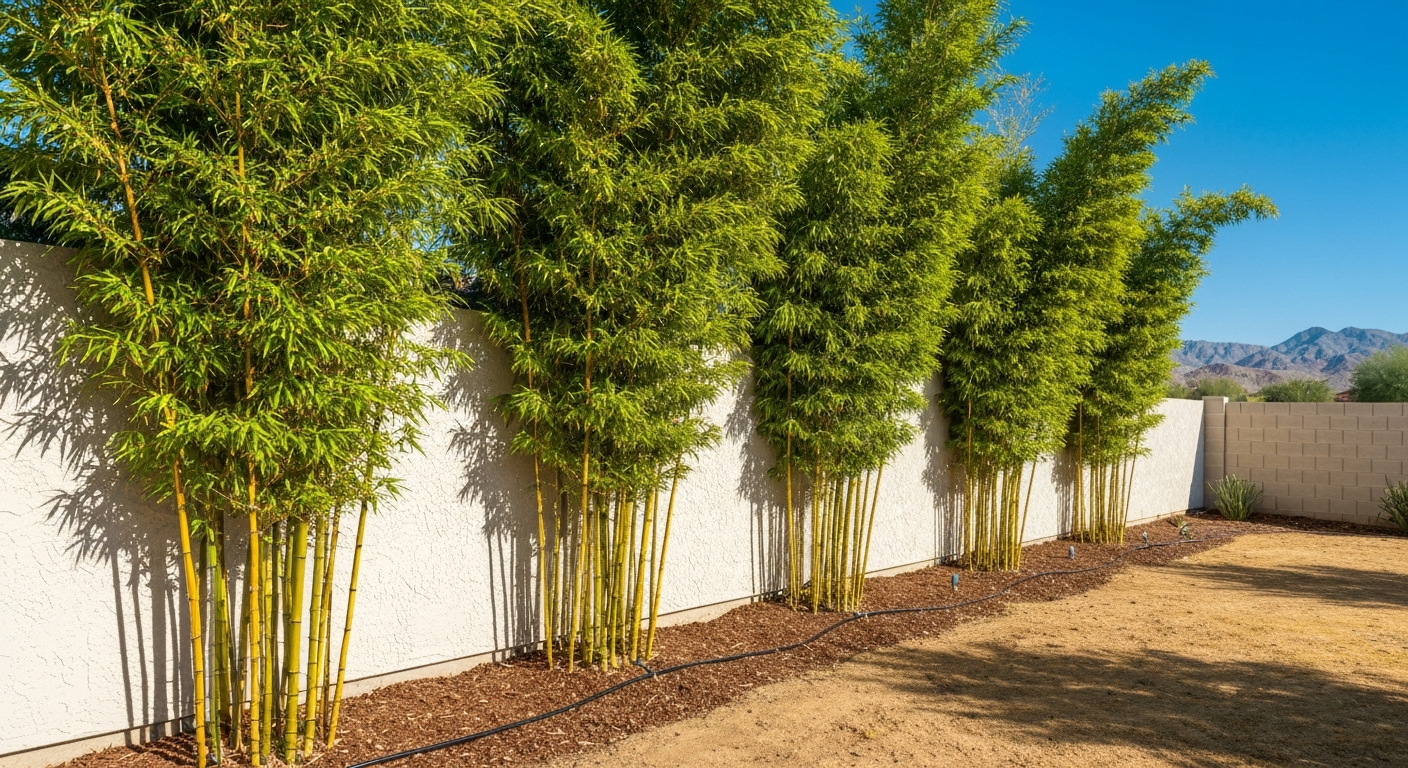
Hot climates are the flip side of the snowy-climate conversation, and understanding both ends of the spectrum helps you calibrate expectations. In hot climates, think Zone 9 and above, or places with prolonged summer temperatures above 95°F (35°C), the stresses shift from cold injury to heat stress, drought, and soil moisture management. Bamboo can grow in hot climates (many tropical species are native to hot, humid environments), but temperate cold-hardy species like Fargesia can struggle badly in heat. Fargesia rufa, for example, which performs beautifully in a snowy Zone 5 garden, can decline rapidly in prolonged heat above 90°F (32°C) without afternoon shade and consistent moisture.
In hot, dry climates, bamboo's primary physiological stress is moisture deficit combined with transpirational demand, the opposite problem of a cold, snowy winter. Running bamboos from tropical and subtropical genera (Bambusa, Dendrocalamus, and related clumping types) are better suited to hot climates than cold-hardy Phyllostachys or Fargesia. The practical takeaway is that species selection in hot climates matters just as much as it does in snowy ones, but you are optimizing for heat and drought tolerance rather than freeze hardiness. Growing bamboo in hot climates is a topic that deserves a separate deep dive, but the core contrast with snowy sites is important: the plants that thrive under snow are often the plants that will suffer most in sustained heat. See 'Can bamboo grow in hot climates' for a focused guide on species selection and care under prolonged heat and drought.
Picking the right species and approach: a decision checklist
Use this checklist to work through your situation before buying any bamboo for a snowy or variable-climate site.
- Confirm your USDA zone and your actual recorded site minimum temperature (not just the zone average)
- Decide whether you want clumping (non-invasive, less maintenance but less vigorous) or running (faster spread, needs containment, often taller) — both have Zone 5-6 representatives
- For Zone 5 or heavy snow sites: prioritize Fargesia rufa, Fargesia murielae, Phyllostachys bissetii, or Phyllostachys nuda; all are documented to -20°F (-28.9°C)
- For Zone 6 with good shelter and drainage: expand your list to include Phyllostachys aureosulcata, P. nigra, and P. aurea
- Assess drainage before planting — reject any site with standing water or heavy clay without amendment; waterlogged frozen soil is more damaging than cold alone
- Plan for 4–6 inches of mulch over the root zone every autumn, applied before the ground freezes
- For container plants in Zone 5-6: plan to sink containers or move to a sheltered, insulated location for winter
- For running bamboos: install rhizome barriers (minimum 24-inch-deep HDPE barrier) at planting, not after — retrofitting containment is a major project
- In hot climates or Zone 8+: switch your species list entirely — cold-hardy Fargesia and most Phyllostachys are poor performers in prolonged heat above 90°F; look at tropical clumping bamboos instead
- Accept that in Zone 5, above-ground dieback in harsh winters is normal — success means rhizome survival and vigorous spring reshooting, not evergreen foliage year-round
The honest truth about growing bamboo in snow is that it rewards good preparation and punishes poor site selection. Get the species match right, address drainage, mulch generously, and protect from wind, and bamboo can be one of the most resilient plants in a cold-climate garden. Go in without those steps and even a Zone 5-rated species can fail. The biology is on your side once you give it what it needs, those cold-acclimation genes are doing real work every autumn, and the insulating rhizome network under a layer of snow and mulch is tougher than it looks.
FAQ
Can bamboo grow in snow or snowy climates?
Short answer: Yes — many temperate bamboo species will survive and grow in snowy climates when you choose cold‑hardy species and use proper siting and winter care. Snow can protect the root zone by insulating soil, but extreme cold, wind, poor drainage or inadequate mulch can cause above‑ground dieback or root damage in marginal plants.
How does cold and snow affect bamboo physiology (dormancy vs damage)?
Bamboo is a perennial grass with cold‑acclimation mechanisms in leaves, culms and rhizomes. In winter many temperate species go partly dormant: growth slows, leaves may brown, and above‑ground culms can be killed back in severe freezes while rhizomes survive. A persistent snowpack often insulates soil and protects roots; loss of snow or saturated, freezing soils increase risk of root and rhizome injury.
What’s the difference between clumping and running bamboo for snowy sites?
Clumping bamboos (genera such as Fargesia) grow in tight, non‑invasive clumps and are generally recommended for home gardens and cold sites because many species are cold‑hardy and evergreen. Running bamboos (mainly Phyllostachys) spread by long rhizomes and can be very cold‑hardy but require root containment and more careful siting to prevent spread. Choose clumpers for low maintenance screening; choose hardy runners if you want faster growth and will use containment.
Which bamboo species are reliable for USDA Zones 5 and 6 (cold and snowy areas)?
Cold‑tolerant options commonly recommended for Zones 5–6 include clumping Fargesia species and cultivars (e.g., Fargesia rufa, F. murielae and their cultivars) and several Phyllostachys species used as hardy runners (e.g., P. bissetii, P. aureosulcata, P. nuda). Select cultivars rated for your zone and local microclimate; botanic garden and extension records document real‑world performance in these zones.
How much does snow protect bamboo roots from freezing?
Snow acts as an insulating blanket: roughly 8 in (≈20 cm) of consistent snow can greatly reduce soil freezing in many temperate areas and protect rhizomes. Insulating snow reduces frost depth and the frequency of freeze‑thaw cycles; conversely, snow removal or thin intermittent cover increases risk of root‑zone freezing and damage.
How does bamboo behave year‑round in cold versus hot climates?
In cold climates bamboo often slows or stops shoot production in winter, may lose foliage or have culm dieback during extreme freezes, but resprouts from rhizomes in spring if roots survive. In warm/hot climates many temperate bamboos remain evergreen, grow year‑round, and produce more and larger culms; however, some tropical bamboos require hot, frost‑free conditions and will not survive freezes.
Next Article
Can Bamboo Grow in Las Vegas? Guide to Success in Desert
Yes, bamboo can grow in Las Vegas with the right species, irrigation, shade, and containment; step-by-step planting and保护