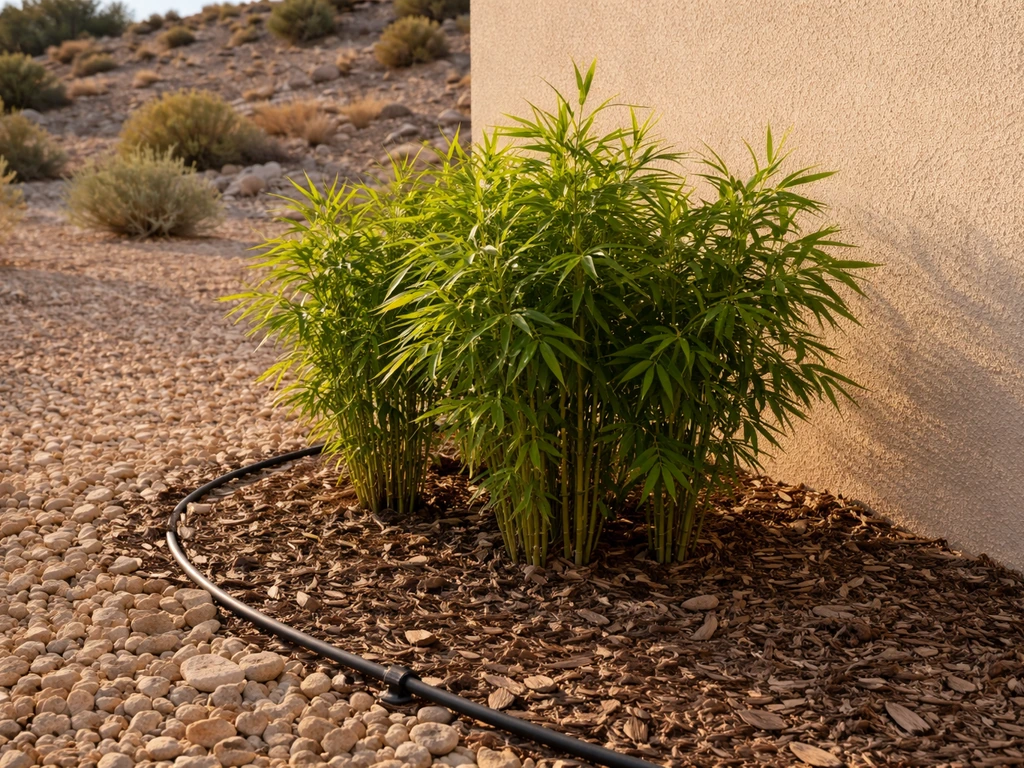
Yes, bamboo can grow in Las Vegas, but not the same way it grows in a humid southeastern backyard or a Pacific Northwest garden. The desert throws three real challenges at bamboo: searing summer heat that regularly pushes past 105°F, alkaline soils with shallow caliche hardpans, and an annual rainfall of roughly 4 inches against an evapotranspiration rate of around 74 inches per year. Close that massive moisture gap with a smart irrigation setup, pick heat-tolerant species (clumping types in particular), and amend your soil, and you can absolutely grow a healthy bamboo screen or grove in the Las Vegas Valley.
Can Bamboo Grow in Las Vegas? Guide to Success in Desert
Marcus Hartwell
15 Jul 2026
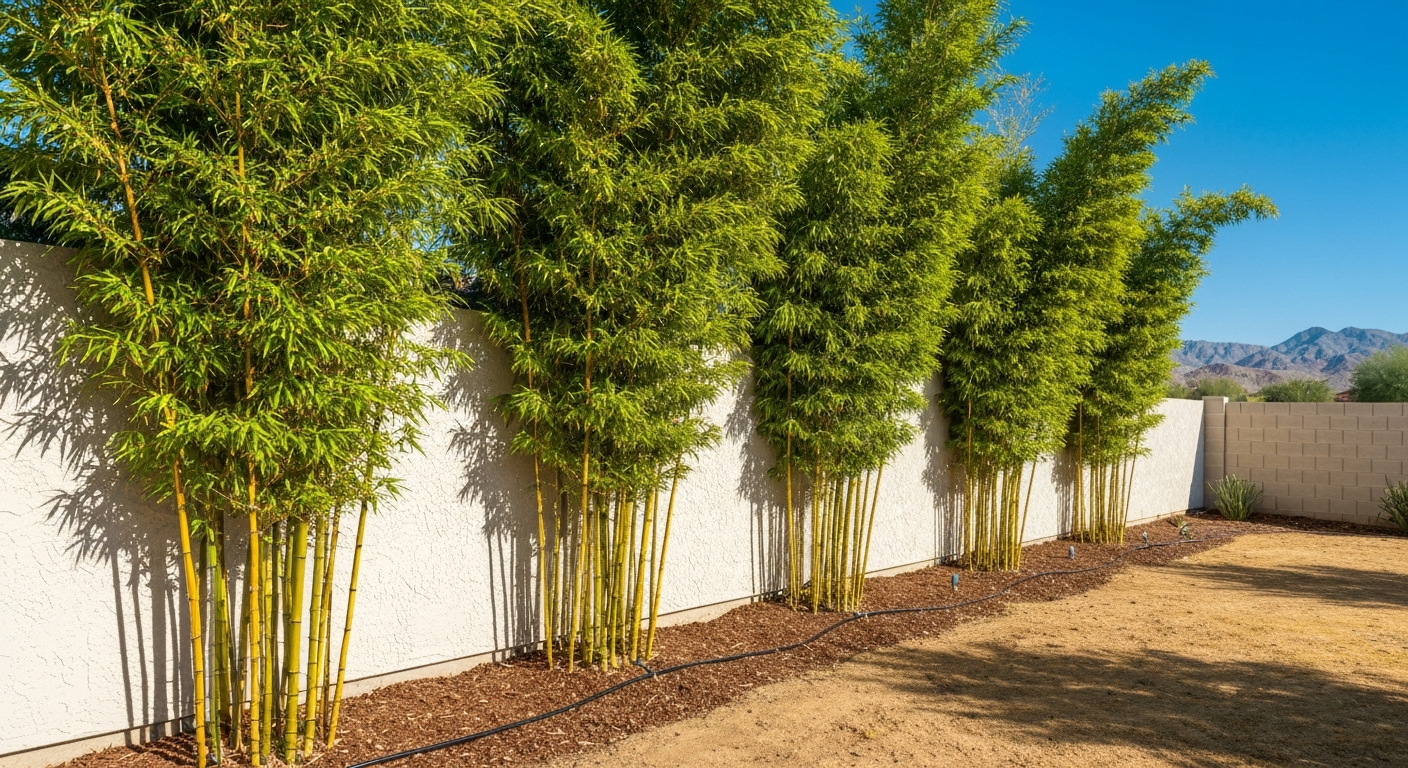
What Las Vegas Climate Actually Does to Bamboo
Las Vegas sits in a hot desert climate (Köppen BWh), and most of the valley falls in USDA Plant Hardiness Zones 9a to 9b based on the 2023 USDA map. That means winter low temperatures typically stay above 20°F to 25°F, cold enough to knock back frost-sensitive tropical bamboos but warm enough for a solid range of subtropical clumpers and temperate runners. Winters here are actually friendlier to bamboo than many people assume.
The real test is summer. Daytime highs routinely exceed 100°F from June through August, and reflected heat from stucco walls, concrete, and asphalt can push leaf-level temperatures even higher. Bamboo responds to that kind of heat with leaf rolling, tip scorch, and dieback if soil moisture runs low even briefly. The reference evapotranspiration (ETo) figure for Las Vegas, roughly 74 inches per year, tells you exactly how aggressive the desert is at pulling water out of your soil. For comparison, a typical bamboo-friendly climate in the southeastern U.S. has an ETo of around 40 to 50 inches and gets 50 or more inches of rain to offset it. In Las Vegas, virtually all of that 74-inch demand falls on your irrigation system.
Microclimates matter enormously in the valley. A north-facing courtyard or a spot with afternoon shade from a block wall can be 10°F to 15°F cooler than a south-facing open bed. If you have options, choose protected microclimates, they can make the difference between bamboo that struggles and bamboo that genuinely thrives. I have seen the same Bambusa oldhamii variety look completely different on the shaded side of a wall versus an exposed south-facing planting, even with identical irrigation.
Clumping vs. Running Bamboo: Choose Wisely Here
This choice matters more in an urban desert setting than almost anywhere else. The two growth habits are fundamentally different, and Las Vegas conditions amplify the trade-offs.
Clumping bamboos (pachymorph rhizome types, mostly Bambusa and Fargesia genera) expand slowly outward from a central crown, typically a few inches per year. They do not send running rhizomes under fences or into neighbors' yards. For a Las Vegas subdivision lot, that is a huge practical advantage. The trade-off is that subtropical clumpers like Bambusa need consistent, generous irrigation through the summer. Let them dry out, and they will tell you about it fast through browning leaves.
Running bamboos (leptomorph rhizome types, mostly Phyllostachys) spread aggressively through horizontal rhizomes that can travel 10 to 20 feet from the parent plant in a single season once established. In the desert Southwest, they are often reported as more drought-tolerant once established than clumpers, which makes them tempting. Bamboo for Gardens, Ted Jordan Meredith (horticultural synthesis on clumping vs running and tolerances) summarizes that clumpers provide dense screening with lower risk of underground spread but generally need more summer irrigation, while temperate runners (Phyllostachys) are often more drought‑tolerant once established but can be invasive without proper containment Bamboo for Gardens — Ted Jordan Meredith (horticultural synthesis on clumping vs running and tolerances). But without a proper root barrier, a 60 mil or thicker HDPE barrier buried at least 24 to 30 inches deep and looped all the way around the planting, a runner will escape. In a city with zero-lot-line properties and concrete driveways, that is a real problem. If you go with runners, containment is non-negotiable.
| Type | Spread Risk | Drought Tolerance (Established) | Summer Heat Tolerance | Containment Needed |
|---|---|---|---|---|
| Clumping (Bambusa spp.) | Low — slow radial expansion only | Moderate — needs regular irrigation | High for subtropical types | No barrier needed; periodic edge pruning |
| Running (Phyllostachys spp.) | High — rhizomes spread 10–20 ft/season | Moderate to good | Good for most species | Yes — 60 mil HDPE barrier, 24–30 in deep |
My honest recommendation for most Las Vegas homeowners: start with a clumping Bambusa species unless you are fully committed to installing proper containment. The peace of mind is worth it, especially in neighborhoods with shared fences and utilities nearby.
Recommended Species for Las Vegas Gardens
Not every bamboo sold at a big-box store is suited for the Mojave. The following species have strong track records in hot, dry southwestern climates and are available through specialty nurseries like Moon Valley, Lewis Bamboo, and similar growers. For authoritative species profiles, native ranges, and synonyms, consult Plants of the World Online, Royal Botanic Gardens, Kew (species profiles) Plants of the World Online — Royal Botanic Gardens, Kew (species profiles).
| Species | Type | USDA Zones | Mature Height | Heat Tolerance | Drought Tolerance | Best Use |
|---|---|---|---|---|---|---|
| Bambusa oldhamii (Giant Timber) | Clumping | 8b–11 | 40–55 ft | Excellent | Moderate — needs regular water | Privacy screen, specimen grove |
| Bambusa textilis 'Gracilis' | Clumping | 8b–10 | 20–35 ft | Excellent | Moderate | Narrow screen, containers |
| Bambusa multiplex 'Alphonse Karr' | Clumping | 8a–10 | 10–20 ft | Good | Moderate | Accent, containers, hedges |
| Phyllostachys aurea (Golden Bamboo) | Running | 7–11 | 10–30 ft | Good | Good once established | Screen (with barrier only) |
| Phyllostachys bambusoides (Timber) | Running | 7–10 | 35–70 ft | Good | Moderate–good | Large screen (with barrier only) |
| Phyllostachys bissetii | Running | 5–10 | 15–25 ft | Good | Good | Tough screen (with barrier only) |
| Phyllostachys decora | Running | 6–10 | 15–25 ft | Good | Good | Ornamental screen (with barrier) |
A note on Fargesia species: these alpine clumpers are popular in cooler climates and tolerate cold down to Zone 5, but they genuinely struggle in Las Vegas summers. They prefer afternoon shade and cool nights, and the Las Vegas Valley does not deliver that consistently. I would not recommend Fargesia for most in-ground Las Vegas plantings. Stick to the Bambusa clumpers or the contained Phyllostachys runners listed above.
How to Plant Bamboo In-Ground in Las Vegas
Planting bamboo in Las Vegas soil requires more prep work than planting in a forgiving loam climate. The valley's soils are typically alkaline, sandy to loamy in texture, often with a shallow caliche hardpan layer anywhere from 6 inches to 2 feet below the surface. That caliche is concrete-hard and blocks both roots and drainage. You need to deal with it before you plant.
Site Selection
Choose a spot with morning sun and afternoon shade where possible, the intense western sun from 2 p.m. onward is brutal in summer. North and east-facing walls are ideal backdrops. Avoid planting near underground utilities, drainage pipes, or property boundaries without a containment barrier in place for running types.
Planting Steps
- Test your soil pH — Las Vegas soils typically run between pH 7.5 and 8.5. Aim to bring the planting zone down to pH 6.5–7.0 with sulfur amendments and generous organic matter.
- Break through any caliche layer with a jackhammer, pick, or rented breaker — do not skip this step. If you leave a hardpan below your planting hole, you will create a water-logged bathtub that drowns roots.
- Dig a planting hole at least twice the width and 1.5 times the depth of the root ball — for most nursery stock, that means 3 to 4 feet wide and 2 feet deep.
- Backfill with a mix of 50% native soil and 50% high-quality compost or a well-structured planting mix. Avoid pure sand (worsens drainage) or heavy clay amendments.
- For running species: install a 60 mil HDPE rhizome barrier around the perimeter of the planting area before backfilling, buried 24 to 30 inches deep with 2 to 3 inches protruding above ground level. Overlap the seam at least 12 inches and use stainless steel clamps to secure it.
- Set the root ball so the top of it sits level with or slightly above the surrounding grade — this helps prevent crown rot and water pooling.
- Backfill, firm gently, and form a shallow watering basin or berm around the plant to direct irrigation water to the root zone.
- Apply 4 to 6 inches of organic mulch (wood chips, straw, or rice straw work well) over the root zone, keeping mulch 2 to 3 inches away from the culms themselves.
- Water in deeply immediately after planting — soak the full root zone slowly using a drip emitter or soaker hose, then establish your drip irrigation schedule before temperatures climb.
Spacing
For a privacy screen with clumping types, space plants 5 to 8 feet apart (center to center) for Bambusa oldhamii and similar large clumpers, they will fill in within 3 to 5 years with good irrigation. Bambusa multiplex and 'Alphonse Karr' can be spaced 3 to 5 feet apart. For running types with a containment barrier, spacing of 4 to 6 feet is common for screen plantings.
Container and Raised-Bed Bamboo: A Smart Option for Las Vegas
Container growing is genuinely excellent for bamboo in Las Vegas, and I would argue it is the best starting point for most homeowners here. You sidestep the caliche problem entirely, you control soil chemistry, you can move plants to shade during heat waves, and you eliminate any invasiveness risk for running types.
Container Setup Step-by-Step
- Choose a large container — at minimum 20 to 25 gallons for smaller Bambusa multiplex types, and 45 to 65 gallons for larger clumpers like Bambusa oldhamii. Bigger is better; bamboo roots run warm in small pots in desert summers.
- Use a pot with multiple drainage holes. In Las Vegas heat, excess water needs to escape quickly to prevent root rot.
- Fill with a well-draining mix: roughly 60% high-quality potting mix, 30% perlite or coarse pumice, and 10% compost. The goal is fast drainage with good moisture retention — a difficult balance but critical in desert heat.
- Set the pot on pot feet or a raised platform to ensure drainage does not get blocked and air circulates under the container.
- Place containers where they receive morning sun and afternoon shade. Light-colored or double-walled containers help insulate roots from extreme heat — dark plastic pots can reach dangerous root temperatures in August.
- Install a dedicated drip emitter or two directly into the pot. In summer, potted bamboo in Las Vegas may need watering every 1 to 2 days. Automated drip on a smart controller is practically essential.
- Mulch the top of the pot with 2 to 3 inches of wood chips or gravel mulch to reduce surface evaporation.
- Plan to repot or divide every 3 to 5 years as roots fill the container — a root-bound bamboo in a hot container is the fastest way to lose the plant.
Raised beds are a middle-ground option: build a frame at least 18 to 24 inches deep from cinder block, cedar, or composite lumber, line it with weed barrier (not bottom, drainage must be free), and fill with amended soil. For runners in raised beds, a liner of 60 mil HDPE on all four sides of the frame prevents rhizome escape through the soil below. Raised beds warm up faster in spring but also overheat in summer, so shade placement is even more critical than for in-ground plants.
Soil, Sun, Irrigation, and Microclimate Guidance
Soil and pH
Bamboo grows best in slightly acidic to neutral soil, roughly pH 5.5 to 7.0. Most Las Vegas valley soils run pH 7.5 to 8.5, which can tie up nutrients like iron and manganese, leading to chlorotic (yellowing) leaves. Amend your planting zone with elemental sulfur and generous compost before planting. Retest every year or two and apply sulfur as needed. Foliar iron chelate sprays can help correct chlorosis quickly if it appears.
Sun Exposure
Most bamboo species marketed as 'full sun' are rated for full sun in climates far less intense than Las Vegas. Here, afternoon sun from roughly 1 p.m. to 5 p.m. in summer is a significant stress event, not just normal exposure. Morning sun (east-facing) with afternoon shade is the sweet spot. Even heat-tolerant Bambusa species will show significant leaf scorch and rolling with unshaded full western exposure in July and August.
Irrigation
Drip irrigation is the right tool for bamboo in Las Vegas, it delivers water directly to the root zone, reduces evaporative loss compared to overhead spray, and keeps foliage dry (which reduces fungal issues and salt deposits from hard water). The Southern Nevada Water Authority (SNWA) recommends ETo-based smart controllers and enforces seasonal watering restrictions, so check current SNWA guidelines before programming your schedule.
As a general framework: during establishment (first two growing seasons), water deeply every 2 to 3 days in summer and every 5 to 7 days in cooler months. Once established, large in-ground clumpers may need deep watering every 3 to 4 days in peak summer and every 7 to 10 days in winter. Potted bamboo needs more frequent attention, check soil moisture daily in summer and water when the top 2 inches dry out. Always water in the early morning to minimize evaporation and heat stress.
Mulching
A 4 to 6 inch layer of organic mulch over the root zone is one of the highest-return investments you can make for bamboo in the desert. It cuts soil temperature significantly, slows moisture loss, improves soil biology as it breaks down, and gradually lowers soil pH. Wood chips, rice straw, and shredded bark all work well. Refresh the mulch layer annually, especially after summer monsoon rains wash or decompose it.
Heat Protection and Summer Management
Summer is when Las Vegas bamboo growers earn their results. The plants can handle the heat if you manage moisture and shade consistently, but they will not forgive neglect the way a cactus will.
- Install shade cloth (30% to 50% shade rating) on the western side of bamboo plantings during June through September if natural afternoon shade is not available. A simple frame with shade cloth can cut leaf-surface temperatures by 10°F or more.
- Never let the soil dry out completely in summer. Bamboo signals drought stress with leaf rolling — by the time that happens, you are already behind on irrigation.
- Water deeply and slowly rather than frequently and shallowly. A slow drip for 30 to 60 minutes pushes moisture down to the full root zone; a quick 5-minute overhead spray wets only the top inch and encourages shallow rooting.
- Avoid fertilizing with high-nitrogen feeds during heat waves — lush new growth is the most vulnerable to heat and sun damage. Wait until temperatures drop below 100°F consistently in September to apply balanced fertilizer.
- If you see leaf scorch (brown, crispy leaf tips and edges), it is almost always a combination of water stress and sun exposure. Increase irrigation frequency first before assuming a disease or pest problem.
- For potted plants, move containers to a sheltered, shaded location during extreme heat events — anything forecast above 110°F is a reasonable threshold to get containers out of direct afternoon sun.
- In winter, Las Vegas temperatures rarely drop to damaging levels for Zone 9 bamboo, but if a hard frost is forecast (below 25°F), wrap container plants in frost cloth and move them away from exposed positions if possible.
Containment, Invasiveness, and Ongoing Maintenance
If you plant running bamboo without containment in Las Vegas, it will eventually escape. The dry climate slows rhizome spread compared to humid climates, but once a Phyllostachys establishes a root network in irrigated, amended soil, it spreads aggressively. Root barriers are the standard solution, HDPE sheet plastic rated at 60 mil minimum, buried in a complete loop around the planting at 24 to 30 inches depth. Check the top edge of the barrier annually and cut off any rhizomes that try to escape over the top.
For clumping species, containment is simpler: once a year, use a sharp spade or mattock to cut back any new culms or clump expansion beyond your target boundary. This is a low-effort task with clumpers, nothing like the work required to manage an escaped runner.
Prune dead or damaged culms at the base any time. Thin the interior of dense clumps by removing old or weak culms each spring to improve airflow and encourage strong new growth. In Las Vegas, this spring thinning also reduces the amount of foliage the plant needs to sustain through summer heat.
Realistic Growth Rates and Timelines
Do not expect bamboo to behave in Las Vegas the way it does in a humid, fertile, high-rainfall climate. A Bambusa oldhamii that puts on 30 feet per year in southern Florida will grow more modestly in Las Vegas, 8 to 15 feet of new culm height per season is realistic with good care, and the plant will spend its first one to two years establishing root mass rather than shooting up culms. The old saying about bamboo, 'the first year it sleeps, the second year it creeps, the third year it leaps', applies here, and the sleep phase may be a little longer in desert conditions. By year three or four with consistent irrigation and amended soil, you should see strong, robust annual shoots and a noticeably denser clump.
Common Problems and Quick Fixes
| Problem | Likely Cause | Fix |
|---|---|---|
| Yellowing leaves (chlorosis) | High soil pH tying up iron/manganese | Apply iron chelate foliar spray; amend soil with sulfur to lower pH |
| Brown leaf tips and edges (scorch) | Heat stress combined with water deficit | Increase irrigation frequency; add shade cloth on west side |
| Leaf rolling in morning | Severe moisture stress | Water immediately and deeply; check drip emitters are functioning |
| Sparse, weak new culms | Root-bound container or depleted soil nutrients | Repot or divide; fertilize with balanced slow-release in spring |
| White crusty deposits on soil surface | Salt buildup from hard water irrigation | Flush soil deeply once a month; switch to drip to reduce salt concentration |
| Spider mites (fine webbing, stippled leaves) | Hot, dry conditions — classic Las Vegas pest | Spray foliage with strong water jet; apply neem oil in early morning |
| Culm die-back after frost | Temperature below species minimum hardiness | Cut dead culms to the ground; established roots usually resprout in spring |
How Las Vegas Compares to Nearby States
Las Vegas sits at the intersection of several challenging southwestern climates. Arizona's low desert (including Phoenix) shares very similar heat and zone conditions, in fact, bamboo culture in Phoenix and Las Vegas is nearly identical, with the same preference for clumping Bambusa species and afternoon shade. See our Phoenix guide, Does bamboo grow in Phoenix, Arizona, for localized species recommendations and irrigation tips. For guidance on conditions and species just across the border, see does bamboo grow in Mexico. Can bamboo grow in Arizona offers region-specific guidance for Phoenix-area conditions, species selection, and heat-management techniques that apply to the low desert. Utah and Colorado are colder, sitting in Zones 5 to 7 for most bamboo-growing regions, which shifts the species selection strongly toward cold-hardy temperate runners and rules out most subtropical clumpers. New Mexico spans a wide range of elevations and zones, making some areas more bamboo-friendly than Las Vegas and others less so. For specifics on which parts of New Mexico can support bamboo, see our guide titled "can bamboo grow in New Mexico.". If you have explored growing bamboo in any of those neighboring states, many of the irrigation and heat management principles here translate directly, the main variable is winter hardiness. For guidance about cooler, higher-elevation climates and whether can bamboo grow in Utah, see the related interior-state guide (internal link to b3f7d39a-7a36-4acb-aa88-23dd4200d194).
The Bottom Line for Las Vegas Bamboo Growers
Bamboo in Las Vegas is entirely achievable, but it requires you to work with the desert rather than against it. Pick a clumping Bambusa species suited for Zone 9, amend your soil aggressively before planting, install drip irrigation on a smart controller, mulch heavily, and protect young plants from afternoon sun. Do those things consistently, and you will have a healthy, attractive bamboo planting that most visitors would not expect to find in the Mojave. Skip any one of those steps regularly, and you will be replacing plants. The desert is an honest teacher, it rewards preparation and punishes neglect, but it does not make bamboo impossible.
FAQ
Title and meta description for SEO
Title: Can Bamboo Grow in Las Vegas? A Practical Guide for Home Gardeners Meta description: Yes—bamboo can grow in Las Vegas with the right species and care. Learn species picks, planting, irrigation, containment and troubleshooting (≤160 chars).
Short answer — can bamboo be successfully grown in Las Vegas' desert climate?
Short answer: Yes — but with important caveats. Las Vegas' hot‑desert climate (USDA zones ~9a–9b, very high ETo and ~4 in/yr rainfall) means bamboo will not thrive without reliable supplemental irrigation, soil amendment, appropriate species selection and active containment/maintenance. Clumping (Bambusa) types are lower‑risk for spread but need consistent moisture; some temperate runners (Phyllostachys spp.) survive heat and variable soils if irrigated and contained. Success depends on water budget, site microclimate and ongoing care.
Which bamboo species are recommended for Las Vegas (clumping vs running and traits)?
Recommended species and traits (summary table): - Table columns: Species | Growth type | Heat tolerance | Water need | Containment note - Bambusa textilis 'Gracilis' | Clumping | High | Moderate–High | Safe (clumper) - Bambusa oldhamii | Clumping (giant) | High | High | Safe (large container/clump) - Bambusa multiplex 'Alphonse Karr' | Clumping | High | Moderate–High | Safe (dense screen) - Phyllostachys bissetii | Running | Moderate–High | Moderate | Tough, needs root barrier - Phyllostachys decora | Running | Moderate–High | Moderate | Tough, vigorous rhizomes - Phyllostachys bambusoides / aurea | Running | Moderate–High | Moderate | Fast, aggressive; strong containment required Notes: Clumpers give predictable, non‑invasive screens but demand steady moisture. Runners can tolerate variable conditions once established and may be more drought‑tolerant, but they are invasive unless contained with barriers or pots.
How to choose between clumping and running bamboo for my Las Vegas yard?
Choose clumpers if you want low invasive risk and are prepared to irrigate regularly and accept a contained clump form. Choose runners only if you want rapid screening, can install a certified root barrier (≥30–36" deep) or plan to grow in containers, and are prepared for regular rhizome management. Match species to your water budget: clumpers often require more consistent watering; some tough runners survive marginally drier conditions but still need summer irrigation.
Step‑by‑step planting instructions for in‑ground bamboo in Las Vegas
1) Site selection: pick a site with some afternoon shade or a microclimate (north/west side of house, windbreaks) to reduce heat stress. 2) Soil prep: excavate twice the rootball width, break caliche if present, incorporate 40–50% compost or well‑aged organic matter to improve water retention and buffer alkalinity. 3) Planting hole: set crown slightly higher than surrounding soil, backfill with amended mix, firm gently. 4) Mulch: apply 3–4" organic mulch, keep 2–3" away from culms. 5) Irrigation: install a dedicated drip line with emitters delivering deep soaking (see irrigation FAQ). 6) Containment: if planting runners, immediately install a vertical root barrier (HDPE ≥40 mil, 30–36" deep) with the top 2"–3" above grade and seal corners. 7) Establishment care: water deeply 2–3× per week in spring/fall and daily to multiple times per week in summer depending on heat and ETo; reduce in winter.
Container planting options and guidance
answer":"Containers are a good option to limit spread and reduce some soil challenges. Use very large pots (50–100+ gallons) for screening clumpers or runners; choose UV‑stable containers with drainage. Media: high‑porosity potting mix amended with compost and a moisture‑retentive component (coco coir or composted bark). Watering: containers dry faster—plan for daily to every‑other‑day irrigation in summer; set up a drip or micro‑spray and check root temperatures (insulate or move pots during extreme heat). Prune roots and repot or topdress every 2–4 years to avoid rootbound decline."},{"question":"Irrigation and soil recommendations for desert bamboo","answer":"- Plan for deep, infrequent irrigation using drip or micro‑spray on a dedicated zone tied to an ETo or smart controller. - Expect much higher water demand than native desert plants; Las Vegas ETo (~74 in/yr) means summer watering is the limiting factor. - Mulch heavily (3–4") to conserve moisture and reduce soil temperature. - Amend soils with large volumes of organic matter to increase water‑holding capacity and buffer alkalinity. - Group bamboo with other high‑water plants on the same irrigation schedule and follow SNWA water‑smart recommendations and local watering restrictions."},{"question":"How to protect bamboo from extreme heat and cold in Las Vegas","answer":"Heat protection: provide afternoon shade or shade cloth during peak summer, mulch thickly, keep irrigation steady, and consider placing containers in shaded microclimates. Cold protection: most recommended species tolerate mild winters in zones 9a–9b; for rare cold snaps (≤25–30°F) protect young shoots with straw, fleece or frost cloth and avoid late‑season fertilizing that promotes tender growth. Monitor specific species hardiness—use USDA hardiness lookup for your exact ZIP code."},{"question":"Containment and invasiveness controls (root barriers, pruning, pots)","answer":"Effective controls: - Install a rigid HDPE or polypropylene root barrier at least 30–36" deep for runners; bevel the barrier outward and keep top 2–3" above soil. - Trenched root interception: inspect and cut rhizomes 2× per year and dispose of removed rhizomes. - Pots: large containers prevent spread completely if roots remain in pot. - Regular pruning: remove new canes at the edge to prevent outward expansion. - Edge maintenance: plant a buffer zone of gravel or a planting strip to slow rhizome travel. Combine measures rather than relying on one method."},{"question":"Realistic growth rates and timelines in Las Vegas conditions","answer":"Timeline expectations: - Year 1: establishment—root spread and modest top growth; needs steady irrigation. - Years 2–3: rapid height and culm production for vigorous species; clumpers expand slowly outward (a foot or two per year), runners can extend rhizomes several feet per year if not contained. - Mature screen: 2–5 years to form a useful screen depending on species and irrigation. Growth slows if roots are water‑stressed, in poor soil, or in small containers."},{"question":"Troubleshooting: common problems (pests, nutrient issues, leaf scorch) and fixes","answer":"- Leaf scorch/browning: usually from heat/water stress or saline/alkaline soil—fix with increased deep irrigation, more mulch, partial afternoon shade, and soil amendment. - Yellowing/new leaves pale: nutrient deficiency (iron/chlorosis in alkaline soils) —correct with iron chelate foliar dips or soil‑applied iron, and maintain organic matter to improve micronutrient availability. - Pests: bamboo can attract aphids, mites, bamboo borers; treat aphids/mites with insecticidal soap or miticide and inspect for borers; remove infested culms. - Root rot: from poor drainage/overwatering—improve drainage, reduce irrigation frequency and repot if container. - Slow growth: check soil depth, rootbound containers, and irrigation frequency; apply balanced slow‑release fertilizer in spring."},{"question":"Comparisons: growing bamboo in nearby states (AZ, UT, NM, CO) vs Las Vegas","answer":"- Arizona (lower desert): similar challenges—high heat and ETo; many southwestern gardeners successfully grow Bambusa in Phoenix area with irrigation and shade. - New Mexico: variable—northern high‑elevation areas are colder; southern low deserts similar to Las Vegas. - Utah/Colorado: cooler climates and harsher winters at elevation—favor cold‑hardy temperate Phyllostachys species; clumpers of tropical origin may fail in freezing zones. Overall: Las Vegas demands desert‑era irrigation like low‑desert AZ; wetter or colder mountain regions (UT, CO) require different species chosen for cold hardiness rather than heat/drought alone."},{"question":"Regulatory and water‑use considerations in Las Vegas","answer":"Check Southern Nevada Water Authority (SNWA) rules and local watering restrictions before planting. Plan bamboo irrigation on a water‑smart zone with drip, use a smart/ETo controller, and consider SNWA rebates for turf conversion or water‑smart upgrades. Be mindful of water budget—bamboo is a high‑water landscape choice in a desert city."},{"question":"Suggested images and on‑site related guides to include with the article","answer":"Suggested images: 1) Planting a bamboo clump in amended soil with mulch. 2) Installed root barrier detail showing depth and above‑ground cap. 3) Large container bamboo on a shaded patio (insulated pot). 4) Drip irrigation emitters and layout for a bamboo row. 5) Examples of healthy Bambusa screen and a contained Phyllostachys in a root‑barrier bed. Related on‑site guides to link: local water‑wise landscaping guide, irrigation controller/ETo setup guide, soil amendment & caliche management, and regional species selection pages for AZ/NM/CO comparisons."}]}
Next Article
Can Bamboo Grow in New Mexico? How to Succeed
Yes, some bamboo can grow in New Mexico. Get species picks and step-by-step tips for site, irrigation, and winter care.