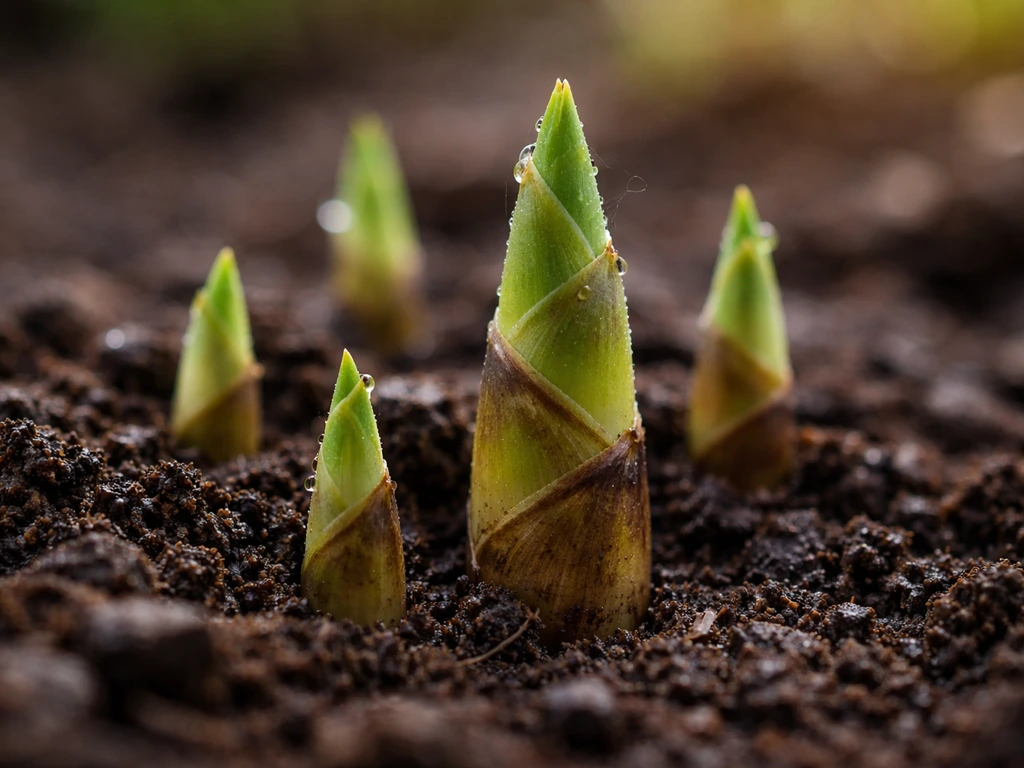
Bamboo grows because of a combination of stored energy in its underground rhizome network, plant hormones that trigger rapid cell expansion, and the right environmental conditions arriving at the right time. Light, warmth, soil moisture, nutrients, and adequate space all play a role, but the biggest driver is often internal: a mature rhizome system packed with non-structural carbohydrates (sugars and starch) waiting for the right seasonal cue to push a shoot upward. Get those conditions right and bamboo is one of the fastest-growing plants on Earth. Get them wrong and even a healthy plant will sit and sulk.
What Makes Bamboo Grow: Key Drivers, Rates & Care Guide
Marcus Hartwell
27 Jul 2026
Who this guide is for and what you'll learn
This guide is written for gardeners considering bamboo for the first time, homeowners trying to understand why their bamboo isn't performing, and indoor growers who want realistic expectations about container bamboo. If you've ever searched 'what makes bamboo grow' because you want to know the actual science, not just 'give it water and sun,' this is the article for you. By the end you'll understand the biology behind bamboo growth, what environmental levers you actually control, how fast different species realistically grow in different climates, how to time planting and care, and how to contain running types so they don't become a neighborhood problem.
Why grow bamboo in the first place
There are good, evidence-based reasons to grow bamboo beyond the novelty factor. See our guide on why grow bamboo for a concise list of benefits and practical considerations. Productive bamboo stands generate roughly 10 to 30 tonnes of dry biomass per hectare per year in research trials, which puts it ahead of most hardwood trees for raw material yield. It establishes fast, so a privacy screen that would take a decade with arborvitae can be functional in three to five years with the right bamboo species. The dense culm canopy suppresses weeds, the leaf litter builds organic matter quickly, and the deep root system holds soil on slopes. For indoor spaces, bamboo brings a genuinely tropical aesthetic and tolerates lower light better than many fast-growing tropicals. That said, the reasons not to grow it carelessly are just as real: running species spread aggressively if uncontained, and no bamboo performs well in heavy, waterlogged clay. Matching the plant to the site is the whole game.
Clumping vs running: the basics you need before anything else
All bamboos fall into two broad growth categories based on how their underground rhizomes behave, and this distinction shapes every decision you'll make about siting, containment, and species selection.
Running bamboos (leptomorph rhizome type) send out long horizontal rhizome arms that can travel several metres per year. Phyllostachys aurea (golden bamboo) is a classic example: the rhizomes branch and extend laterally before sending up culms, which is why a single plant can colonize a large area surprisingly fast. These are the types that end up in neighbors' yards and earn bamboo its bad reputation.
Clumping bamboos (pachymorph rhizome type) grow outward from a tight central mass with short rhizome internodes. The clump expands slowly at the edges, typically 15 to 30 cm per year, which is manageable in most garden settings without any barrier at all. Genera like Bambusa, Fargesia, and Chusquea are clumping types, and they're generally the safer choice for residential plantings unless you have good containment infrastructure.
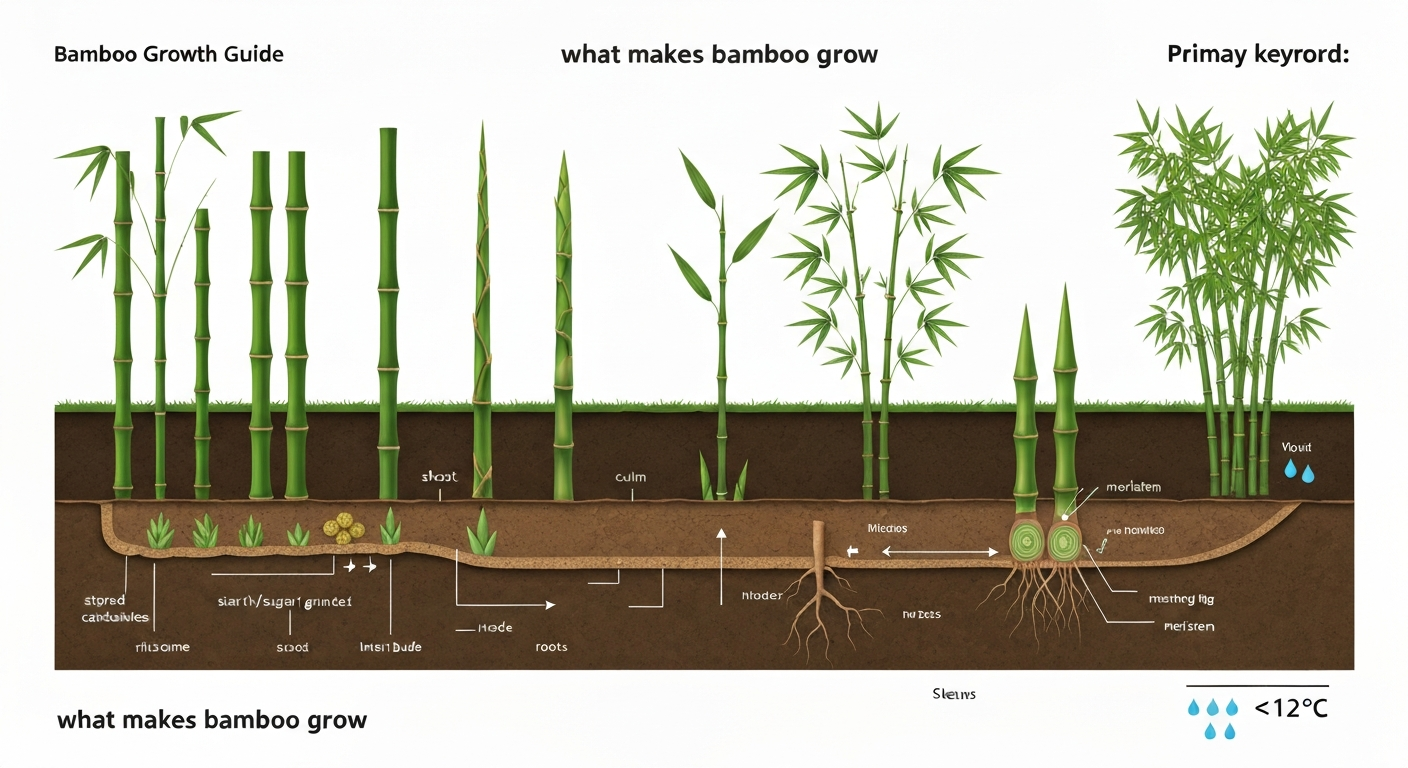
- Culm: the above-ground woody stem of a bamboo plant, what most people call 'the bamboo'
- Rhizome: the underground stem network that stores energy and produces new shoots and roots
- Shoot: the rapidly-elongating new culm that emerges from the soil during the growing season
- Meristem: the active cell-division zone at nodes and shoot tips where growth actually happens
- Node: the solid joint along a culm or rhizome from which branches, leaves, and new growth emerge
- Internode: the hollow section between two nodes
How bamboo actually grows: the biology behind the speed
The reason bamboo can grow so fast is not because it creates new cells unusually quickly. It's because all the cells in a shoot are formed at the base before the shoot even clears the soil, and elongation happens across every internode simultaneously. Think of it as a stack of telescoping cylinders all extending at the same time. Once a shoot emerges, the meristematic tissue at each node is already present and pre-loaded.
The fuel for this explosion comes from the rhizome. Non-structural carbohydrates, mainly soluble sugars and starch, are stored in the rhizome and culm tissue through the dormant period. When shoot emergence is triggered, the plant mobilizes these reserves rapidly. Research measuring rhizome NSC levels in Phyllostachys (Moso) bamboo confirms that stored carbohydrates drop sharply during the shoot-elongation period, then are rebuilt after the growing season through photosynthesis in the new canopy. This is why a young bamboo plant with a small, undeveloped rhizome system grows modestly in its first year or two: there's not enough stored energy to drive aggressive shoot production yet.
Three plant hormones coordinate the whole process. Gibberellins drive the rapid cell elongation that makes individual internodes extend. Auxin coordinates apical dominance and vascular differentiation as the culm matures. Cytokinins interact with carbohydrate status to regulate bud activation in the rhizome, essentially serving as the chemical trigger that says 'conditions are right, activate this bud.' This hormone-carbohydrate interaction is why well-fed, well-watered bamboo breaks dormancy more vigorously than stressed plants.
The six conditions that control how fast bamboo grows
Light
Most bamboo species perform best in full sun to partial shade, meaning at least four to six hours of direct sunlight per day. Full sun drives faster photosynthesis, which means more carbohydrates stored in rhizomes and more vigorous growth the following season. Shade-tolerant species like Fargesia will perform adequately in dappled light, but even they thin out and grow more slowly with less than three hours of direct sun. For indoor bamboo, position near the brightest window available, ideally south or west-facing.
Temperature
Temperature is a growth trigger, not just a survival factor. Temperate species like Phyllostachys typically need soil temperatures to climb above roughly 10 to 15°C (50 to 59°F) before shoot emergence begins in spring. For subtropical species like Bambusa, optimal growth often requires sustained air temperatures above 20°C (68°F), which is why the same species grows much faster in Florida than in coastal Oregon. Cold limits growth at one end; excessive heat and drought together stress the plant at the other.
Water
Reliable soil moisture during shoot emergence is one of the single biggest controllable factors in bamboo growth. Research from forest growth trials confirms that shoots emerging into dry conditions are smaller, more likely to abort, and produce thinner culms. During active shoot growth, bamboo needs consistent moisture, roughly equivalent to 25 to 40 mm of water per week in warm growing conditions, either from rainfall or irrigation. The caveat is drainage: bamboo in chronically waterlogged or poorly draining soil is highly susceptible to Pythium and Phytophthora root rots. The ideal is moist but well-drained, which is an important distinction from 'wet.'
Soil
Bamboo grows best in loamy, well-drained soils with a pH of roughly 5.5 to 7.0. It tolerates a moderately wide pH range but performs poorly in strongly alkaline soils (above about pH 7.5), where micronutrient availability drops. Heavy clay soils slow rhizome expansion and increase disease risk, while very sandy soils drain too fast and require more frequent irrigation. Improving either extreme with organic matter before planting pays dividends for years.
Nutrients
Bamboo is a nitrogen-hungry plant. Field research on Moso bamboo (Phyllostachys edulis) documents plant N uptake exceeding 150 kg per hectare per year in productive stands, which is a high demand. For garden-scale growing, this translates to a genuine need for nitrogen supplementation, especially in soils with low organic matter. However, research from field experiments in China found that N addition above approximately 60 kg N per hectare per year showed diminishing returns and altered leaf nutrient ratios, suggesting there's a ceiling beyond which more nitrogen doesn't help and may cause problems. Field experiments with Moso bamboo applied N up to about 60–90 kg N ha−1 yr−1 and found diminishing returns and altered foliar nutrient responses above roughly 60 kg N ha−1 yr−1; see Management practices regulate the response of Moso bamboo foliar stoichiometry to nitrogen deposition (Scientific Reports, PMC). A practical approach is to apply a balanced slow-release fertilizer in early spring before shoots emerge, and a second lighter application after the shooting season, with rates adjusted to your soil test results rather than guessing.
Space and containment
Space matters differently for running versus clumping types. Clumping bamboo generally needs 1.5 to 3 metres of clearance from structures and boundaries to expand naturally. Running bamboo, if you're using it, needs either a very large open area or a properly installed rhizome barrier. University of Maryland Extension and multiple state extension programs recommend HDPE or polypropylene geomembrane barriers 60 to 100 mil (0.060 to 0.100 inches) thick, installed to a depth of 30 to 36 inches (75 to 90 cm), with 2 to 6 inches left protruding above the soil line so you can see if rhizomes are trying to cross. Annual inspection and trimming of any escaping runners is non-negotiable maintenance for running species.
How all the growth drivers interact: timing, stored energy, and seasonal triggers
Understanding bamboo growth means understanding that what happens above ground this spring was largely determined by what happened underground last year. Temperate species like Phyllostachys form shoot buds on the rhizome in late summer and autumn, then those buds remain dormant through winter. When soil temperature rises in spring and the hormonal triggers align, the plant mobilizes its stored carbohydrates and drives those pre-formed shoots upward. The entire aboveground culm, which might reach six to twelve metres in an established grove, is essentially fully formed in cellular terms within a matter of weeks.
This is a critical point for new growers: a culm does not keep growing taller year after year. The first season's shoot sets the final height of that individual culm. What grows each subsequent year are new culms from new shoots. An established plant with a large rhizome and high NSC reserves grows taller, thicker culms each year for several years until it reaches its genetic potential for that site and climate. This is why patience in the first two to three years (the 'sleep, creep, leap' pattern people often reference) is real, not a myth.
For tropical and subtropical species, the trigger is less about soil temperature and more about soil moisture. Monsoon-adapted species like many Bambusa types respond to the onset of the wet season, which is why they shoot prolifically in summer rainy periods. If you're growing subtropical bamboo in a Mediterranean climate, supplemental irrigation during what would naturally be the dry season can either trigger or extend the shooting period.
Real growth rates: what the numbers actually look like
You've probably seen claims that bamboo grows 90 cm or even 120 cm in a single day. That extreme figure, cited for large tropical timber bamboos under peak conditions, is a documented short-term maximum for specific species in near-optimal field conditions. It is not a realistic expectation for garden bamboo, and reporting it without context does a disservice to anyone trying to plan a planting.
Forest research bulletins measuring growth periods and weekly elongation rates for Bambusa and Phyllostachys species show that active shoot elongation in temperate Phyllostachys typically spans four to eight weeks, with peak daily rates commonly in the range of 15 to 30 cm per day for established, well-nourished plants in good conditions. Smaller garden varieties of the same genus often peak at 5 to 15 cm per day. Bambusa species in tropical or subtropical climates have longer active growth periods, often 30 to 120 days, with species-specific peak rates that are generally lower per day but sustained over a longer window. A newly planted bamboo in its first year might add only 30 to 60 cm total height while it establishes its root system. By year three to five on a well-managed site, the same plant can be shooting aggressively.
Shoot-emergence calendar by climate zone
When bamboo shoots is one of the most practical questions you can ask, because it determines when to irrigate, fertilize, and watch for pest pressure. For localized timing, see our guide on what month does bamboo grow for month-by-month shoot-emergence windows by climate zone. For a detailed, zone-specific schedule and guidance on timing, see our shoot-emergence guide on when do bamboo shoots grow. The answer depends heavily on your climate zone. The table below gives typical shoot-emergence windows by zone and bamboo type.
| Climate Zone | Typical Bamboo Types | Primary Shoot Season | Notes |
|---|---|---|---|
| Temperate (USDA zones 5–7) | Phyllostachys, Fargesia, Pleioblastus | April to June | Triggered by soil warming above ~10–15°C; bud formation in prior autumn |
| Transitional / warm temperate (USDA zones 7–9) | Phyllostachys, Bambusa, Dendrocalamus hybrids | March to May (main); possible secondary flush Sept–Oct | Earlier onset with mild winters; secondary flush possible in wet autumns |
| Mediterranean (USDA zones 9–10, dry summers) | Bambusa, Phyllostachys aurea, Otatea | February to April (spring rain); secondary Oct–Nov with irrigation | Dry summer suppresses midsummer shooting; irrigation can extend season |
| Subtropical (USDA zones 9b–11) | Bambusa, Guadua, Dendrocalamus, Thyrsostachys | June to October (wet season) | Shooting tracks rainfall onset; longer growth periods (60–120 days) |
| Tropical (USDA zones 11–12) | Bambusa, Dendrocalamus, Gigantochloa | Year-round with wet-season peak | Growth driven primarily by moisture and temperature, not photoperiod |
Timing your fertilizer application two to three weeks before the typical shoot-emergence window in your zone allows the plant to have nutrients available at the moment of maximum demand. Watering up in the weeks before expected shooting, especially in dry climates, has a measurable impact on shoot size and culm diameter in the new season.
Best bamboo to grow by use and USDA hardiness zone
Choosing the wrong species is the single most common reason bamboo plantings fail or become problems. If you're unsure which species fits your needs and zone, see our guide on what is the best bamboo to grow for specific uses and hardiness zones. The table below compares a range of commonly grown species by use case, hardiness, root habit, and realistic height, so you can match the plant to your situation before you spend money at a nursery.
| Species / Common Name | USDA Zones | Root Habit | Typical Height | Primary Use | Notes |
|---|---|---|---|---|---|
| Phyllostachys aureosulcata (Yellow groove bamboo) | 5–9 | Running | 5–8 m | Screening, timber, cold-climate grove | One of the hardiest runners; needs barrier in small gardens |
| Phyllostachys aurea (Golden bamboo) | 6–10 | Running | 4–7 m | Dense screening, hedge | Very aggressive spreader; best with barrier or in containers |
| Phyllostachys edulis (Moso bamboo) | 7–10 | Running | 10–20 m | Timber production, large grove | Largest temperate bamboo; not for small suburban lots |
| Fargesia robusta (Clumping fountain bamboo) | 5–9 | Clumping | 3–5 m | Screening, hedge, shade-tolerant garden | Excellent for cold climates and partial shade; no barrier needed |
| Fargesia murielae (Umbrella bamboo) | 5–9 | Clumping | 2–4 m | Garden specimen, shade border, containers | Drought-tolerant once established; elegant arching form |
| Bambusa oldhamii (Giant timber bamboo) | 8–11 | Clumping | 10–18 m | Tall screening, privacy, timber | Fast-growing clumper for warm climates; not cold-hardy |
| Bambusa multiplex 'Alphonse Karr' (Alphonse Karr bamboo) | 8–11 | Clumping | 3–6 m | Ornamental, hedge, containers | Colourful striped culms; good for warm-climate gardens |
| Otatea acuminata (Mexican weeping bamboo) | 9–11 | Clumping | 3–5 m | Ornamental, dry-climate garden | Tolerates drought better than most; distinctive weeping form |
| Dendrocalamus asper (Giant bamboo) | 10–12 | Clumping | 20–30 m | Large-scale timber, tropical plantations | Requires genuine tropical or subtropical climate; very productive |
Choosing the right species: a practical decision checklist
Before you buy anything, work through these questions. The answers will eliminate most mismatched species before they become regrets.
- What is your USDA hardiness zone (or equivalent local zone)? Eliminate any species whose minimum zone is warmer than yours.
- Do you have a barrier already installed, or are you willing to install one to the required 75–90 cm depth? If not, choose clumping species only.
- What is your primary use: privacy screening, ornamental specimen, indoor container, food production (shoots), or timber/material?
- What is the maximum height you can accommodate? A Moso bamboo reaching 15 metres is not suitable for a suburban backyard.
- What is your soil type and drainage situation? Test your pH. If your soil is heavy clay or pH above 7.5, plan to amend before planting.
- How much sun does the planting site receive? Less than three to four hours of direct sun per day pushes you toward shade-tolerant Fargesia types.
- What is your typical summer moisture situation? In dry-summer climates, plan for irrigation during the shooting season.
- Will this bamboo be near a property boundary, foundation, or paved surface? If yes, containment or a clumping species is mandatory.
Planting in-ground: step-by-step from site prep to first year care
In-ground planting gives bamboo the best opportunity to establish a substantial rhizome system, which is the foundation of all future growth. Do the site preparation properly once rather than trying to fix problems after the plant is in the ground.
- Choose your site and assess drainage. Dig a hole 30 cm deep and fill with water. If it drains in under two hours, drainage is adequate. If not, raise the bed or improve drainage with organic matter.
- Test your soil pH. Aim for 5.5 to 7.0. Add sulfur to lower pH in alkaline soils; add lime to raise pH in very acidic soils (below 5.0).
- If installing a rhizome barrier for a running species, do this before planting. Dig a trench 75 to 90 cm deep around the intended planting area, install 60 to 100 mil HDPE geomembrane, overlap and seal the ends with a 15 cm overlap and stainless clips, and leave 5 to 6 cm protruding above the soil line.
- Improve the planting hole with compost or aged organic matter mixed into the removed soil at roughly a 1:3 ratio. Avoid fresh manure directly against roots.
- Dig the planting hole two to three times the width of the root ball and roughly the same depth. Bamboo should be planted at the same depth it was in the pot, not deeper.
- Space plants according to species and intended use. For a privacy screen, 1 to 2 m spacing for clumping types, or 1.5 to 3 m for running types within a barrier. Closer spacing fills in faster but is not required for long-term density.
- Water thoroughly at planting. Add a 5 to 10 cm layer of organic mulch (wood chips, straw) over the planting area, keeping mulch 5 cm away from the culm bases to reduce crown rot risk.
- Water regularly for the first two growing seasons. During the first year, the plant is primarily investing in rhizome development, not height. Do not expect dramatic aboveground growth until year two or three.
- Apply a balanced, slow-release fertilizer (e.g., 10-10-10 or similar) in early spring of year two, before shooting. Avoid heavy nitrogen applications in the establishment year.
Planting in containers and indoors: what you need to know
Container growing is a legitimate option for both running and clumping bamboos, and it's the most practical approach for indoor growing. The container itself acts as containment for running species, which is a useful side effect. The main challenge is that bamboo in a pot dries out fast, heats up more than in-ground soil in summer, and eventually gets root-bound in ways that suppress shooting.
- Choose a container that is at least 45 to 60 cm in diameter and 45 cm deep for smaller species. For medium species (3 to 5 m), go larger: 60 to 75 cm diameter minimum. Drainage holes are mandatory.
- Use a mix of quality potting medium with added coarse perlite or pumice for drainage: roughly 70% good potting mix, 30% perlite. Avoid heavy garden soil in containers.
- Water consistently. Container bamboo in summer may need watering daily in warm weather. Check by pushing a finger 5 cm into the soil; water when the top 3 to 5 cm is dry. Never allow the pot to sit in standing water.
- Feed with a diluted liquid fertilizer every three to four weeks during the active growing season (spring through midsummer). Reduce or stop feeding in autumn and winter.
- Expect to repot every two to three years as the rhizome mass fills the container. Autumn or very early spring is the best time. Divide the root mass if needed, retaining healthy rhizome sections with attached culms.
- For indoor bamboo, position near the brightest available window. Supplement with a grow light in low-light spaces. Maintain humidity above 40% if possible: bamboo in centrally-heated dry indoor air drops leaves readily.
- Outdoor container bamboo in cold climates may need winter protection. Move containers to an unheated garage or shelter, or wrap with insulating material, if temperatures will drop below the species' cold tolerance.
Routine care through the seasons
Watering
Established in-ground bamboo is more drought-tolerant than its reputation suggests, but 'established' means three or more years with a substantial rhizome system. During those first few years and during every active shooting season, consistent moisture is essential. Target 25 to 40 mm of water per week (rain plus irrigation) during active growth. Outside the shooting season, bamboo needs far less water but should not be left bone-dry for extended periods.
Feeding
Apply a slow-release balanced fertilizer in early spring, two to three weeks before expected shoot emergence. A second lighter application after shooting (late summer) helps rebuild rhizome carbohydrate reserves. Research on Moso bamboo suggests that nitrogen application above roughly 60 kg per hectare per year causes diminishing returns at plantation scale. For a home garden this translates to a fairly modest amount: don't over-apply in the belief that more nitrogen means more growth, because it doesn't past a threshold, and it can create foliar nutrient imbalances.
Mulching
A 7 to 10 cm layer of organic mulch over the root zone does multiple jobs: it regulates soil temperature (important for early shoot emergence in spring), conserves moisture, and breaks down to feed the soil over time. Bamboo leaf litter is itself an excellent mulch and the plant does best when you leave it in place rather than raking it up. Supplement with wood chips or straw if you want additional depth.
Pruning and thinning
Bamboo culms don't regrow after they're cut the way grass does. A culm that is cut at the base is gone. Thinning is done for grove management, not for regrowth: remove old, damaged, or overcrowded culms at the base each year to improve airflow and light penetration into the grove. A good rule is to remove any culm that is more than three to five years old, as older culms lose vigor and can harbor pests. Never cut a culm partway up and expect it to regrow; you'll just have a dead stub.
Containment maintenance for running species
Inspect your rhizome barrier perimeter every spring and summer. University of Maryland Extension's Containing and Removing Bamboo recommends geomembrane rhizome barriers 30–36 inches deep with 2–6 inches left above the soil for inspection University of Maryland Extension's Containing and Removing Bamboo recommends geomembrane rhizome barriers 30–36 inches deep with 2–6 inches left above the soil for inspection.. Check where the barrier protrudes above soil for any runners climbing over the top edge and cut them off immediately. If you've chosen not to use a barrier, perform an annual 'rhizome trench' by cutting vertically with a spade along the perimeter of where you want the bamboo to stay, to a depth of at least 30 cm. Doing this every six to twelve months keeps running species in check without requiring full removal. Washington State University Extension is clear on this: barrier inspection and rhizome pruning are ongoing requirements for running bamboo, not optional extras.
Troubleshooting: when bamboo doesn't grow as expected
Most bamboo problems trace back to one of a small number of causes. Work through this checklist before reaching for a chemical solution.
- No new shoots or very few shoots: most likely cause in years 1 to 2 is normal establishment; in years 3 and beyond, check soil moisture during the expected shooting window and consider whether the rhizome system has adequate stored energy (was it heavily defoliated or drought-stressed the prior season?)
- Shoots emerge and then abort: almost always a moisture problem. Shoots that start emerging and then brown and die are experiencing water stress. Increase irrigation immediately when you see new tips emerging.
- Yellow leaves throughout the canopy: nitrogen deficiency is the most common cause; test soil and feed appropriately. Also check drainage; waterlogged soil causes yellowing from root rot.
- Brown leaf tips: low humidity (common indoors), salt buildup in container soil, or wind desiccation on exposed sites. Flush container soil with water to clear salt; improve humidity indoors.
- Mites (Tetranychus species): small reddish-brown mites on the undersides of leaves, visible webbing, and stippled/bleached foliage. Most common on indoor or container bamboo in dry conditions. Improve humidity and spray forcefully with water; apply insecticidal soap if infestation is severe.
- Mealybugs: white cottony masses at leaf nodes, particularly on indoor bamboo. Remove manually and treat with insecticidal soap or neem oil.
- Root rot (Pythium/Phytophthora): mushy, dark rhizomes; collapsing culms; foul smell from soil. Caused by chronically saturated soil. Improve drainage urgently; remove affected material; avoid overwatering.
- Bamboo not spreading after barrier installation: sometimes the barrier itself is installed too shallow and rhizomes are avoiding that direction. Check that the barrier depth and protrusion are correct. Growth suppression near barriers is also common in the first year after installation.
- Culms shorter than expected: if you're seeing new shoots every year but they're smaller than the prior year's culms, the most common causes are crowding (too many old culms reducing light and resources), nutrient depletion, or drought stress during elongation. Thin old culms, feed, and ensure irrigation during the shooting window.
FAQ
Title and meta description for an article about what makes bamboo grow
Title: What Makes Bamboo Grow: Biology, Environment, Rates, and Practical Care Meta description (<=160 chars): Science-backed guide to bamboo growth: biology, rates, seasonal calendar, species picks, planting, containment, and troubleshooting.
What are the primary biological drivers of bamboo growth?
Bamboo growth is driven by the rhizome–culm system, stored non‑structural carbohydrates (NSCs), and plant hormones. Rhizome architecture (running/leptomorph vs. clumping/pachymorph) determines lateral spread potential and where new shoots originate [USFS]. NSCs (soluble sugars and starch) are stored in rhizomes and culms and mobilized seasonally to fuel bud initiation and rapid shoot elongation; NSC pools decline during active shoot growth and rebuild after the growth season [PMC review]. Hormones — principally gibberellins (GA), auxin and cytokinins — regulate bud activation, cell elongation and vascular differentiation during shoot emergence and culm elongation [Journal of Experimental Botany review]. (References: USFS on rhizome habit; PMC on NSCs; hormone review.)
What environmental conditions most influence bamboo growth and how do they interact with the biology?
Key environmental factors and interactions: - Soil moisture: consistent moisture during shoot emergence supports full-size shoots; drought during active growth reduces shoot size and increases mortality, while waterlogged soils raise root‑rot risk (Pythium/Phytophthora) [FFPRI; UC ANR]. - Soil texture & drainage: well‑drained loamy soils with good organic matter are ideal; pH ~5.5–7.0 suits many species [UC ANR]. - Light: species-dependent — many timber/Phyllostachys prefer full sun to light shade; understory bamboos tolerate more shade. - Temperature/seasonality: temperate species set buds late season and push shoots in spring; tropical/monsoon species often time shoots to rainy seasons [Plant Journal / seasonal studies]. - Nutrients: bamboo can be high N-demand; managed species (e.g., Moso) respond to N additions up to ~60 kg N·ha−1·yr−1 with diminishing returns above that — match fertilization to soil tests and harvest removal [Scientific Reports]. Interactions: Adequate NSC reserves, triggered by hormonal signals, allow shoots to emerge quickly when moisture/temperature cues are met; nutrient and water status modulate both NSC replenishment and hormone balance, influencing next season's vigor.
What numeric growth rates and timelines should gardeners expect?
Typical garden ranges (species- and site-dependent): - Daily peak elongation (temperate Phyllostachys): commonly tens of cm/day during peak — e.g., 10–60 cm/day in vigorous garden conditions; exceptional timber records are higher but rare [FFPRI]. - Tropical Bambusa: elongation period often 30–120 days from emergence to full culm height; daily rates lower but sustained over a longer period [FFPRI]. - Annual biomass/productivity (productive stands): roughly 10–30 t dry matter·ha−1·yr−1 in trials — varies with species, climate and management [WBC proceedings]. Practical timelines for home gardeners: - Year 1 (establishment): slow root/rhizome development, limited shoot production in many species. - Years 2–3: stronger shoot production and more typical growth rates as rhizome NSC pools build. - Mature stand: full potential (maximum shoot size, predictable seasonality) often reached by years 3–5 under good care. Note: single-day headline records (e.g., ~1 m/day) are measured maxima for certain timber species under ideal conditions and should not be taken as typical for garden bamboo [FFPRI].
How does seasonality and climate zone affect when shoots emerge?
Seasonality depends on species and local climate: - Temperate (e.g., Phyllostachys): buds set in autumn/winter; shoots typically emerge in spring (when soil warms) and elongate rapidly for several weeks to a couple of months [Plant Journal seasonal study]. - Subtropical/tropical (e.g., Bambusa, Dendrocalamus): many produce shoots in the rainy season; timing tracks precipitation and soil moisture. - Indoor/container-grown bamboo: seasonality may be muted but still follows light/temperature cycles — expect spring/summer growth with reduced winter activity. Suggested shoot-emergence calendar by generalized climate zones (Northern Hemisphere months): - USDA zones 3–6 (cold temperate): late April–June. - USDA zones 7–8 (mild temperate): March–May and sometimes late summer shoots. - USDA zones 9–11 (subtropical/tropical): main shoot flushes during wet season (varies: May–September in monsoon climates), occasional flushes year-round where frost-free. Local microclimate and species selection shift these windows; use local extension data for precise timing.
Which bamboo species are recommended by use and USDA hardiness zones?
Comparison (short table). Use this to narrow selections; check local availability and invasive risk. Species | Best uses | USDA hardiness | Growth habit | Notes Phyllostachys edulis (Moso) | Timber, large clumps, edible shoots | 6–9 | Running | High biomass, commercial; high nutrient demand [Scientific Reports] Phyllostachys bambusoides | Screening, timber | 6–9 | Running | Tall, strong culms Phyllostachys aurea (Golden) | Screening, ornamental | 6–9 | Running | Vigorous spreader; needs containment [USFS] Phyllostachys nigra (Black) | Ornamental, specimen | 7–10 | Running | Slower spread, attractive culms Bambusa oldhamii | Timber, screening in warm climates | 8–11 | Clumping/weak runner | Large culms, tropical/subtropical Bambusa multiplex | Containers, hedging | 8–11 (can handle 7 if mulched) | Clumping | Good for pots and hedges Fargesia spp. (e.g., F. rufa, F. murielae) | Cold-climate clumping, shade | 4–7 | Clumping | Cold-hardy, non-invasive; good for northern gardens Chusquea culeou | Cold-hardy clumping, windbreak | 6–9 | Clumping | Native to Andes; strong culms Notes: "Running" species spread through long leptomorph rhizomes and require containment in many gardens; "clumping" (pachymorph) are naturally contained. Hardiness ranges are approximate; local microclimate matters. (Sources: USFS, extension literature, production studies.)
Next Article
When Do Bamboo Shoots Grow? Timing and Growth Guide
When bamboo shoots grow and why. Learn sprouting cues, growth stages, expected sizes, and what to do if none appear.