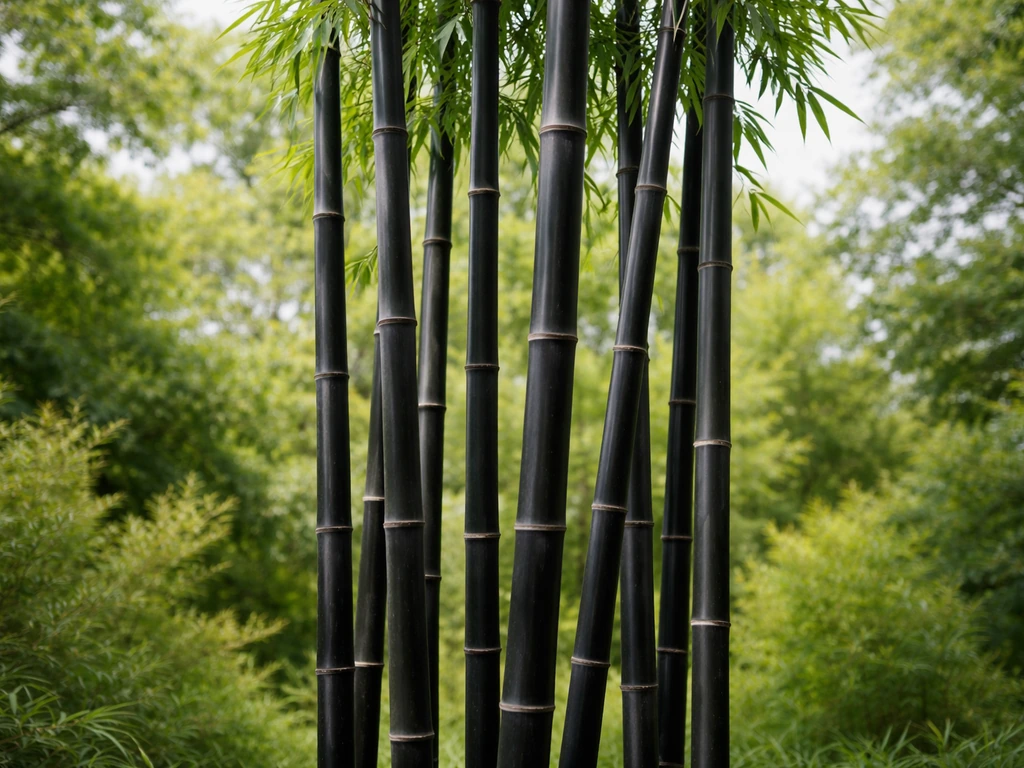
Most bamboo grown in containers reaches somewhere between 1 and 4 metres (3–13 ft) tall, depending on the species and how big your pot is. Running types like Phyllostachys in very large planters can push 5–8 m (16–25 ft) over many years, but the average patio bamboo in a sensible-sized tub will stay well under 3 m. That is noticeably shorter than the same plant in the ground, and that gap is not an accident, the pot is doing that deliberately, in a way, whether you intend it or not.
How tall does bamboo grow in pots: typical heights & care guide
Marcus Hartwell
17 Jul 2026
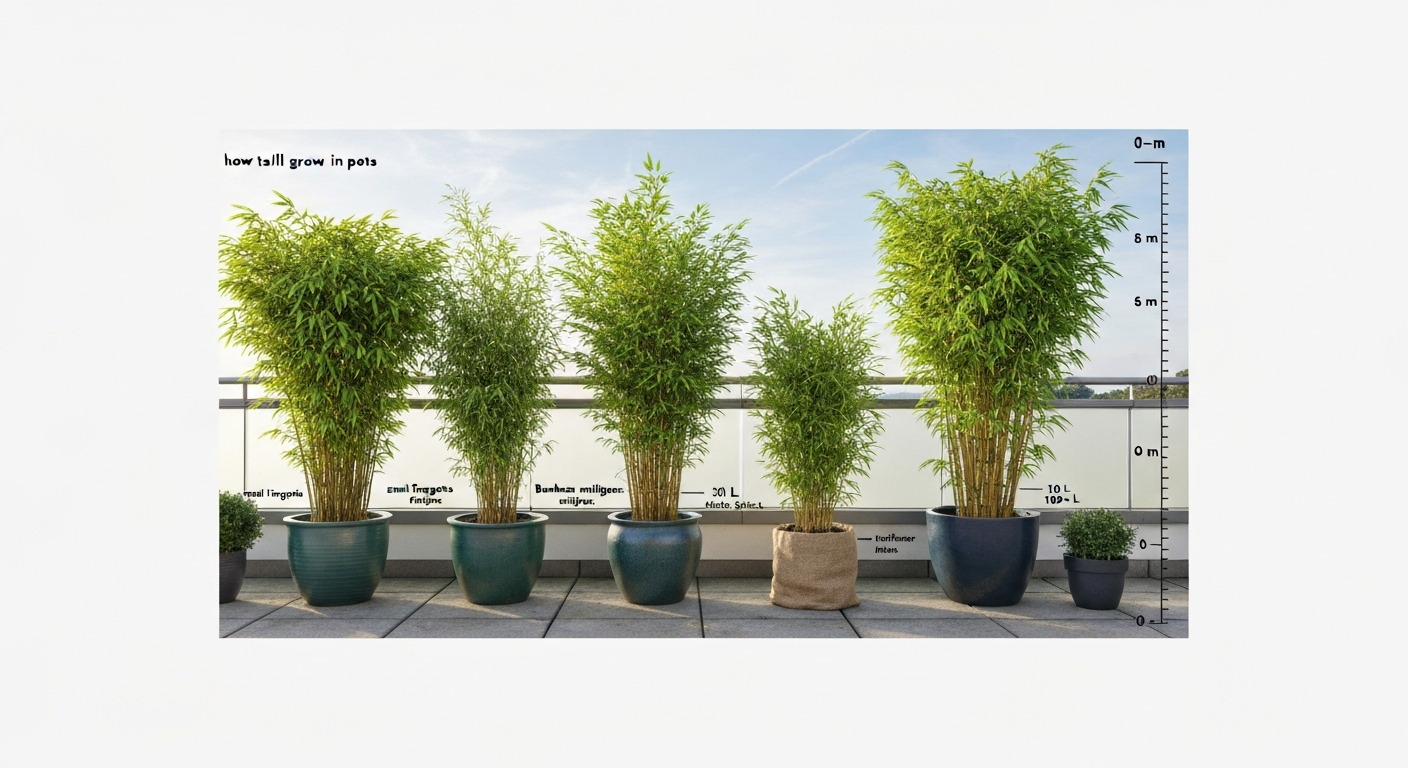
Typical height ranges for bamboo in pots
To give you something concrete to work with upfront: clumping Fargesia species, the ones most commonly sold for patio and garden containers in the UK, Europe, and cooler parts of North America, typically settle at roughly 1–3 m (3–10 ft) in containers over several years of normal care. Many nurseries list Fargesia rufa at about 2–3 m (6–10 ft) at maturity in a well-managed pot. Running Phyllostachys species are a different story: they can get surprisingly tall in large planters, with specialist growers commonly estimating long-term container performance at around 40–75% of their in-ground height. That still means 3–8 m (10–25 ft) in a generous planter, but you need a serious container volume to get anywhere near those figures. Tropical clumping Bambusa multiplex sits in the middle, commonly 3–7 m (10–23 ft) where the climate cooperates. These are all approximate ranges with real variation based on pot size, climate, feeding, and how often you repot.
Why pot-grown bamboo stays shorter, the science
The single biggest factor is root confinement. Bamboo, like any woody plant, relies on root volume to drive above-ground growth. Horticultural research consistently shows that plant height and stem growth increase with container volume, often in a roughly linear or quadratic relationship across tested ranges. When roots hit the walls of a pot and start circling, the plant's root-to-shoot ratio shifts, root signalling changes, and shoot elongation is directly curtailed. Journal of Environmental Horticulture – Root pruning and planting depth (effects on root and shoot) supports that cutting or restricting roots alters root architecture and can reduce shoot elongation via root‑to‑shoot signalling and changes in root:shoot ratio. This is not speculation; it is a well-documented physiological mechanism seen across container-grown trees and shrubs, and bamboo is no exception.
Beyond root space, a pot limits nutrients and water in ways the ground does not. A container holds a finite volume of growing medium. Even with regular feeding, you cannot fully replicate the nutrient buffering of a large soil body. Bamboo is a heavy feeder during its shooting season, and any deficit during those 6–12 weeks when culms are elongating, which is when the bulk of annual height gain happens, directly reduces final culm height. Containers also dry out faster and swing between wet and dry more dramatically than garden soil, which stresses the plant at exactly the wrong moment.
Climate adds another layer. Pots expose roots to temperatures that in-ground planting would moderate. In winter, a pot sitting on a patio can freeze through to the centre far faster than garden soil would, damaging or killing rhizomes and reducing the following year's shoot production. In summer, a dark pot in full sun can heat the root zone to levels that stress or scorch roots. Both effects reduce the number of viable culms produced each year and cap the effective maximum height the plant can reach.
Clumping vs running bamboo: how growth habit changes what you can expect
Clumping bamboos (mostly Fargesia and Bambusa species) spread slowly outward from a tight crown. In a container, that habit works surprisingly well, the plant fills the pot at a pace you can manage, and height stays moderate. Fargesia species in particular are well-suited to container life: they are shade-tolerant, cold-hardy (many to USDA Zone 5–6), and their moderate mature height means a 30–50 L (8–13 gal) tub can genuinely sustain them for years. The trade-off is that clumpers rarely give you the dramatic height some gardeners want.
Running bamboos, primarily Phyllostachys, Pseudosasa, and similar genera, spread aggressively via far-ranging rhizomes in the ground. In a pot, that running tendency is contained by the walls, which actually makes large containers one of the most popular ways to grow these plants without them taking over a garden. The containment does, however, come at a height cost. The rhizome network that drives those tall, thick culms simply cannot develop the same mass in a pot. You will get taller plants than with clumpers, often with impressive culms, but nowhere near the heights you see in open ground. Think of a running Phyllostachys in a large planter as a permanently bonsai'd version of itself, still striking, just scaled down.
Growth rates and timelines in containers
Bamboo's growth habit genuinely surprises people. New culms do not grow incrementally over a whole season, they shoot up to close to their final height within roughly 45–90 days of emergence, with the bulk of elongation compressed into about 6–12 weeks. After that, the culm hardens, branches develop, and height is essentially fixed for the life of that cane. What changes year-on-year is that new culms emerge slightly taller (or shorter, if conditions are worse) than the previous year's batch.
In the first one to two years in a container, most bamboo does relatively little above ground while it establishes root mass. This is normal and worth knowing so you do not panic and overfeed. From year two or three onward, you will see a meaningful increase in shoot count and culm height each season. Temperate clumpers like Fargesia typically add roughly 0.3–1 m (1–3 ft) per year once established. Larger running Phyllostachys in well-managed planters commonly add 1–1.5 m (3–5 ft) per year under good conditions, though in containers that rate will be slower than in-ground. By year five, a well-cared-for container plant of most common species should be approaching its realistic container maximum height for the pot size it is in.
Long-term, once a container bamboo has filled its pot with root mass, typically every 3–5 years depending on species and pot size, growth slows noticeably. At that point you have three choices: divide and repot into fresh compost, move to a larger container, or accept that the plant will gradually lose vigour and height potential. Doing nothing eventually leads to a congested, starved root ball that produces shorter, weaker culms each year.
Common species compared: pot height and growth rate
| Species | Habit | In-ground height | Typical container height | Container growth rate | Notes |
|---|---|---|---|---|---|
| Fargesia rufa | Clumping | 2–3 m (6–10 ft) | 1–3 m (3–10 ft) | 0.3–0.8 m/yr once established | Good patio choice; cold-hardy to ~Zone 5–6; tolerates part shade |
| Fargesia murielae | Clumping | 2–4 m (6–13 ft) | 1–3 m (3–10 ft) | 0.3–1 m/yr once established | Similar to F. rufa; excellent for containers in cool climates |
| Phyllostachys nigra (black bamboo) | Running | 6–11 m (20–35 ft) | 3–4 m (10–13 ft) in large pots | 1–1.5 m/yr in large planters | Needs large container (100+ L) for best results; slower in small pots |
| Phyllostachys aurea | Running | 6–10 m (20–33 ft) | 3–6 m (10–20 ft) in large planters | 1–1.5 m/yr in generous containers | Pot confines running habit; still needs large planter for tall culms |
| Phyllostachys edulis (moso) | Running | 8–18 m (25–60 ft) | Variable; limited in ordinary pots | Slow in containers; needs huge volume | Not recommended for standard patio pots; needs very large container and warm climate (Zone 7–9) |
| Bambusa multiplex | Clumping (tropical) | 3–8 m (10–25 ft) | 3–7 m (10–23 ft) where climate allows | Moderate once established | Requires frost protection in cool climates; good for large containers in subtropical zones |
All container heights above are approximate ranges based on typical long-term performance in appropriate container volumes with regular care. Actual results vary with pot size, climate zone, watering, and feeding. Smaller pots will produce shorter plants than the ranges suggest; cold climates without winter protection will reduce both growth rate and maximum height.
Species-specific notes and honest cautions
Black bamboo (Phyllostachys nigra)
Black bamboo is one of the most popular container choices, and for good reason, those dark culms look stunning in a large planter. In the ground it commonly reaches 6–11 m (20–35 ft), but specialist container growers typically promote it at around 3–4 m (10–13 ft) in long-term pot culture. If you’re asking how tall does black bamboo grow, expect about 6–11 m (20–35 ft) in the ground and roughly 3–4 m (10–13 ft) in long-term containers, with 100 L (26 gal) or larger planters needed to approach the upper end of its container range. That is a significant reduction, but still impressive for a patio plant. The key is container volume: black bamboo in a small or medium pot will stay much shorter and produce fewer, thinner culms. You really need a 100 L (26 gal) or larger planter to get anywhere near the upper end of its container range. It is worth noting that Phyllostachys nigra is a running bamboo, so even in a container the rhizomes will push hard against the walls, plan to divide or root-prune every 2–3 years.
Moso bamboo (Phyllostachys edulis)
Moso is the giant of the bamboo world in its natural range, Missouri Botanical Garden records field heights of 8–18 m (25–60 ft). If you want more detail on where moso bamboo grows, see our guide on where moso bamboo grows (e1d6f21c-0467-4b96-9e21-c4bb12395fdd). In containers, the honest answer is that ordinary patio pots simply cannot support it to anything approaching that scale. Moso requires deep, extensive rhizome networks to drive its extraordinary culm growth, and those networks cannot develop in a typical garden container. Very large planter installations (think commercial-scale raised beds rather than patio pots) in warm climates (USDA Zone 7–9) can produce impressive plants, but this is not a species I would recommend for a standard container setup. For more detail on typical Moso bamboo sizes, see how tall does moso bamboo grow. For most home gardeners wanting something tall and dramatic in a pot, a large Phyllostachys aurea or even P. nigra in a generous planter is a far more realistic choice.
Fargesia species
Fargesia rufa and Fargesia murielae are genuinely the best starting point for most container gardeners in temperate climates. They are reliably cold-hardy, clumping (so no containment worries), and sized realistically for pot culture. Fargesia rufa in particular is commonly listed at 2–3 m (6–10 ft) in a well-managed container, which is exactly the kind of screening or architectural height most patio gardeners are after. They do not like prolonged hot, dry summers, so if you are in Zone 8 or warmer, make sure the pot has shade from afternoon sun and never dries out completely.
Phyllostachys species (other running bamboos)
Phyllostachys aurea (golden bamboo) is a solid mid-range option for large containers, reliable, attractive, and capable of reaching 3–6 m (10–20 ft) in a sizeable planter. Like all Phyllostachys it is a runner, so the pot is doing you a containment favour, but you still need to manage root congestion. Most Phyllostachys are hardy to around USDA Zone 6–7 (species-dependent), making them versatile across a wide range of climates. The taller the culms you want, the bigger the planter needs to be, that relationship is direct and unforgiving.
Bambusa multiplex
Bambusa multiplex is a clumping tropical/subtropical species that works well in large containers in warmer climates, it can reach 3–7 m (10–23 ft) in a generous patio planter where temperatures stay above freezing. NC State Extension – Bambusa multiplex (plant toolbox) notes that Bambusa multiplex typically reaches 3–8 m (10–25 ft) in-ground and 3–7 m (10–23 ft) in large containers where climate allows, and that it requires frost protection in cooler areas. In cooler zones it needs to be moved indoors or into a heated greenhouse for winter, and any cold damage will visibly reduce the following year's culm height. If you are in a Zone 8–10 climate and want a tall, lush container bamboo, Bambusa multiplex is worth considering. In Zone 7 and below, the overwintering logistics become significant.
How pot size, root confinement, and soil mix set the ceiling
The RHS recommends a minimum container size of 45 cm (18 in) across and deep for small patio bamboos, and that is genuinely a minimum, not a target. For anything you want to grow taller than about 1.5 m (5 ft), you should be thinking bigger. A practical rule of thumb reported by experienced growers: 10–15 L (2–4 gal) pots are nursery sizes that can hold young plants at 1–2 m (3–7 ft), 30–50 L (8–13 gal) large tubs support many clumping bamboos to around 1.5–3 m (5–10 ft), and you need 100 L (26 gal) or more to support near-timber heights in Phyllostachys. These are not arbitrary numbers, they reflect the root volume needed to sustain the rhizome mass that drives culm production.
Soil mix matters almost as much as volume. A loam-based, free-draining compost is strongly preferred, the RHS recommends something like John Innes No. 3 mixed with horticultural grit to improve drainage. Peat-free options work well. Avoid pure bark-based multipurpose composts as the sole medium: they compact over time, drain poorly, and break down quickly. A balanced slow-release granular fertiliser at potting, combined with regular liquid feeding during the active growing season, will meaningfully improve final culm height compared to unfed plants in the same size pot. During the shooting season especially, bamboo pulls hard on nitrogen, and running out of available nutrients at that point directly shortens the culms.
Root pruning and repotting are the maintenance tools that keep container bamboo growing well year after year. Most specialist nurseries recommend inspecting and dividing or repotting every 2–5 years for patio plants. When the pot is densely packed with roots and rhizomes and the compost has broken down to a dark, compacted mass, that is your signal. Peer-reviewed nursery research does show that severe root pruning can temporarily reduce shoot growth, so the approach is to do light or moderate division rather than cutting away large fractions of the root ball all at once. Moving up one container size at each repotting, rather than jumping to a very large pot all at once, tends to produce steadier growth.
Indoor vs outdoor container bamboo: realistic differences in height
If you are considering growing bamboo indoors as a houseplant, it is worth being direct: the vast majority of the bamboo species discussed here are not suitable for long-term indoor growing, and those that survive indoors will be noticeably shorter and less vigorous than the same plant outdoors. Temperate Fargesia and Phyllostachys require full to part sun outdoors to reach their container potential. Indoor environments have much lower light levels (low PPFD) and typically reduced daylength compared to outdoor conditions, both of which directly reduce shoot production and final culm height. A Fargesia that would reach 2–3 m outdoors might stall at under 1 m in a typical living room.
A small number of species, mostly smaller tropical clumpers, can tolerate indoor conditions with bright indirect light, but even these will underperform compared to outdoor specimens. If you want bamboo indoors primarily for aesthetics, you will get better results from a naturally compact species in a bright conservatory or sunroom than from trying to push a large species in a dim corner. The light really is the limiting factor, not the pot or the water.
Outdoor container bamboo has its own challenge: overwintering. Because pot walls provide little insulation, root zones can freeze through during hard winters far faster than the same plant in the ground. This is especially relevant for Phyllostachys species at the edge of their hardiness zone (most are reliably hardy in USDA Zones 6–9, species-dependent; moso is typically recommended for Zones 7–9). In zones colder than a species' rated hardiness, container roots need protection, insulating the pot with fleece or hessian, moving it against a sheltered wall, or bringing it into an unheated greenhouse or garage for winter. Root-zone freezing causes significant dieback or complete plant loss, and even sub-lethal freezing reduces rhizome health and the following year's culm production. This is one of the practical reasons why outdoor container bamboo in marginal climates will often end up shorter than the same plant grown somewhere warmer.
Practical tips that directly affect how tall your bamboo grows
- Choose the largest feasible pot for your species — container volume is the single most direct lever you control for maximum height.
- Use a loam-based, free-draining compost (e.g., John Innes No. 3 mixed with grit) rather than a pure bark-based multipurpose mix.
- Feed regularly during the active growing season with a balanced fertiliser, paying particular attention to nitrogen availability during the shooting window (typically spring to early summer in temperate climates).
- Water consistently — bamboo in pots can dry out quickly in warm weather and moisture stress during culm elongation will permanently shorten that year's culms.
- Repot or divide every 2–5 years before the root ball becomes severely congested; moderate division is better than waiting until the plant is completely pot-bound.
- Site outdoor container bamboo in a bright, sheltered position — full to part sun for most species, with protection from strong drying winds that accelerate moisture loss from both pot and foliage.
- In climates at or near the edge of your species' hardiness zone, insulate the pot or move it to a sheltered location for winter to protect the rhizome zone from hard freezing.
- For running species, check the pot base for escaping rhizomes each spring and trim any that have found their way out, to keep the root mass productive inside the container.
Container or in-ground: which makes sense for your goal?
If maximum height is your primary goal, for a screen, windbreak, or visual impact at scale, in-ground planting will always outperform a container for the same species. See our guide on how tall can bamboo grow for detailed species-by-species maximum heights and comparisons between in-ground and container growth. The height gap is real: running Phyllostachys in the ground can reach 6–12 m (20–40 ft), while the same plant in even a large planter is likely to top out at 3–8 m (10–25 ft) depending on container volume and management. That is a significant difference if you are screening a two-storey building.
If containment, portability, or patio use are priorities, or if you are growing a running species and do not want it spreading through your garden, a large container is an excellent solution and will give you an impressive plant by any reasonable standard. Clumping Fargesia species are genuinely well-suited to container life and deliver dependable, manageable height in the 1–3 m range with minimal fuss. For most patio gardeners, that is more than enough. The key is going in with realistic expectations about the height ceiling your pot size and climate impose, and then managing the plant well within those constraints.
FAQ
Quick answer: How tall does bamboo grow in pots?
Typical container heights vary by species and pot size. Small clumping bamboos (Fargesia spp.) usually reach ~1–3 m (3–10 ft) in pots; many medium Phyllostachys (running) will reach ~3–8 m (10–25 ft) in large planters; giant timber types (Moso, Phyllostachys edulis) rarely reach full field height in ordinary pots and need very large containers or being planted out to exceed ~3–6 m (10–20 ft). These are approximate ranges — climate, pot volume, and care change outcomes.
Why do bamboo heights differ between pots and the ground?
Root volume limits: container root confinement reduces available water, nutrients and space for rhizomes so above‑ground growth is curtailed. Microclimate: pots heat and cool faster (root stress in winter or hot summers). Resource supply: restricted soil reduces long‑term culm production. Species genetics (clumping vs running) and local climate (length of growing season, cold damage) also determine final height.
How quickly do bamboo shoots reach their final height in a season?
Most temperate and tropical bamboos elongate new culms rapidly and complete the bulk of vertical growth within ~45–90 days after shoot emergence. Annual height increment (new culm height) varies by species and conditions: clumping temperate species often add ~0.3–1 m (1–3 ft)/year once established; larger running species can add ~1–1.5 m (3–5 ft)/year in good conditions — container rates are usually lower.
How does pot size influence maximum height?
Larger container volume generally permits taller plants. As pot volume increases, root system size, water holding and nutrient reserves increase, allowing greater culm production and taller culms. Practical guidance: use the largest feasible pot (RHS suggests ≥45 cm / 18 in as a minimum for many patio bamboos). Small nursery pots (10–15 L) limit long‑term height; very large 100+ L tubs are needed to approach timber heights for big Phyllostachys.
Are there typical expected heights for common species in pots? (short comparison table)
Species — expected pot height — typical growth rate in pots: • Fargesia rufa / murielae — 1–3 m (3–10 ft) — ~0.3–1 m/yr • Phyllostachys aurea (golden) — 3–6 m (10–20 ft) — ~0.5–1.2 m/yr • Phyllostachys nigra (black bamboo) — 3–4 m (10–13 ft) commonly in pots — ~0.5–1 m/yr • Phyllostachys edulis (moso) — 3–6+ m (10–20 ft) in very large containers; limited in small pots — variable, slower in pots • Bambusa multiplex (tropical clumping) — 3–7 m (10–23 ft) in suited climates/large tubs — ~0.5–1.5 m/yr (These are typical/approximate; actual height depends on pot size, climate and care.)
Indoor vs outdoor container growth — how different are the results?
Outdoor containers generally produce much greater height because of higher light (PPFD), longer effective growing season and better air circulation. Most temperate bamboos need outdoors to reach container potential. Indoor light and limited seasonal cues usually reduce shoot production and final height; only a few clumping species tolerate long‑term indoor culture as modest houseplants.
Next Article
How Tall Does Black Bamboo Grow? Real Expectations
Real expectations for black bamboo height, growth rate, and indoor vs outdoor factors that affect how tall it gets.