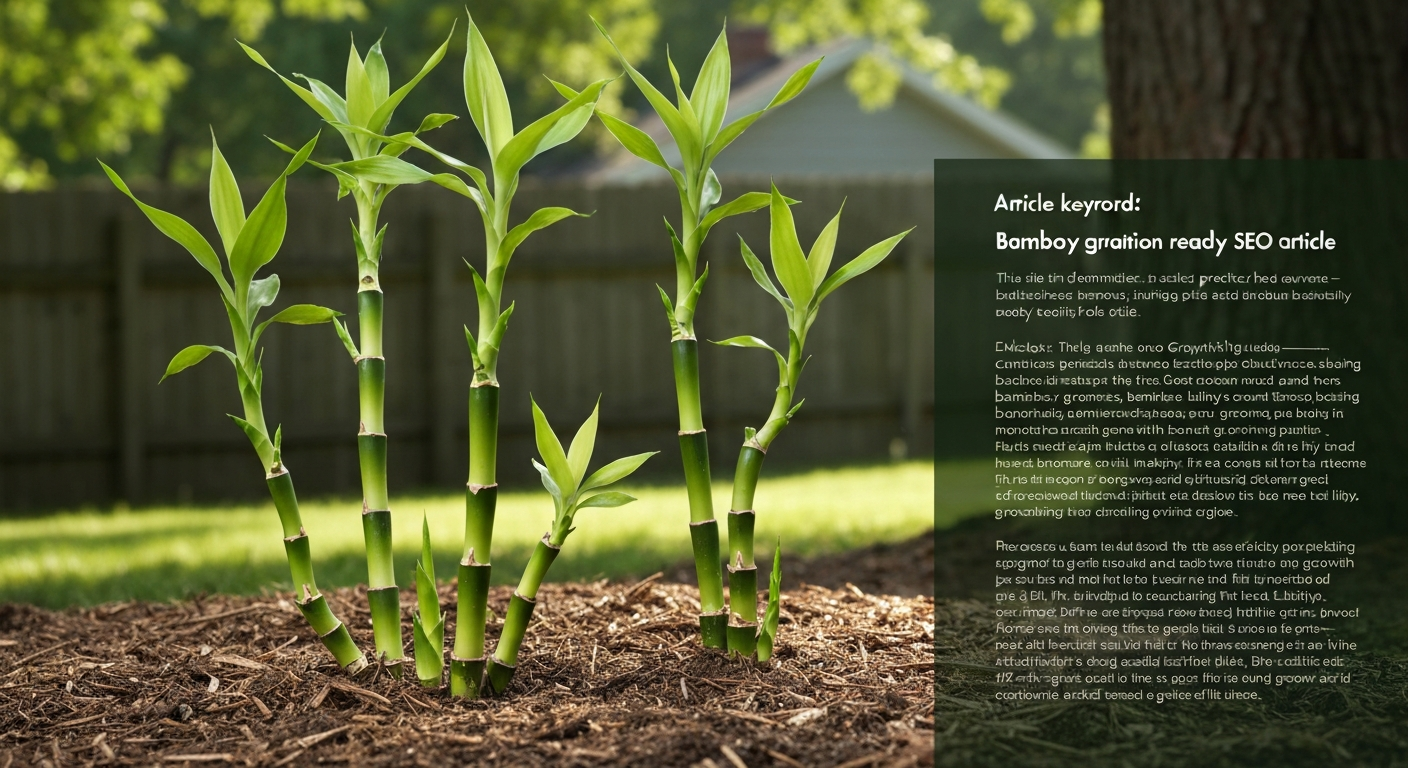
Yes, bamboo can absolutely grow outside, and for most species, the outdoors is exactly where it thrives. Temperate genera like Phyllostachys and Fargesia are cold-hardy enough to survive winters in USDA zones 4 through 9, while tropical genera like Bambusa and Dendrocalamus do best outdoors in zones 8 through 11. The real question isn't whether bamboo can grow outside, but which species suits your specific climate, your yard, and what you're actually hoping to achieve.
Can Bamboo Grow Outside? Planting, Care, Species & Control
Marcus Hartwell
26 Jul 2026
Who this guide is for and how to use it
I put this guide together for three kinds of readers. First, the curious home gardener who's seen bamboo growing somewhere and wants to know if they can pull it off in their own backyard. Second, bamboo enthusiasts already growing it indoors or in containers who want to move things outside. Third, people who've heard bamboo is invasive and want to make an informed decision before planting anything. If you're in any of those camps, you're in the right place.
Before you buy anything, run through this quick decision checklist. What's your USDA hardiness zone? Do you have full sun, partial shade, or mostly shade? How much lateral space can you give? Are you planting for privacy, aesthetics, or timber? Do you have room to manage spread, or do you need a well-behaved clumper? Your answers to these questions will determine your species choice far more than any general bamboo enthusiasm will. We'll walk through all of it below.
Clumping vs running bamboo: what actually matters for your garden
The single most important thing to understand about bamboo before you plant is the difference between clumping and running types. Running bamboos (mostly in the genus Phyllostachys) spread via long horizontal rhizomes that can travel several feet underground in a single season. Clumping bamboos (Fargesia, Bambusa, Chusquea and others) produce tight, short rhizomes that expand slowly outward from a central crown, maybe 6 to 12 inches per year in good conditions. I've seen both in action, and the behavioral difference is enormous.
Running bamboo
Running species like Phyllostachys aurea (Golden bamboo), P. nigra (Black bamboo), and P. edulis (Moso) are among the most widely planted bamboos in North America. They're cold-hardy, fast-growing, and can reach impressive sizes: Golden bamboo tops out around 20 to 35 feet (6 to 11 meters); Moso can hit 25 to 60 feet (8 to 18 meters) in optimal conditions with culm diameters up to 8 inches (20 cm). The trade-off is containment. Without a physical root barrier or aggressive annual root pruning, running bamboo will move into neighboring gardens, under fences, and along driveways. That's not a scare tactic, it's just what it does.
Clumping bamboo
Clumping species are far more garden-friendly for most homeowners. Fargesia nitida (Blue fountain bamboo) stays around 10 to 12 feet (3 to 4 meters), while Fargesia rufa is smaller still at 5 to 10 feet (1.5 to 3 meters), perfect for a privacy screen in a tight space. Fargesia murielae (Umbrella bamboo) reaches 8 to 12 feet (2.5 to 4 meters) and handles shade better than most bamboos. Bambusa oldhamii, a clumping tropical giant, can reach 40 to 60 feet (12 to 18 meters) in warm climates. Clumping bamboos expand slowly and predictably, which makes them much easier to manage long-term.
| Species | Type | Height | USDA Zones | Best Use |
|---|---|---|---|---|
| Phyllostachys aurea (Golden bamboo) | Running | 20–35 ft (6–11 m) | 6–9 | Screen, grove |
| Phyllostachys edulis (Moso) | Running | 25–60 ft (8–18 m) | 7–10 | Timber, large grove |
| Phyllostachys nigra (Black bamboo) | Running | 20–40 ft (6–12 m) | 6–9 | Ornamental screen |
| Fargesia nitida (Blue fountain) | Clumping | 10–12 ft (3–4 m) | 4–7 | Shade, privacy |
| Fargesia rufa | Clumping | 5–10 ft (1.5–3 m) | 5–8 | Small garden, pots |
| Fargesia murielae (Umbrella bamboo) | Clumping | 8–12 ft (2.5–4 m) | 4–7 | Shaded border |
| Bambusa oldhamii (Giant timber) | Clumping | 40–60 ft (12–18 m) | 8–11 | Tropical screen, timber |
| Chusquea culeou (Chilean feather bamboo) | Clumping | 15–25 ft (4.5–7.5 m) | 7–9 | Ornamental, temperate |
Bamboo palm and lucky bamboo: are these actually bamboo, and can they grow outside?
This comes up constantly, and the answer is a hard no on both counts, neither bamboo palm nor lucky bamboo is true bamboo. Bamboo palm (Chamaedorea seifrizii) is a palm species, full stop. Lucky bamboo (Dracaena sanderiana) is a succulent from the Asparagaceae family. For more on its growth habit and whether lucky bamboo will grow taller, see will lucky bamboo grow taller. For more on caring for and whether "is lucky bamboo one time harvest in grow a garden" applies to these plants, see our dedicated guide on lucky bamboo care and harvesting. If you want to know whether bamboo palm can grow outside in your climate, see can bamboo palm grow outside for practical guidance. Both are sold under the bamboo name purely because of their appearance, not their biology.
Bamboo palm can be grown outdoors in warm climates (roughly USDA zones 10 to 12) where frost is rare. It prefers filtered light and humidity, making it a natural for shaded tropical gardens or covered patios. In cooler zones it's strictly an indoor or containerized plant. Lucky bamboo is even more frost-sensitive and is almost always grown indoors in water, rocks, or soil as a decorative houseplant. It can go outside during warm months in mild climates, but it won't survive frost and isn't suited to outdoor garden planting the way true bamboo is. Lucky bamboo behaves quite differently from real bamboo, it can regrow from cut stalks under the right conditions, and whether it grows taller depends heavily on light and container setup, which is worth understanding if you're growing it indoors.
Matching bamboo to your climate: USDA zones and cold tolerance
Bamboo's hardiness range is wider than most people expect. Phyllostachys species are generally rated for zones 5 through 9, with some cultivars pushing into zone 4 in sheltered spots. See Phyllostachys aurea, NC State Extension Plant Toolbox (zone/adaptation notes) for cultivar-specific cold hardiness and local adaptation guidance Phyllostachys aurea — NC State Extension Plant Toolbox (zone/adaptation notes). Fargesia cultivars are among the hardiest bamboos available, frequently recommended for zones 4 through 7, I've seen Fargesia rufa described as surviving temperatures well below 0°F in protected settings. Bambusa species are the warm-climate crew and need zones 8 through 11, with most suffering severe cold injury below about 25°F (-4°C).
Research into Moso bamboo's cold tolerance is genuinely interesting here. A 2022 study in Tree Physiology documented the anatomical, metabolomic, and transcriptomic changes Moso undergoes during cold acclimation, it's not just tolerating cold passively, it's actively responding to it. Field trials in Kunming showed Phyllostachys, Fargesia, and Bashania species all demonstrating relatively strong low-temperature tolerance across multiple winters, while some Dendrocalamus species suffered severe cold injury. The takeaway: species choice matters enormously, and zone ratings on plant tags are a starting point, not the final word.
Microclimates can shift the effective zone by a full step or more. A south-facing wall in a zone 6 garden can create conditions closer to zone 7 at the base of the wall. Conversely, a low-lying frost pocket in zone 8 might kill bamboo that would otherwise survive fine nearby. Think about wind exposure, nearby structures, and soil warmth when deciding whether a marginal species is worth the risk.
Picking the right spot: space, privacy, and landscape placement
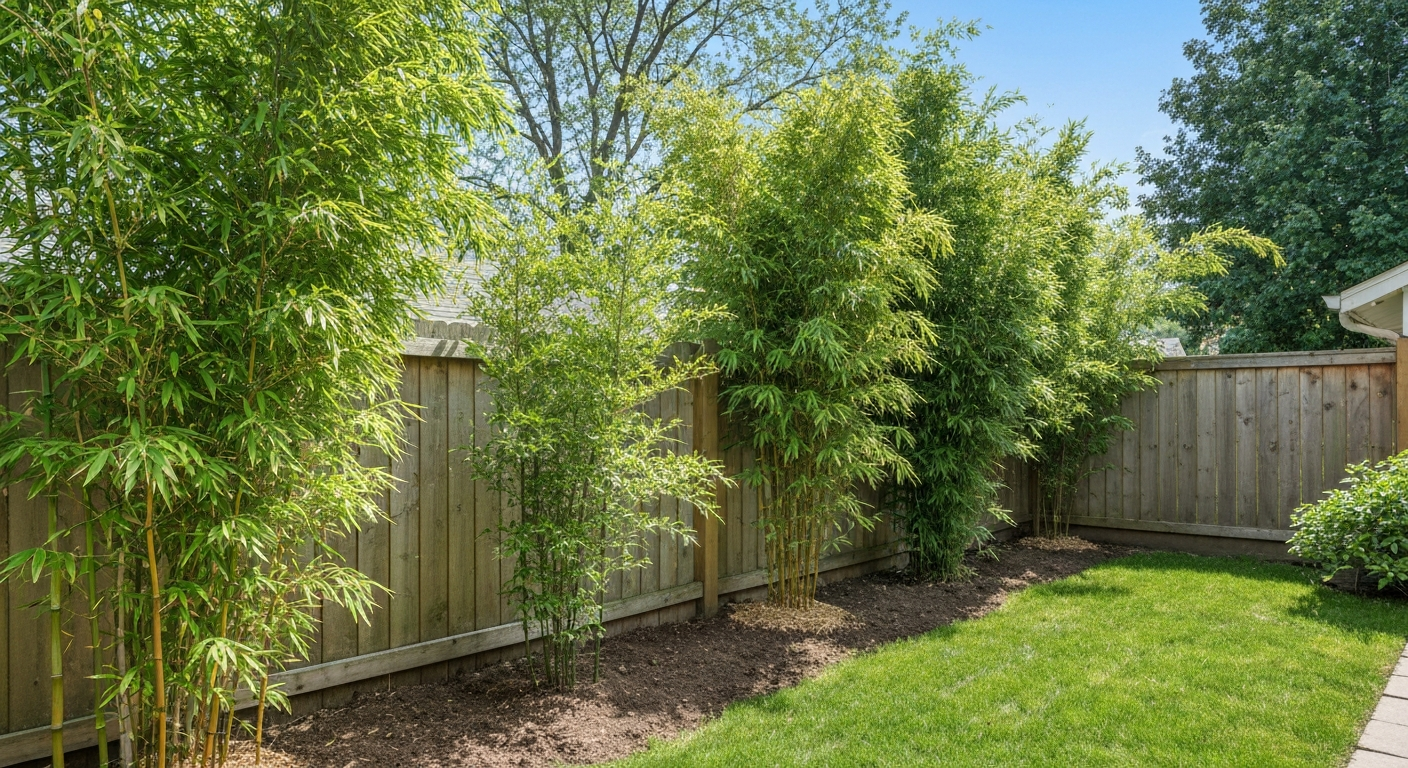
Site selection is where a lot of first-time bamboo growers go wrong. They plant where they have space rather than where the bamboo will perform best and cause the fewest headaches. For running species, give serious thought to proximity to property lines, driveways, underground utilities, and drainage systems. Running rhizomes can and will exploit any gap or soft soil path. A running bamboo planted 2 feet from your fence is a problem waiting to happen.
For privacy screening, clumping bamboos like Fargesia nitida or Bambusa oldhamii (in warm zones) are the smart choice because you can predict exactly where the plant will be in five years. Running bamboos can create a denser screen faster, but they require a HDPE root barrier (at least 60 mil, installed 18 to 24 inches deep) to keep them honest. Plan the root barrier before you plant, retrofitting one around an established runner is miserable work.
Wind exposure is worth factoring in too. Bamboo culms are surprisingly flexible, but repeated strong winds can stress new plantings and damage the leaf canopy. A slightly sheltered spot with good airflow, rather than a fully exposed hilltop, will give new plants a better start, especially in marginal cold-hardiness zones.
Soil and drainage: what bamboo actually needs underfoot
Bamboo is not picky, but it does have a preference: fertile, well-drained loam or loamy-clay soil with decent organic matter content. That's the sweet spot recommended by both extension services and INBAR's technical guidance. What bamboo genuinely dislikes is waterlogged, compacted soil. Consistently wet feet will stunt growth and can cause root rot, particularly in running species. If your soil is heavy clay that pools water, raised beds or amended planting areas with added grit or organic matter will make a significant difference.
Soil pH should sit in the 5.5 to 7.0 range, slightly acidic to neutral. Most established garden soils fall in this window, but it's worth doing a basic soil test before planting, especially if you're in an area with naturally alkaline soils or where heavy lime applications have been made. Soils trending toward pH 7.5 or higher will often show yellowing leaves (chlorosis) as iron availability drops. Acidifying amendments like sulfur or acidifying fertilizers can correct this over time.
- Ideal soil: fertile, well-drained loam or loamy-clay with good organic matter
- Target pH: 5.5 to 7.0 (slightly acidic to neutral)
- Avoid: waterlogged, compacted, or heavily alkaline soils
- Heavy clay soils: amend with organic matter or use raised beds to improve drainage
- Alkaline soils: apply elemental sulfur based on soil test results before planting
- Compost incorporation: 2 to 4 inches worked into the top 12 inches at planting improves any soil type
Light and water: how much each species actually needs
Sun and shade requirements
Most Phyllostachys species perform best in full sun to light shade and will produce fewer, thinner culms in heavy shade. Bambusa also prefers full sun in warm climates, it's a tropical plant and behaves like one. Fargesia is the exception: it's genuinely shade-tolerant and in fact prefers some protection from hot afternoon sun, particularly in zones 6 and above. Planting a Fargesia on the north side of a building or under deciduous tree canopy is not a compromise, it's often the recommended approach.
Irrigation and drought tolerance
New bamboo plantings need consistent moisture for the first one to two growing seasons, full stop. Deep, infrequent watering (think thorough soakings every few days rather than shallow daily sprinkles) encourages deeper root development and stronger establishment. Research on Moso bamboo forests confirms that bamboo can be a high water user relative to leaf area, which tracks with what you see in practice: a vigorous new planting in summer heat will wilt and sulk if it dries out too much.
Once established, bamboo stands are reasonably drought-tolerant in temperate climates, but they perform best with supplemental irrigation during dry summers. In climates with dry summers, like California or the Pacific Northwest east of the Cascades, plan on regular summer watering even for mature plants. In consistently humid climates with regular rainfall exceeding about 40 inches annually, established bamboo often needs no supplemental water at all. Know your rainfall pattern, and don't assume bamboo is as drought-proof as its reputation sometimes suggests.
| Species Group | Light Preference | Water Needs (Established) | Drought Tolerance |
|---|---|---|---|
| Phyllostachys (running) | Full sun to light shade | Moderate to high | Moderate |
| Fargesia (clumping, temperate) | Partial shade to full shade | Moderate | Moderate |
| Bambusa (clumping, tropical) | Full sun | High | Low to moderate |
| Chusquea (clumping, temperate) | Full sun to partial shade | Moderate | Moderate |
A final practical note: mulching the root zone with 3 to 4 inches of wood chips or straw makes a meaningful difference for moisture retention and soil temperature regulation, especially during the establishment phase. It also suppresses weeds, which compete with young bamboo for water and nutrients during that critical first season. It's a simple step that consistently pays off.
FAQ
Can bamboo grow outside?
Yes. Many bamboo species are adapted to outdoor cultivation. Temperate genera (e.g., Phyllostachys, Fargesia, Chusquea) include cold‑hardy species for outdoor landscapes in cooler climates, while tropical/subtropical genera (e.g., Bambusa, Dendrocalamus) are suitable outdoors in warm climates (generally USDA zones ~8–11). Species and local microclimate determine success.
How do I decide between clumping and running bamboo?
Clumping bamboo (short rhizomes; e.g., Fargesia, Bambusa, Chusquea) expands slowly and stays in a tight clump—better for small gardens and low invasive risk. Running bamboo (long rhizomes; e.g., Phyllostachys) spreads rapidly and can become invasive without containment—better if you want a fast, tall screen but plan containment measures.
Which bamboo species are recommended for cold climates (hardiness guidance)?
Cold‑tolerant choices: Fargesia species and many cultivars (often hardy to USDA zone 4–7) are reliably cold‑tolerant and shade‑friendly. Phyllostachys species vary by cultivar—some hardy to zone 5–9. Chusquea culeou can be hardy to around zone 7. Always check the specific cultivar’s USDA zone rating and local extension guidance.
Which bamboo species are best for warm, subtropical climates?
Bambusa and Dendrocalamus genera are suited to warm, frost‑free or mild‑frost climates (commonly USDA zones 8–11). Examples: Bambusa oldhamii (giant timber bamboo) performs well in subtropical climates. Choose species rated for your USDA zone and local frost exposure.
What site, soil, light, and water conditions do outdoor bamboos need?
Site/soil: fertile, well‑drained loam with good organic matter; avoid waterlogged or compacted soils. pH: generally pH 5.5–7.0. Light: many Phyllostachys prefer full sun to light shade; Fargesia performs better in partial to full shade; Bambusa prefers full sun in warm climates. Water: consistent moisture during establishment (first 1–2 seasons) with deep, infrequent watering is best; mature stands tolerate short droughts but benefit from summer water in dry climates.
How do I plant bamboo outdoors (step‑by‑step)?
1) Select a species suited to your USDA zone and site. 2) Choose location with appropriate light and space (consider mature height/spread). 3) Amend soil with compost for fertility and drainage if needed. 4) If planting running bamboo, install a containment barrier or plan for control before planting. 5) Dig a hole twice as wide as the rootball and level with surrounding soil. 6) Backfill, firm soil, water deeply. 7) Mulch to conserve moisture and suppress weeds. 8) Water regularly during the first two growing seasons and fertilize in spring and mid‑summer according to soil test or package directions.
Next Article
Does Lucky Bamboo Regrow in a Garden? Regrowth, Planting & Care
Can lucky bamboo regrow outdoors or after pruning? Rooting steps, USDA zone tips, pests and winter care.