Yes, bamboo can absolutely grow and establish itself in the end, but whether it succeeds depends almost entirely on where you start. A healthy rhizome division transplanted into the right soil will be thriving within a single season. A dry bamboo stake pushed into the ground will not. The answer lives in the biology, and once you understand how bamboo actually grows, the question answers itself.
Can Bamboo Grow in the End: How, When and Where It Establishes
Marcus Hartwell
7 Aug 2026
How bamboo actually grows: rhizomes, culms, and nodes
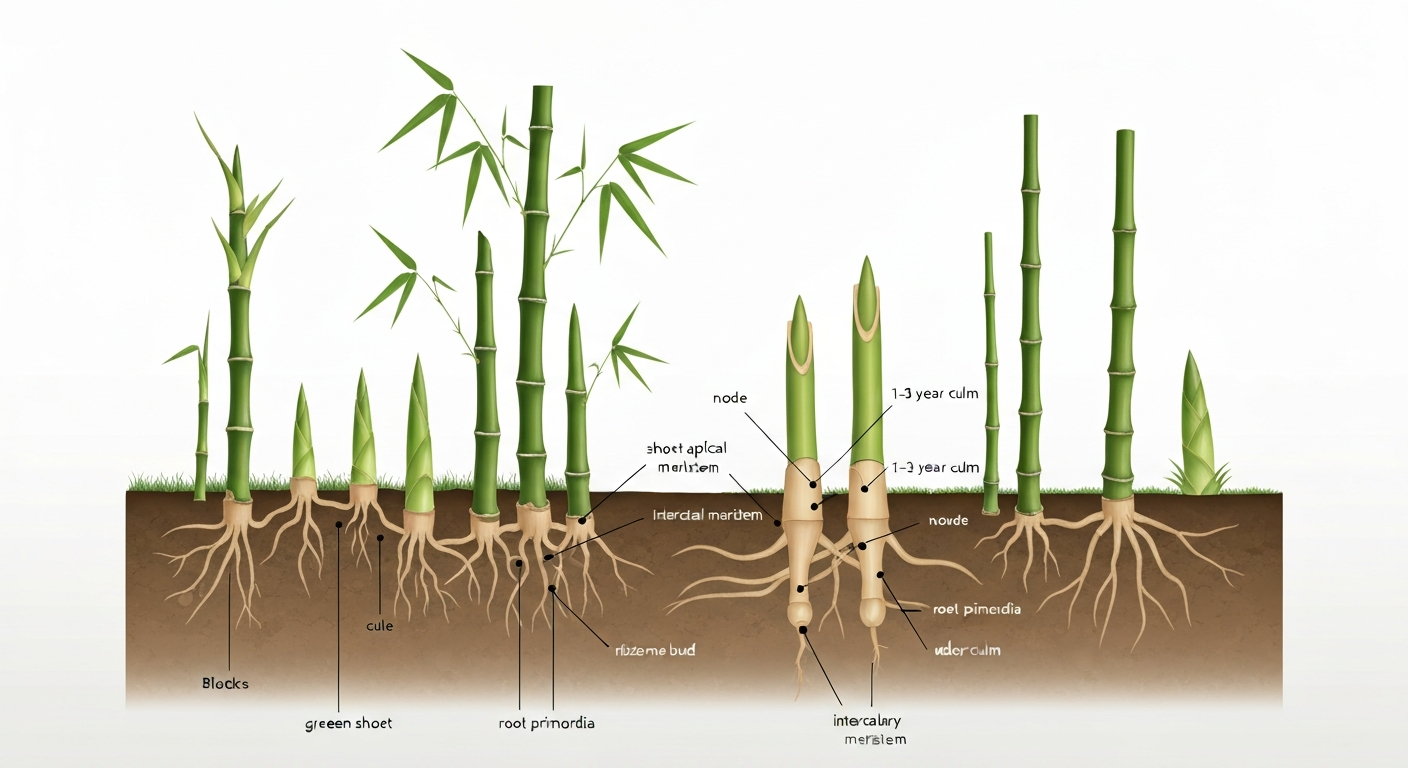
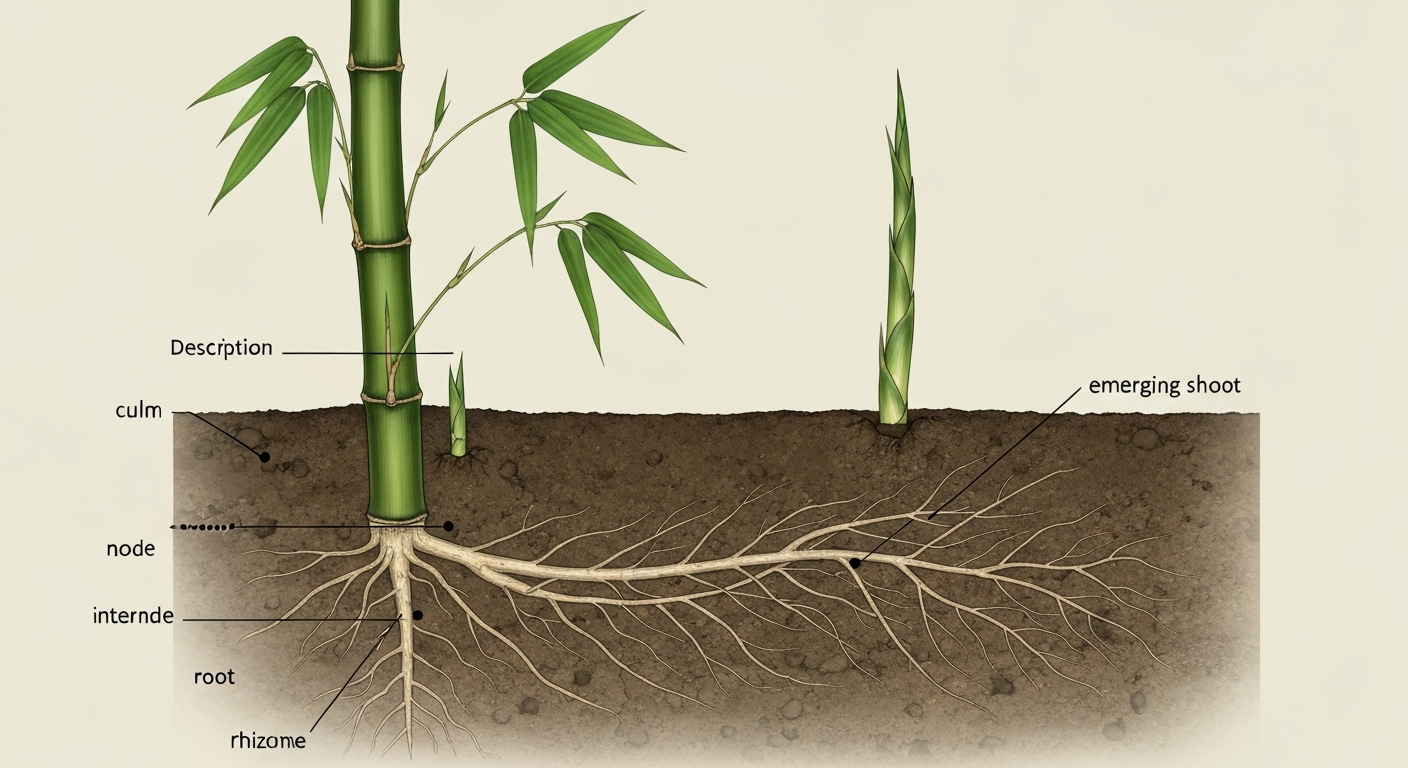
Bamboo grows from the ground up, not from the top down. For a clear explanation of whether bamboo grows from the top or bottom, see does bamboo grow from the top or bottom. This is one of the most misunderstood things about the plant. The growing point on a bamboo culm (the woody stem) is at the base and within the nodes, those ringed joints you see spaced along the stem, not at the tip. Each internode is pre-formed inside the sheath before it even emerges from the soil. Once a culm breaks the surface, it reaches its full height within weeks. It does not keep extending from the tip the way a tree does.
The real engine of the plant is the rhizome: the horizontal underground stem that stores carbohydrates and sends up new shoots. Rhizomes contain nodes with meristematic tissue and root primordia, meaning they are biologically primed to produce both new roots and new shoots. Culm nodes carry the same tissue, which is why culm cuttings can sometimes produce adventitious roots when conditions are right. The rhizome-culm system functions as a unified carbohydrate network. When a new shoot emerges, it draws on reserves stored across the whole rhizome system, which is why a well-established plant with a deep, mature rhizome network pushes up shoots so aggressively.
Running bamboos (genera like Phyllostachys) spread horizontally through long leptomorph rhizomes that can travel several feet per year. Clumping bamboos (genera like Bambusa and Dendrocalamus) use pachymorph rhizomes that curve upward close to the parent plant, producing a tighter, less aggressive expansion. Both types rely on the same fundamental node-based biology, but their growth habit, cold hardiness, and propagation responses differ enough that you really need to treat them as separate categories when planning anything.
Can bamboo grow from a cut stem, a stick, or a stake?
This is where I see the most confusion, so let me be direct. A freshly cut green bamboo stem with living nodes can potentially root under the right conditions. For step-by-step guidance on growing bamboo from stem cuttings, see can bamboo grow from stem can bamboo grow from stem cuttings. A dry, cured bamboo stake or garden cane that has been harvested, dried, and sold as a support, cannot. The cells in dried bamboo are dead. There is no meristematic tissue left to activate. I've had people ask me why their bamboo cane support didn't sprout after a season in the garden, and the answer is simply that it never had a chance. It's structurally useful timber at that point, not a propagule.
A green, freshly harvested culm cutting is a different story entirely, though success rates vary dramatically by species, node selection, cutting age, and the humidity and warmth you provide during rooting. Tropical clumping genera like Bambusa and Dendrocalamus respond to culm cuttings far more reliably than temperate running genera like Phyllostachys, which are notoriously difficult to root from stem cuttings and are much better propagated by division.
Propagation methods at a glance
There are six principal vegetative propagation methods used for bamboo worldwide: division, rhizome cuttings, culm (stem) cuttings, branch or node cuttings, air layering, and tissue culture. Seeds exist but are rarely practical. Here is how they compare in terms of reliability, effort, and which types of bamboo they suit best.
| Method | Best for | Difficulty | Typical success rate | Time to establishment |
|---|---|---|---|---|
| Division (rhizome + culm offset) | All species; most reliable overall | Low–moderate | Very high (80–95%+) | 1–2 seasons |
| Rhizome cuttings | Both running and clumping; large-scale propagation | Moderate | Moderate (50–70% with good timing) | 1–2 seasons |
| Culm cuttings (whole or sectioned) | Tropical clumping genera (Bambusa, Dendrocalamus) | Moderate | Variable: 10–60%+ species-dependent | 12–30 months to maturity |
| Branch/node cuttings | Tropical and subtropical species | Moderate–high | Low–moderate (20–50%) | 12–30 months |
| Air layering (marcotting) | Tropical clumping genera; large stems | High | Moderate–high (60–80% in suitable species) | 6–12 months to rooted layer |
| Tissue culture | Commercial/research scale | Very high (lab only) | High in lab conditions | Months in lab, then hardening |
Division: the most reliable way to grow bamboo
Division is the method I recommend first to any home gardener. You are moving a piece of bamboo that already has an established rhizome, roots, and one or more culms. The plant does not need to build a root system from scratch, so survival rates are high and establishment is fast. Expect an actively growing plant within the same growing season if you time it right.
Step-by-step division
- Time it right: early spring just before new shoots emerge is ideal. The rhizome is charged with carbohydrates and the plant is primed for growth. Late autumn (after the growing season) also works if you can keep the division from freezing.
- Choose your division: select a section of rhizome with at least one healthy culm attached, ideally two to three. The rhizome section should be 12–18 inches long with visible buds.
- Cut cleanly: use a sharp spade, mattock, or pruning saw. Cut culms back to 12–24 inches to reduce transpiration stress on the still-limited root system.
- Minimize root exposure: work quickly and keep roots moist. Wrap the root ball in wet burlap or plastic if you cannot plant immediately.
- Plant at the same depth it was growing: set the rhizome horizontally at roughly the same depth it occupied in the ground. In most species this is 4–8 inches deep.
- Water thoroughly and mulch: give the division a deep soak immediately after planting and apply 3–4 inches of organic mulch to retain moisture and moderate soil temperature.
- Protect from wind: the cut-back culms will still lose moisture through leaves. A temporary windbreak helps in the first weeks.
- Expect slow above-ground activity in the first season: the plant is busy rebuilding its root system. New shoots typically appear in earnest in the second growing season.
Success rates with division are very high, typically 80 to 95 percent or better when timing and aftercare are reasonable. The main causes of failure are desiccation of the root ball before planting, planting too deep, or choosing a division with no viable rhizome buds.
Rhizome cuttings: propagating without the culm
A rhizome cutting is a section of underground stem, harvested without an attached culm. Because rhizomes contain the same meristematic nodes as a full division, they can produce both roots and new shoots, but they start with lower carbohydrate reserves than a division that includes a photosynthesizing culm. Timing and technique matter more here.
Step-by-step rhizome cuttings
- Harvest in late winter to very early spring, before shoot emergence, when rhizome starch reserves are at their seasonal peak.
- Select healthy, firm rhizome sections 8–18 inches long with at least two to four visible buds and some attached roots if possible.
- Cut ends cleanly with a sharp blade and dust cut surfaces with a fungicide powder to reduce rot risk.
- Plant horizontally, 3–5 inches deep, in a well-draining but moisture-retentive mix. A 50/50 blend of quality potting soil and coarse perlite works well.
- Keep soil consistently moist (not waterlogged) and maintain temperatures above 60°F (15°C). A cold frame or greenhouse speeds rooting significantly.
- Expect shoot emergence in 4–10 weeks under warm conditions. Rooted cuttings ready to pot up or transplant typically take 3–6 months.
- Pot on or transplant once the young plant has two to three culms and a visible root system filling the container.
Success rates for rhizome cuttings run roughly 50 to 70 percent under good conditions. They drop significantly if cuttings are harvested late in the season when carbohydrate reserves are lower, or if soil is waterlogged. Running bamboos (Phyllostachys and relatives) tend to respond better to this method than clumping tropical species, which often do better with culm or branch cuttings.
Culm and node cuttings: variable but worth knowing
This is the method people most often ask about, usually because they have a freshly cut culm and wonder if they can grow it into a plant. Culm cuttings rely on the adventitious root and shoot potential at the nodes, which is real, but it is highly species-dependent. In published propagation trials, rooting rates for culm cuttings have ranged from single-digit percentages in some Bambusa species under poor conditions to 40–60 percent or better for Dendrocalamus and certain Bambusa under optimized protocols. With auxin rooting hormone, high humidity, and warm bottom heat, some species have shown rooting rates of 70 percent or above. The temperate running genera like Phyllostachys are considerably harder and generally not worth attempting from culm cuttings.
Step-by-step culm and node cuttings
- Select material: use one- to two-year-old culms (not juvenile first-year canes and not hardened old culms). The cutting should be green and flexible, not brittle.
- Cut into sections with one to two nodes each, leaving 2–3 inches of internode on each side of the node. Seal the upper cut with wax or grafting paste to reduce drying.
- Optional but effective: score the node area lightly and apply an indole-3-butyric acid (IBA) rooting powder or gel at 3,000–8,000 ppm concentration.
- Orient correctly: culm cuttings can be planted horizontally (laid flat in a shallow trench, 1–2 inches deep) or upright. Horizontal placement is generally preferred as it maintains contact across the full node.
- Cover with a humidity tent or place in a mist propagation unit. Aim for 85–95% relative humidity during rooting.
- Maintain bottom heat at 75–85°F (24–29°C) if possible. Rooting occurs much faster with supplemental warmth.
- Roots typically emerge in 4–12 weeks. Shoots may take an additional 4–8 weeks after rooting.
- Harden off and pot up once the rooted cutting has two to three visible shoots and a root system that holds the medium together.
Realistic expectations: for tropical clumping species under good conditions, a 40–60 percent rooting rate is achievable for a careful home propagator. Do not expect a mature plant quickly. Even a successfully rooted culm cutting will take 12 to 30 months to develop a robust enough rhizome system to behave like an established plant. Patience is the key variable.
Air layering bamboo: slower, but useful for thick-stemmed species
Air layering (also called marcotting) is a technique where you encourage roots to form on a culm while it is still attached to the parent plant, then sever it once rooted. It sidesteps the carbohydrate problem of detached cuttings because the developing roots have access to the full plant's resources throughout. I find it most useful for thick-stemmed tropical clumping species where cutting and propagating by other means is difficult.
Step-by-step air layering
- Select a healthy culm on a vigorous plant, ideally one to two years old. Choose a node mid-way up the culm where branch buds are visible.
- Remove branches within 6 inches of the target node. Lightly girdle or score the culm just below the node — remove a 1-inch ring of the outer culm wall if possible, or score deeply through the outer layer.
- Apply a generous amount of IBA rooting hormone paste or gel to the wounded area.
- Pack moist sphagnum moss (pre-soaked, then squeezed to moist-not-dripping) around the node in a ball roughly the size of a baseball.
- Wrap tightly with clear polyethylene film and seal both ends with grafting tape or electrical tape. The moisture must be sealed in completely.
- Check every 2–4 weeks by looking through the clear film. Root tips visible at the moss surface indicate success.
- Once roots are clearly visible and 1–2 inches long (typically 6–12 weeks in warm conditions), sever the culm below the rooted layer.
- Remove wrapping carefully, keep moss intact around the root ball, and pot up immediately in a well-draining mix. Keep in bright shade for 2–4 weeks while the roots adapt.
Air layering success rates in suitable tropical and subtropical species typically run 60 to 80 percent when technique is good and conditions are warm and humid. It is less practical for temperate running bamboos and genuinely not worth the effort when division is available. The main advantage is producing a rooted plant without disturbing the parent, useful when you want multiple propagules from a single prized specimen.
Seeds and tissue culture: what you need to know
Bamboo seeds are rare, irregular, and often not commercially available because most bamboo species flower only once in their lifetime, sometimes once every 60 to 120 years, and then die. When seeds do appear (during a mass flowering event), they can germinate readily, but you are unlikely to encounter them unless you happen to be near a species in its flowering cycle. Tissue culture (micropropagation) produces high volumes of uniform plants in laboratory conditions and is used commercially, but it is not accessible to home growers and requires sterile technique and specialized media. For the purposes of any practical home propagation question, seeds and tissue culture are informational background, not realistic options.
Climate, soil, and container suitability
Whether bamboo will ultimately thrive depends heavily on matching species to climate. Phyllostachys species are your best bet in cooler temperate climates, some, like P. nuda and P. bissetii, handle USDA Zones 5 to 6 reliably, meaning they can survive winters down to around -10°F (-23°C). Compare that to Dendrocalamus giganteus or Bambusa oldhamii, which need subtropical warmth and will die to the ground or not at all in a hard frost. I always tell people: identify your zone first, then pick your species. Getting that backward is the most common and most avoidable mistake I see.
For soil, bamboo wants fertile, well-drained, moisture-retentive ground with good organic matter content. The ideal pH range is 5.5 to 6.5 for most species. Heavy clay that sits wet will rot rhizomes. Sandy soil that dries out completely will stress the plant and slow establishment. Amending with compost before planting makes a noticeable difference. University extension guidance (including UF/IFAS fact sheets) consistently backs this up: soil preparation is not optional if you want fast, healthy establishment.
Container growing is genuinely feasible, but you need to be realistic about scale and maintenance. A small decorative pot will be outgrown quickly and rhizomes will find their way through drainage holes or crack the container entirely if left too long. Use very large planters, I recommend a minimum of 25–30 gallons for most species, and large stock tanks work well. Use a moisture-retentive but well-draining mix, feed regularly with a balanced fertilizer through the growing season, and plan to divide and repot every 5 to 10 years. Container-grown bamboo is unlikely to reach the same size as ground-planted bamboo, but it can be healthy and attractive.
| Species | USDA Zone | Type | Propagation recommended | Container suitable? | Invasiveness concern |
|---|---|---|---|---|---|
| Phyllostachys bissetii | 5–9 | Running (temperate) | Division, rhizome cutting | With barrier or large container | High — install root barrier |
| Phyllostachys aurea (Golden Bamboo) | 6–10 | Running (temperate) | Division | With barrier or large container | Very high — listed invasive in many states |
| Phyllostachys nuda | 5–9 | Running (temperate) | Division, rhizome cutting | With barrier or large container | High — manage aggressively |
| Bambusa oldhamii | 8–11 | Clumping (subtropical) | Culm cutting, division, air layering | Large containers, no barrier needed | Low |
| Bambusa multiplex (Hedge Bamboo) | 7–11 | Clumping (subtropical) | Division, culm cutting | Large containers, no barrier needed | Low–moderate |
| Dendrocalamus asper | 9–12 | Clumping (tropical) | Culm cutting, air layering, division | Large containers (tropical only) | Low |
| Fargesia robusta (Clumping Hardy) | 5–9 | Clumping (temperate) | Division | Yes — well suited | Very low |
Invasiveness and containment: the honest part
Running bamboos are genuinely aggressive spreaders, and I want to be direct about this because I think it gets undersold. Phyllostachys aurea (Golden Bamboo) is listed as an invasive species in multiple US states and documented in regional invasive species databases as capable of displacing native vegetation. The biology is straightforward: a single leptomorph rhizome can travel 5 to 15 feet in a season underground. You do not notice the problem until it is already established outside your intended planting area.
Physical containment is the most effective preventive approach. Standard extension guidance recommends digging a trench roughly 30 to 36 inches deep around the planting area and installing a non-porous root barrier, HDPE, polypropylene, or metal sheet, with 2 to 3 inches of the barrier exposed above the soil surface so rhizomes cannot grow over the top. The barrier must be inspected annually; rhizomes will eventually find the top edge or any gap. This is not a set-and-forget solution.
If you already have an unwanted bamboo stand and need to remove it, expect a multi-season effort. Repeated cutting at ground level depletes rhizome carbohydrate reserves over time. Glyphosate or imazapyr applied to fresh-cut stumps or new regrowth can accelerate the process, but neither herbicide is a one-season eradication. Rhizome reserves persist, and plants will re-sprout. Oregon State University Extension guidance describes integrated mechanical and chemical approaches as the realistic path, not a quick fix. If you are considering a clumping species instead, the containment burden is dramatically lower, which is one strong reason to favor Fargesia or Bambusa species in residential settings.
Using bamboo canes as plant supports
On the practical side: dried bamboo canes are excellent structural supports in the garden. Peas, beans, and other climbers will happily use bamboo canes as supports, the nodes and rough surface texture give climbing plants natural grip points. For guidance on whether peas will climb bamboo supports, see will peas grow up bamboo canes. This is a completely separate question from whether bamboo will grow from those canes (it will not, as covered above), but it is worth noting that the material's durability and light weight make it one of the best natural staking options available. A well-made bamboo cane or stake can last two to five seasons in the garden before needing replacement, depending on the species it was made from and how wet the soil stays.
Realistic growth timelines: what to actually expect
Here is where I try to set honest expectations, because I've seen a lot of disappointment from people who expected bamboo to be a fast-growing screen within a single season. The truth is that the first one to two years after planting are largely underground. The plant is establishing its rhizome network before it produces significant above-ground growth. This is normal and not a sign that something is wrong. After that establishment phase, what growers call 'year one sleep, year two creep, year three leap', growth accelerates noticeably. By years three to five, a well-sited bamboo in appropriate soil and climate will be producing vigorous new culms each spring.
For culm and node cuttings, the timeline to a genuinely mature, established plant is longer: 12 to 30 months to develop a rhizome system robust enough to behave like a settled clump, depending heavily on species and conditions. Division gives you the fastest path to an established, productive plant. If time matters to you, and it usually does, start with division.
Bottom line: can bamboo grow in the end?
Yes, with the right starting material, the right species for your climate, adequate soil preparation, and realistic expectations about timing. Division is your most reliable route. Rhizome cuttings work well for large-scale propagation with proper timing. Culm and node cuttings can succeed for tropical clumping species under optimized conditions but require more effort and patience. Air layering is a solid option for prized specimens where you cannot afford to disturb the parent plant. Dried stakes and canes will not grow, no matter how hopeful you are. Contain running species from day one, choose clumping species wherever possible in residential settings, and match your species to your USDA zone before you do anything else. Do all that, and bamboo will almost certainly grow in the end.
FAQ
Quick answer: can bamboo ultimately establish and grow from stems, stakes or other starting materials and in different conditions?
Short answer: Yes — bamboo will establish and grow in the end, but success depends on the material, species, propagation method and growing conditions. Vegetative organs with nodes (rhizome sections, culm/branch nodes, or divisions that include rhizome + culm) contain meristematic/root‑primordia tissue and can produce new plants. The most reliable methods are division (rhizome+culm offsets) and properly prepared rhizome or node/culm cuttings. Success rates and time to a vigorous plant vary widely by species, protocol and climate.
How does bamboo grow — what are the key parts (rhizomes, culms, nodes) and where does new growth come from?
Bamboo is driven by a rhizome–culm system. Rhizomes are underground stems that produce new culms (canes) and storage reserves; culms are aboveground stems made of sections separated by nodes. Nodes contain meristematic tissue and root primordia and can produce adventitious roots or shoots under the right conditions. New shoots typically emerge from rhizome buds; culm/node cuttings form roots from nodes or damaged culm bases. Carbohydrate reserves in rhizomes and culms feed new shoots, so reserve status and the presence of live buds greatly affect establishment.
Can bamboo grow from a cut stem or a stake stuck in the ground? (Practical evaluation)
Short: Sometimes, but variable. A bare cane or stake without live nodes or attached rhizome rarely produces a full plant. If the cane has intact nodes with healthy tissue and is handled quickly (kept moist, placed so nodes contact medium, sometimes treated with rooting hormone), some species will form roots and shoots. Typical reality: • Division (rhizome+culm) — very reliable. • Rhizome cuttings (with buds) — reliable if timed and handled correctly. • Culm/node cuttings — species‑dependent: low to very high success (single digits to >60% in trials) depending on species and method. • Old, dry canes or plain stakes lacking nodes/buds — unlikely to become a full plant.
Step‑by‑step propagation methods and realistic success rates
Division (most reliable): 1) Dig up a section including rhizome and at least one young culm with roots. 2) Retain soil on roots, plant into amended soil or container, keep moist and shaded until established. Success: very high for both clumping and many running species when done correctly. Rhizome cuttings: 1) Cut rhizome into 10–30 cm sections with at least one bud. 2) Lay horizontally in a moist, well‑drained medium or bury shallowly. 3) Maintain warm, humid conditions. Success: moderate to high for many species when timed for active growth; variable. Culm/node cuttings (stem cuttings): 1) Cut culm into sections containing one or more nodes. 2) Place horizontally or upright with node buried in moist medium; cover or mist to maintain humidity; use auxin rooting hormone for harder species. 3) Protect from direct sun and keep warm/humid. Success: very species‑dependent — published trials range from single‑digit % to 70–90% for certain tropical species with optimized protocols. Air‑layering: wound a node/section on a live culm, wrap with moist medium and cover; roots form then sever and pot. Success: generally good where culm remains vigorous. Note: success rates depend strongly on species, timing, temperature, humidity and use of hormones.
Which propagation method should I use for my bamboo?
Recommendations: • Want fast, reliable clones? Use division (rhizome+culm). • Propagating running Phyllostachys in temperate zones? Division and rhizome cuttings are most reliable. • Tropical clumpers (Bambusa, Dendrocalamus)? Culm/node cuttings and air‑layering often do well. • Limited space or a single culm available? Try air‑layering or node cuttings with rooting hormone and high humidity. Choose method per species — when in doubt, division is the safest option.
Climate, soil and container suitability — what conditions are needed and which species suit my climate?
Climate: species vary — many Phyllostachys tolerate USDA zones ~5–9 (some down to zone 5), while Bambusa and Dendrocalamus typically need warmer subtropical/tropical climates. Soil: fertile, well‑drained but moisture‑retentive, high organic matter; avoid waterlogged or very poor, compacted soils. Containers: feasible but require very large pots, high‑quality mix, regular feeding and repot/divide every 5–10 years. Small containers will limit growth and rhizomes may escape through drainage holes. Match species cold‑hardiness to local climate — consult species guides.
Next Article
Does Bamboo Grow from the Top or Bottom? Quick Garden Guide
Does bamboo grow from the top or bottom? Clear answer, anatomy, propagation from culms, and cane-stake tips.