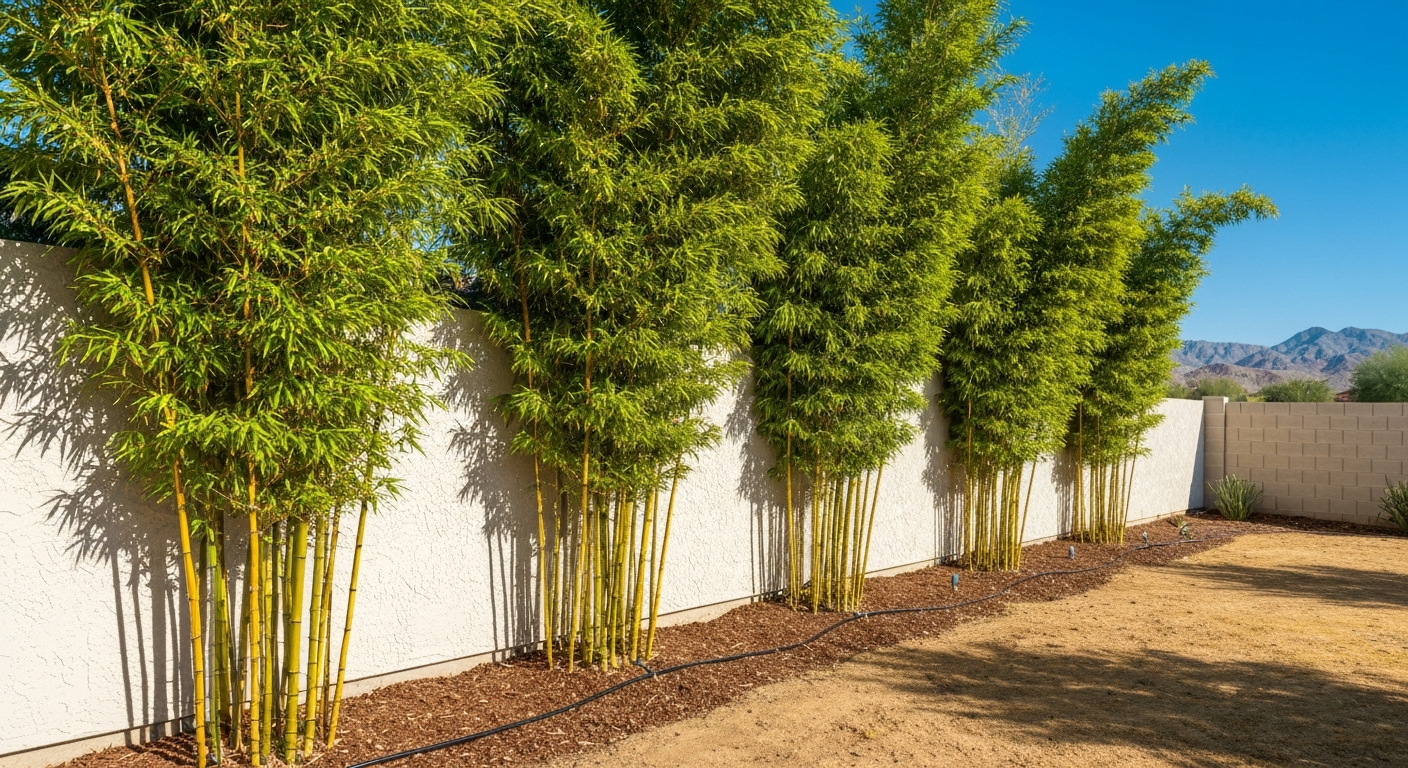
Bamboo grows from the bottom, not the top. New shoots emerge from buds on the underground rhizome system, and each culm's height is determined before it ever breaks the soil surface. Once a culm is fully extended, it will never grow taller, no matter what you do to the tip. That fact changes how you think about pruning, propagation, and what to expect from a cut cane in a garden bed.
Does Bamboo Grow from the Top or Bottom? Quick Garden Guide

Marcus Hartwell
21 Jul 2026
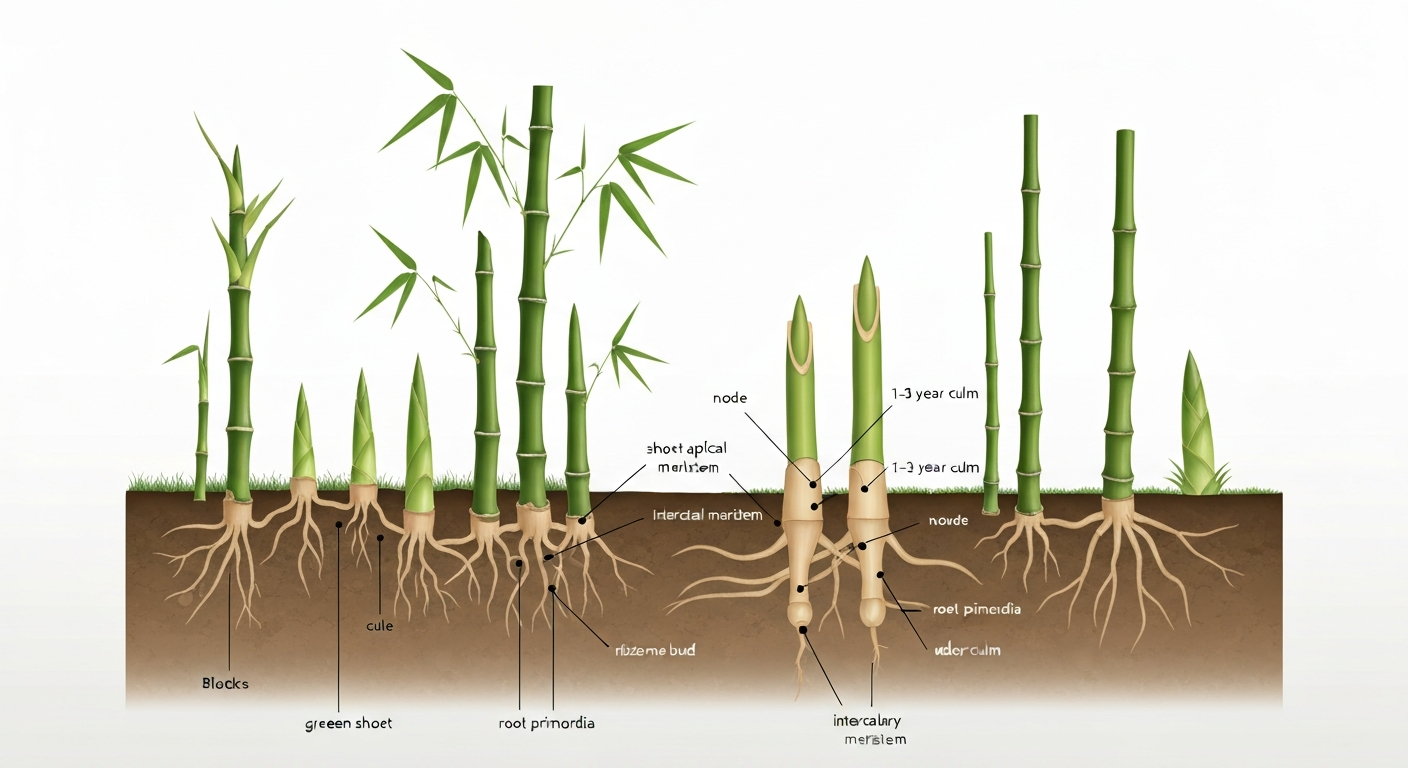
Bamboo anatomy: culms, nodes, rhizomes, and where new shoots form
To really understand where bamboo grows, it helps to picture the whole plant, not just the visible canes. A bamboo plant has three main structural systems: the culms (the above-ground canes), the nodes and internodes along each culm, and the rhizome network underground.
The rhizome is where almost everything important begins. Rhizomes are horizontal underground stems that store energy and carry growth buds called rhizome buds. These buds contain pre-formed shoot primordia, the early cellular blueprint of a future culm, that develop through several stages over months before they ever emerge above ground. Research on species like Moso bamboo (Phyllostachys edulis) shows this underground developmental phase can span roughly four to six months before you see anything above the soil.
Once a shoot bud activates and pushes up through the soil, a shoot apical meristem (SAM) at the very tip of the developing shoot controls the culm's shape and initial form. Below that, intercalary meristems sitting at each node and internode region drive the explosive vertical elongation that bamboo is famous for, sometimes several feet in a single day for fast-growing species. These intercalary meristems are why bamboo can grow so fast, but they also explain why a culm stops growing permanently once those meristems finish their work and the tissue hardens.
Root primordia and culm bud primordia are concentrated at the base of developing shoots and along the rhizome, not at culm tips. That's the anatomical foundation behind the short answer above, and it has real practical implications.
Why bamboo doesn't grow from the culm top
A bamboo culm is not like a tree trunk. Trees have apical meristems at branch tips that keep producing new tissue throughout the tree's life. Bamboo culms don't work that way. The shoot apical meristem at the tip of a developing bamboo culm is active only during the initial emergence and formation phase. Once the culm finishes extending, which happens entirely through those intercalary meristems expanding each internode segment from the base upward, the meristematic tissue essentially exhausts itself. The culm hardens into a woody structure that no longer has any ability to generate new height.
Cut the top off a mature culm and nothing grows back from that cut point. The culm stays exactly the height you cut it to, and that internode will slowly dry and hollow at the cut end. New growth in the clump comes entirely from the rhizome buds underground, not from anything happening at the tip of an existing cane. This is one of the most common misconceptions I see from gardeners who are new to bamboo, especially those used to hedging shrubs or topping trees to encourage bushy regrowth. If you're wondering about a different context, such as whether bamboo will grow in the End, see the guide titled "can bamboo grow in the end" for specifics.
Basal buds located at the lower nodes of the culm and along the rhizome neck are the true drivers of new shoot production. In clumping species, these are tightly clustered near the base of the clump. In running species, they're distributed along long, laterally spreading rhizomes that can travel several feet from the parent plant each year.
Can bamboo regrow from cut culms, stakes, or cane pieces?
This is where it gets more nuanced, and where a lot of confusion comes from, especially for people who've read that bamboo can be propagated from cuttings. The honest answer is: sometimes, under the right conditions, with the right species and method, yes. See can bamboo grow from stem for a focused guide on propagating bamboo from culm and node cuttings. But a dry bamboo garden stake or a decorative cane sitting in a vase has essentially no chance of rooting or regenerating into a new plant.
Dead, dried, or treated cane has no living meristematic tissue. Once bamboo is harvested, dried, or kiln-treated (as most commercial stakes and garden canes are), the cells that could have rooted are gone. A dried bamboo stake pushed into soil will not sprout. It will just sit there, which does make it useful as a physical support for climbing plants like peas, beans, or sweet peas, but it's not going to become a bamboo plant. If you're wondering whether bamboo sticks or stakes can grow, the condition and origin of the material matters enormously. If you're specifically wondering will bamboo stakes grow, see the detailed section addressing whether cut canes or garden stakes can root and regenerate. For a focused explanation on whether bamboo sticks or stakes can grow, see do bamboo sticks grow.
Fresh-cut culm segments from living plants are a different story. A segment cut from a healthy, living bamboo culm, particularly one taken from a one-to-three-year-old culm, with at least one intact node, and treated and planted quickly, can potentially root and produce new shoots. This is the basis of culm cutting propagation, which is a legitimate nursery technique used worldwide, particularly in tropical and subtropical regions. But success rates depend heavily on species, culm age, node position, substrate, and care.
Which species work for culm and nodal cuttings
Not all bamboo responds equally to cutting propagation. Broadly speaking, tropical and subtropical clumping bamboos in the Bambusa and Dendrocalamus genera are the most reliably propagated from culm or branch cuttings. Temperate running bamboos like Phyllostachys are much less amenable to cutting propagation and are almost always propagated by rhizome division instead.
In published propagation trials, culm cuttings of Bambusa nutans achieved roughly 88% rooting success, while branch cuttings of the same species came in around 40%, a significant difference that illustrates how much method and species interact. Bambusa vulgaris nodal branch cuttings with leaves, treated with IBA (a rooting hormone), have also shown good root and shoot numbers in nursery conditions. The manual blank" rel="noopener noreferrer">Bamboo Propagation, Management and Utilization: Practical Manual (propagation manual) reports auxin treatments (IBA or NAA) commonly improve rooting of culm/branch/nodal cuttings, with practical ranges from about 100–1,000 ppm (for example, 100–200 ppm overnight or 500–1,000 ppm short dips depending on species and method). These figures come from controlled trials, so real-world garden results will vary.
For running genera like Phyllostachys, the standard approach is rhizome division: digging up a section of rhizome with intact buds and culm stubs and transplanting it. This works reliably because you're giving the new plant exactly the tissue it needs, living rhizome with viable buds. Trying to root a culm cutting of Phyllostachys in a pot is generally a frustrating exercise with low success rates, and most experienced growers don't bother.
| Genus / Type | Propagation Method That Works Best | Culm Cutting Viability | Notes |
|---|---|---|---|
| Bambusa (clumping, tropical) | Culm cuttings, branch cuttings, division | Good (60–88% in trials) | IBA treatment improves results; mid-culm nodes preferred |
| Dendrocalamus (clumping, tropical) | Culm cuttings, branch cuttings, division | Moderate to good | Thick walls; fresh material essential |
| Phyllostachys (running, temperate) | Rhizome division | Poor | Culm cuttings rarely root; use division instead |
| Fargesia (clumping, temperate) | Division | Poor to moderate | Cold-hardy; division most reliable |
| Guadua (clumping, tropical) | Culm cuttings, branch cuttings | Moderate | Used in South American nurseries; node quality critical |
Running vs. clumping bamboo: different rhizome habits, different spread
The distinction between running (leptomorph) and clumping (pachymorph) bamboo isn't just a botanical detail, it directly affects where new shoots appear and how the plant spreads. See blank" rel="noopener noreferrer">PROSEA: Introduction to Bamboos (species habits and rhizome types) for an overview of leptomorph (running) and pachymorph (clumping) rhizome differences and their effects on shoot origin and spread. Running bamboos like Phyllostachys have long, slender, horizontally spreading rhizomes that can push several feet per year. Shoot buds along these rhizomes can pop up far from the parent plant, which is both why running bamboo spreads aggressively and why containment is so important in temperate gardens.
Clumping bamboos have short, curved pachymorph rhizomes that turn upward quickly, producing new shoots tight to the parent clump. The spread is predictable and slow, typically only a few inches per year at the clump perimeter, which makes clumping species much more manageable in home gardens. Understanding this distinction also explains why rhizome division is the go-to propagation method for both types: you're working with the tissue that actually generates new growth.
When to try propagation: timing matters more than most people think
Timing your propagation attempt can be the difference between good success and complete failure. The general principle is to work with the plant's natural growth momentum. For most species, the best window is late spring through early summer, just as the plant is entering active growth and rhizome buds are most physiologically ready. In tropical climates, just before the rainy season is the classic timing used by nurseries across Southeast Asia and South America.
In temperate climates like the southeastern US (USDA Zones 7–9), I've found the sweet spot is typically late April through June, once soil temperatures are consistently above 60°F. In the UK or Pacific Northwest, late May through July tends to work better. Avoid attempting culm cuttings in late summer or autumn, the declining daylength and cooling temperatures reduce rooting hormone activity and bud development, and you're setting yourself up for failure.
For air layering and trench layering (ground layering), the same warm-season window applies. These techniques take longer than simple cuttings but tend to have higher success rates because the cutting material has already begun forming roots before it's severed from the parent plant.
What you need before you start: materials, substrate, and rooting aids
Good propagation doesn't need expensive equipment, but a few things genuinely matter. Here's what I'd put together before attempting culm cuttings.
- Sharp, clean cutting tools: a pruning saw or bypass loppers for culm segments, and a sharp knife for clean node trimming. Dirty cuts introduce rot-causing pathogens immediately.
- Rooting hormone: IBA (indole-3-butyric acid) powder or solution is the most widely used. Practical ranges reported in propagation trials are 100–200 ppm for overnight soaks or 500–1,000 ppm for quick 5-second dips, depending on species. Talc-based IBA powder (available at most garden centers) works fine as a simplified option.
- Rooting substrate: a well-draining but moisture-retentive mix is critical. Coarse sand mixed with perlite or vermiculite works well. Pure garden soil is too dense and promotes rot. A 1:1 coarse sand and perlite mix is a reliable starting point for most species.
- Propagation trays or wide containers: flat trays work well for horizontal culm placement; individual deep pots work for vertical single-node methods.
- Plastic sheeting or a humidity dome: maintaining high ambient humidity (above 70–80%) around the cuttings reduces moisture loss through any remaining leaf tissue and keeps the node area moist.
- Misting system or spray bottle: consistent surface moisture without waterlogging is the goal. Daily misting is usually sufficient unless conditions are hot and dry.
- Thermometer: soil temperature between 65–85°F (18–30°C) supports rooting. A propagation heat mat set to around 70–75°F can help significantly in cooler climates or early-season attempts.
Step-by-step: rooting nodal and culm cuttings
This method works best for tropical and subtropical clumping bamboos like Bambusa and Dendrocalamus. For temperate running bamboos, rhizome division is more reliable, but you can attempt this with lower expectations.
- Select your source culm. Choose a culm that is one to three years old — identifiable by its still-green or slightly yellowing color without heavy surface mold or significant wall damage. Avoid very young first-year culms (too soft and prone to rot) and old gray culms (buds are often dormant or dead).
- Cut culm segments with at least one node each. Single-node segments (one internode below and one above the node) are the most economical. Two-node segments are also effective. Cut cleanly with a saw, leaving a few centimeters of internode on each side of the node.
- Trim and seal the cut ends. Make clean horizontal cuts. Some growers seal cut ends with wax, grafting compound, or even candle wax to reduce moisture loss and pathogen entry — especially the upper end, which will not root.
- Apply rooting hormone to the lower cut end and the node area. If using IBA powder, dampen the node region slightly, dip it in powder, and tap off the excess. If using IBA solution, a short dip (5–10 seconds for 500 ppm, or an overnight soak for 100–200 ppm solutions) works well.
- Prepare your substrate in trays or containers. Moisten it thoroughly so it holds shape when squeezed but doesn't drip freely. A slightly damp consistency is what you're aiming for.
- Place segments horizontally in the substrate. Bury the segment so the node is covered by about 2–3 cm of substrate. The horizontal position consistently produces better results in trials than vertical placement, likely because more of the nodal tissue stays in contact with moist medium.
- Cover with plastic sheeting or a humidity dome. Maintain temperatures between 70–85°F (21–30°C) and humidity above 75%. Mist lightly once or twice daily if no automated misting is available.
- Wait and monitor. Do not disturb the segments. Check moisture levels every two to three days. In warm conditions with good species-to-method matching, you may see the first shoot emergence in four to eight weeks. Root development takes longer and isn't visible until you gently tug the segment and feel resistance.
- Harden off and transplant. Once shoots are several centimeters tall and you feel root resistance when tugging, begin reducing humidity gradually over one to two weeks. Transplant into a larger container with a good bamboo-friendly soil mix (slightly acidic, pH 5.5–6.5, with good drainage) before planting out.
Common failure points and how to avoid them
Most failures trace back to a handful of predictable problems. Rot at the node is the most common, usually caused by a substrate that holds too much water, especially in warm conditions. If your medium stays wet (not just moist) for days at a time, switch to something with more drainage. Coarse sand is your friend here.
Using old or dried culm material is the second major failure point. Even a week of drying after cutting can significantly reduce bud viability in some species. If you're collecting culm segments from your own plants, get them into prepared substrate within 24 to 48 hours. If that's not possible, wrap them in damp burlap and keep them shaded and cool.
Choosing the wrong species or the wrong propagation method accounts for most of the remaining failures. If you're working with Phyllostachys and your cuttings aren't taking, it's not your technique, it's the species. Dig up a section of rhizome instead.
- Waterlogged substrate: switch to a coarser, better-draining mix and reduce watering frequency
- Using dried or treated bamboo (garden stakes, decorative cane): these have no living tissue and will not root under any conditions
- Wrong culm age: culms older than three to four years have largely dormant or dead buds; fresh one-to-three-year-old material is essential
- Wrong node position: top-culm nodes often have lower bud viability; mid-culm and basal nodes perform better in most species
- Low temperature: below 60°F (15°C), rooting activity drops significantly; use a heat mat in temperate climates
- Attempting culm cuttings with running bamboo species: use rhizome division for Phyllostachys, Pleioblastus, and similar genera
Using bamboo canes as plant supports (stakes that won't grow)
One practical side note worth covering: dried bamboo garden canes and stakes are genuinely excellent plant supports precisely because they won't root or sprout. If you're using bamboo canes to support climbing peas, beans, sweet peas, or tomatoes, you want them to stay put and do their structural job, not start producing shoots in your vegetable bed. Commercially produced bamboo stakes are kiln-dried or heat-treated, ensuring there's no living tissue left. If you wonder whether peas will climb bamboo canes, see will peas grow up bamboo canes for practical tips on spacing and tying. They're lightweight, strong, and biodegradable.
The main practical consideration when using bamboo canes as supports is ensuring they're pushed deep enough into the soil for stability, at least 20–30 cm (8–12 inches) for canes supporting tall climbers. For peas and similar lightweight climbers, even shallower placement works fine. Whether bamboo canes provide a good climbing structure for peas depends more on spacing and how you connect the canes than on any growth concerns. A simple teepee or grid arrangement works well.
Realistic expectations: what you can actually achieve
I want to be honest here, because propagation guides often oversell success rates. Culm cutting propagation works well for tropical clumping bamboos in warm, humid climates with fresh material and careful substrate management. In these conditions, rooting rates of 60–88% are achievable with species like Bambusa nutans. In a temperate garden with cooler temperatures and a species less suited to cutting propagation, 20–40% would be a more realistic expectation, and zero is entirely possible if the conditions aren't right.
The most reliable propagation method for nearly all bamboo species remains rhizome division. It's less technically demanding, it works across both running and clumping species, and you're starting with tissue that the plant has already invested in developing. If you're trying to establish bamboo in a new garden spot, dividing an existing clump in spring and transplanting a section with healthy rhizome and at least two to three culm stubs is almost always the most dependable path.
For anyone drawn to culm cutting experiments, especially with tropical species, it's a genuinely rewarding technique when it works. Just go in with the right material, the right species, good substrate, spring timing, and realistic expectations. And if you're curious about how fast a newly established bamboo will grow once it's in the ground, that depends heavily on your climate, soil, and species, a topic worth exploring alongside propagation to set proper expectations for your first few seasons.
FAQ
Short answer: Does bamboo grow from the top or the bottom?
Short answer: Bamboo produces new above‑ground culms from buds on its underground rhizome system (basal/rhizome buds) — not by emerging from the cut top of an existing culm. The developing shoot has a shoot apical meristem at its tip while underground rhizome apical/subapical meristems generate new shoot primordia that later emerge as culms.
Anatomy: How do bamboo meristems and rhizomes control where shoots originate?
Bamboo has two key meristem systems: (1) the rhizome meristems (apical/subapical) produce and position new shoot primordia along the rhizome; (2) the shoot apical meristem (SAM) at the tip of a developing culm drives primary elongation. Intercalary meristems at nodes/internodes enable fast internode elongation. Together this means new shoots come from basally located rhizome/ bud tissue rather than from the top of an old culm.
Can a cut bamboo culm regrow new shoots from the cut (top) end?
Generally no: a severed culm lacks the rhizome connection and the necessary basal meristematic tissue to produce new independent shoots. Some limited regrowth (sprouting) can occur from live buds at or near the base of the original plant or from buried culm nodes if they retain node/rhizome tissue and are in favorable conditions, but growth from a cut top alone is not how bamboo normally regenerates.
Can bamboo be propagated from culm (stem) or nodal cuttings, and which species respond best?
Yes — many species can be propagated by culm cuttings, single‑ or two‑node nodal cuttings, branch (leafy) cuttings, trench/ground layering or air‑layering. Success is species‑dependent: Bambusa (clumping) species and some tropical running bamboos root well from branch or nodal cuttings; many temperate Phyllostachys (running) species are propagated by rhizome division or culm cuttings with variable success. Nursery and research trials show wide variability, so check species‑specific guidance.
Which culm segments root best (age, position, node count)?
Best practice from propagation trials: use relatively young but mature culms (commonly 1–3 years old), mid‑to‑basal culm segments perform better than top segments, and segments with 1–3 nodes are practical and effective. Nodes must be intact and positioned so the node meristem contacts moist rooting medium (horizontal burial often improves success).
Materials and basic supplies needed for rooting culm or nodal cuttings
Supplies: sharp pruning saw/knife, clean cutting surface, rooting substrate (coarse sand, sand:soil mix, or sand:peat/vermiculite for drainage and moisture retention), containers or trench bed, water/misting system, optional rooting hormone (IBA or NAA) at appropriate concentration, plastic sheeting or humidity tent, labels, and protective gloves. Ensure cuts are clean and tools sterilized to reduce rot.
Next Article
Can Bamboo Grow in Las Vegas? Guide to Success in Desert
Yes, bamboo can grow in Las Vegas with the right species, irrigation, shade, and containment; step-by-step planting and保护