Yes, bamboo can grow in the desert, but you need the right species, a smart planting location, and a reliable irrigation setup. Without those three things locked in before you plant, most bamboo will struggle and die within a season or two. Get them right, and you can have a thriving grove in some of the harshest climates in North America.
Can Bamboo Grow in the Desert? A Practical Guide
Marcus Hartwell
7 May 2026
What bamboo actually needs to survive desert conditions
Bamboo's biggest enemies in the desert aren't what most people expect. It's not just heat, and it's not just low rainfall. The real killers are the combination of extreme heat, desiccating wind, and low humidity working together to pull moisture out of the leaves faster than the roots can replace it. This is called desiccation stress, and it's what causes bamboo to go yellow and drop leaves even when the soil is moist.
Research on Moso bamboo (Phyllostachys edulis) has shown that prolonged drought can push a plant past a hydraulic threshold where the water-conducting tissue starts to fail, a process called xylem embolism. Research on Moso bamboo links drought-induced water depletion and increased xylem embolism to higher mortality risk during extreme drought events [prolonged drought can push a plant past a hydraulic threshold](https://pmc. ncbi. nlm.
nih. gov/articles/PMC11119542/). Once that damage exceeds [roughly 85%](https://pmc. ncbi.
nlm. nih. gov/articles/PMC10602750/) of the plant's conducting capacity, you're in serious trouble. Newly sprouted culms are especially vulnerable compared to established ones, which have a more developed root and rhizome network to draw from.
This is exactly why the establishment phase, those first one to two years in the ground, is when desert bamboo is most likely to die.
The good news is that bamboo's clonal rhizome system actually gives it a built-in survival tool. As the colony grows, connected rhizomes share water and nutrients along water potential gradients, so a larger, more established colony is genuinely more drought-resilient than a single young plant. The goal for the first couple of years is simply to keep the plant alive long enough to build that network.
Picking the right bamboo species for the desert
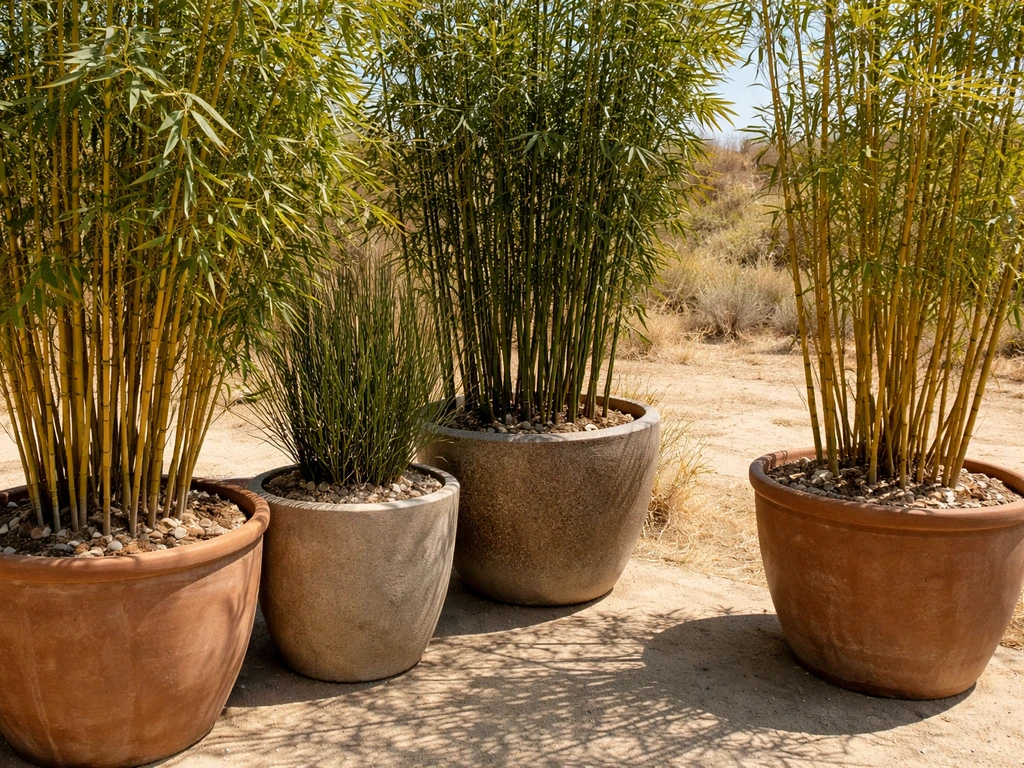
Species selection is where most desert bamboo attempts fail before they even start. Tropical species that love humidity will cook. Cold-sensitive clumpers will die in a hard frost. You need to match the species to both your summer highs and your winter lows, because the Sonoran Desert, the Mojave, and high-desert areas like New Mexico and Colorado all have very different temperature profiles.
Species worth trying in arid climates
- Phyllostachys aurea (Golden bamboo): One of the most commonly recommended running types for hot, dry climates. It's rated for USDA zones 6a–10b, handles heat well, and once established it's genuinely drought-tolerant with deep, infrequent watering. It will spread aggressively, so barrier installation is non-negotiable.
- Bambusa balcooa: A clumping tropical bamboo with documented low rainfall requirements and moderate drought tolerance once mature. It prefers deep, well-drained soil with pH 5.5–7.0. Not cold-hardy, so it's better suited to low-elevation desert areas like Phoenix or Las Vegas that rarely freeze hard.
- Phyllostachys aureosulcata (Yellow groove bamboo): Another running type with solid heat and cold tolerance, useful in high-desert zones where winter temperatures can drop well below freezing.
- Fargesia species (clumping): Shade-tolerant, cold-hardy, and actually do better with some afternoon shade during the hottest part of the day. A good choice for high-desert and mountain-adjacent areas, but they need more attention to humidity and watering in extreme heat.
Clumping vs running bamboo in a desert yard
This is a practical decision, not just a botanical one. Running bamboo (Phyllostachys and related genera) spreads via rhizomes that can travel several feet per year and will infiltrate garden beds, foundations, and neighboring properties. In a desert yard where you're already investing in irrigation infrastructure, the last thing you want is rhizomes traveling toward a drip line or under a patio. If you choose a running type like Golden bamboo, install a high-quality rhizome barrier: at least 60 mil polypropylene or HDPE, ideally 80 mil. A typical installation requires a trench about 28 inches deep with the barrier rising roughly 2 inches above grade, and you should leave 12 to 24 inches between the barrier edge and any structures.
Clumping bamboo (Bambusa and Fargesia) spreads slowly and stays where you put it, which makes it easier to manage in a carefully irrigated planting area. The tradeoff is that many clumping species are either cold-sensitive (tropical clumpers like Bambusa) or prefer more humidity than the desert provides (Fargesia). Know your zone and pick accordingly.
| Species | Type | USDA Zones | Drought Tolerance | Desert Suitability |
|---|---|---|---|---|
| Phyllostachys aurea | Running | 6a–10b | High (once established) | Excellent for low/mid-desert |
| Bambusa balcooa | Clumping | 9–11 | Moderate–High | Good for frost-free desert areas |
| Phyllostachys aureosulcata | Running | 5–10 | Moderate–High | Good for high-desert/cold winters |
| Fargesia species | Clumping | 4–9 | Moderate | Best in shaded, high-desert sites |
Choosing your site and building a microclimate
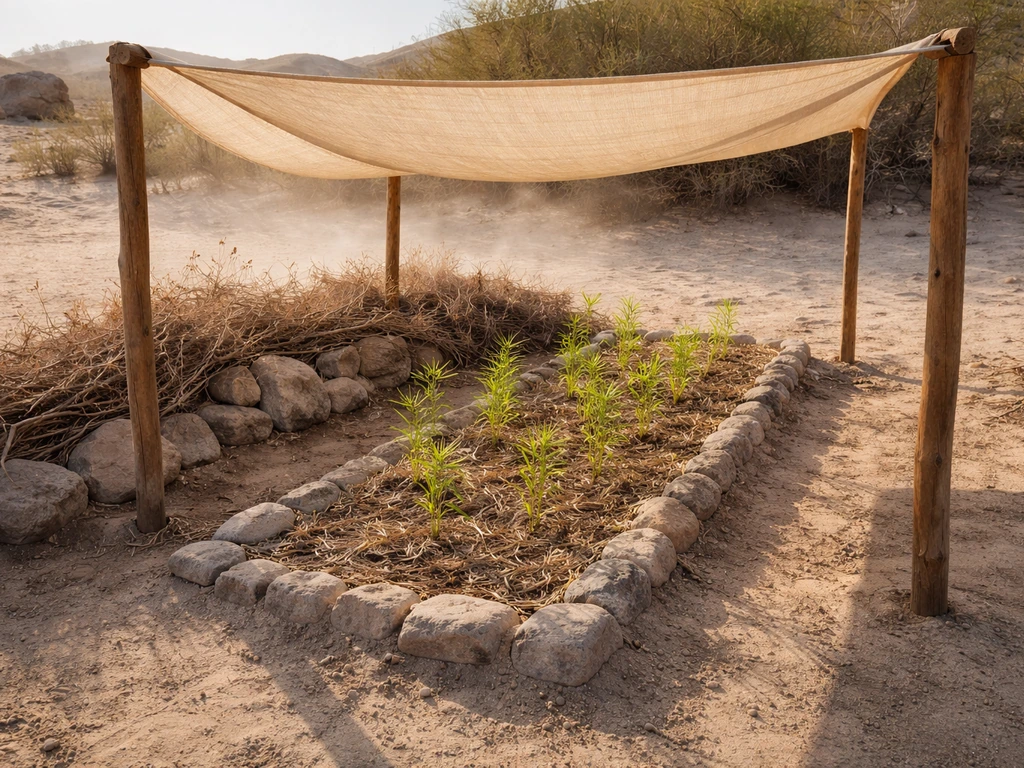
Where you plant matters almost as much as what you plant. In the desert, you're essentially trying to create a small pocket of less-harsh conditions within a brutal environment. A spot that gets direct afternoon sun from 1 to 6 PM in July is going to be dramatically harder to manage than a location that gets morning sun and afternoon shade from a wall, fence, or large tree.
Afternoon shade is particularly valuable for species like Fargesia, which the American Bamboo Society notes are happiest with shade during the hottest part of the day. Even for more heat-tolerant running types, partial shade reduces leaf temperature and slows evaporative water loss, which directly reduces how much irrigation you need during establishment. A south-facing wall can reflect intense heat onto plants, so east-facing or north-facing exposures near structures tend to work better in hot desert climates.
Wind is the other major factor people underestimate. Hot, dry desert wind is extraordinarily effective at desiccating bamboo foliage. Site your bamboo where a fence, wall, or row of existing shrubs breaks the prevailing wind. If no natural windbreak exists, consider planting a temporary wind screen or using shade cloth for the first couple of summers while the grove establishes.
Water access is the final site requirement. Plant bamboo near an existing irrigation line or in a location where you can run drip irrigation without a complicated setup. Establishing bamboo in an arid climate takes a lot of water, and you do not want to be hauling a hose across the yard in July heat. Proximity to your water source isn't a luxury, it's a practical necessity.
Soil prep, planting, and watering in arid conditions
Getting the soil right
Desert soils are typically alkaline, compacted, and low in organic matter, which is the opposite of what bamboo wants. Bamboo thrives in slightly acidic, well-draining loamy soil with a pH of 5. 5 to 6. 5, rich in organic matter.
That means you'll need to amend your planting area before putting anything in the ground. Mix in generous amounts of compost to improve organic content and water retention, and check your soil pH with an inexpensive test kit. If your pH is above 7, add sulfur to bring it down over time. Sandy desert soils drain too fast and hold no nutrients, while heavy clay desert soils hold too much water and will cause root rot.
Either way, amending with compost is the fix.
Planting and mulching
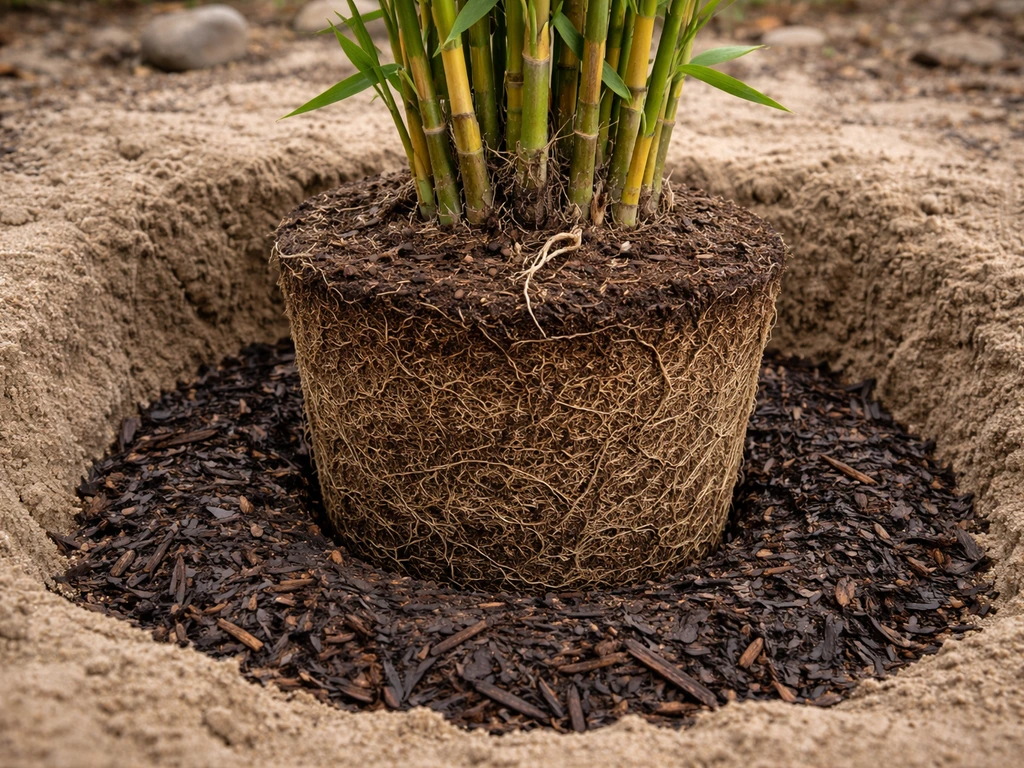
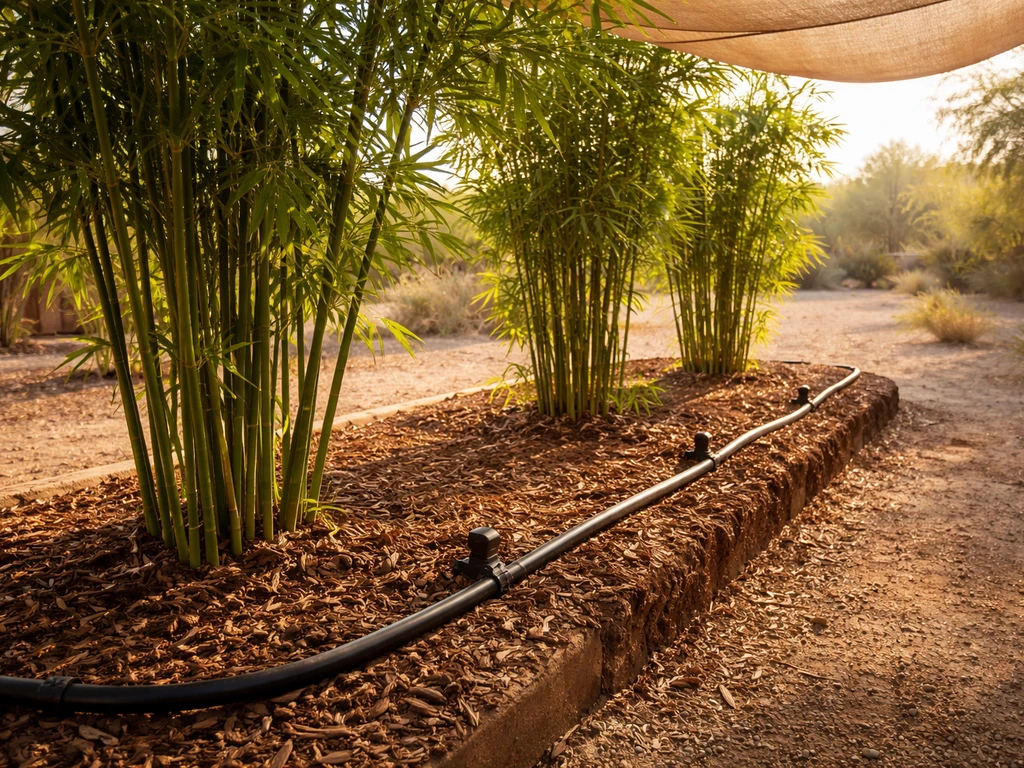
Dig your planting hole to about twice the width of the root ball and roughly the same depth. Plant at the same level the bamboo was growing in its container. Backfill with your amended soil, water in thoroughly, and then apply 3 to 4 inches of mulch around the base, keeping it a few inches away from the culms themselves. Mulch is critical in the desert because it reduces soil surface evaporation dramatically, keeps root-zone temperatures cooler, and slowly breaks down to feed the soil. Think of the mulch layer as your most cost-effective irrigation strategy.
Irrigation: what a realistic schedule looks like
Drip irrigation is the best system for desert bamboo. It delivers water slowly and directly to the root zone, minimizes evaporation, and lets you run it on a timer without constant attention. The Arizona Department of Water Resources recommends drip run times of 2 hours or more per watering session in Sonoran Desert conditions, with additional water needed for new plantings or unusually hot and dry weather. During the first summer, expect to water every 2 to 3 days during peak heat, and check the soil several inches down before you water. If it's still moist, wait another day.
A rough seasonal framework for the first two years looks like this: water heavily and frequently during summer establishment (every 2 to 3 days in extreme heat), dial back to every 4 to 5 days once temperatures drop in fall, and reduce further in winter to 1 to 2 times per week depending on conditions. In the spring, ramp back up as temperatures rise and new shoots emerge. Once the grove is established, typically after year 2 or 3, it can get by with much less irrigation, though you'll still want consistent deep watering during the growing season for good culm production.
What to expect in years 1 through 3
Be honest with yourself about what success looks like in the first year: it's a plant that's still alive. If you're wondering about space-age growing conditions, the next big question is whether bamboo can grow on Mars can bamboo grow on mars. Bamboo is a slow starter after transplanting because almost all of its energy goes underground to establish roots and rhizomes. You may see a few small shoots in the first spring, shorter and thinner than what you planted. That's normal and actually a good sign.
By the third spring, you should see new shoots that are close to the size of the original plant, and the grove should start to look like something. In the desert specifically, expect this timeline to stretch a bit compared to a temperate climate with natural rainfall, because the plant is spending extra energy managing water stress even when you're irrigating well. A full, mature grove typically takes 7 to 10 years to develop, so patience is genuinely required. The first couple of years are about root building, not above-ground drama.
Temperate bamboos like Phyllostachys shoot in spring, while tropical clumpers like Bambusa tend to shoot in late summer and fall. Knowing your species' shooting schedule helps you plan your heaviest watering and fertilizing effort around the period when the plant is making its biggest push.
Failure modes: what goes wrong and how to catch it early
Temperature extremes
Cold snaps are a real threat in high-desert areas. A tropical clumper like Bambusa balcooa in Phoenix might handle most winters fine, but a freak cold snap can kill it to the ground. Research your species' cold hardiness before committing. The American Bamboo Society recommends heavy mulching and added protection from cold and drying winds if you're planting late in the year, and that advice applies year-round in the desert as preventive care. On the heat side, if your site gets reflected heat from pavement or walls, you may see leaf scorch and rapid wilting even with irrigation. Shade cloth rated to block 30 to 50% of sunlight can save a struggling plant through the worst of summer.
Underwatering and overwatering
Both kill bamboo in the desert. Underwatering is the more obvious risk, but overwatering in poorly draining soil causes root rot that attacks the rhizome and bud tissue first. You'll notice signs above ground, such as yellowing leaves and weak culms, but by the time it's visible the underground damage is already significant. If your soil stays soggy for more than a day or two after watering, you need to improve drainage before you plant.
Raise the bed, add coarse compost, or switch to sandy loam. This is also related to why bamboo growing in sand or in water environments requires such a different approach, since soil drainage profiles change the entire equation for root health. Bamboo can also grow in water, but the container setup and filtration matter just as much as the species bamboo growing in sand or in water environments.
Bamboo can grow in sand, but it needs the right species and frequent moisture management because sand drains so quickly. If you’re wondering about growing bamboo in a water-based setup, the approach changes again because drainage and root oxygen needs are completely different bamboo growing in sand or in water environments.
Wrong species for your zone
Buying whatever bamboo is available at a local big-box store is how a lot of people lose their first plant. If the tag doesn't list the species name and cold hardiness zone, don't buy it. Source from a reputable bamboo nursery that can tell you the exact species and its performance in your climate region. This single step eliminates most species-mismatch failures.
Runaway rhizomes
Running bamboo without a barrier becomes a landscape management problem quickly, and in a desert yard with drip irrigation lines and gravel paths, rhizomes can be especially destructive and hard to track. Install the barrier at planting time, not after the grove has already spread. Removing established running bamboo is a serious project that most people underestimate.
Your practical next steps
- Identify your USDA hardiness zone and your average summer high temperatures to narrow your species list.
- Choose a planting site with afternoon shade, wind protection, and proximity to an irrigation source.
- Test your soil pH and amend with compost to bring it to the 5.5–6.5 range before planting.
- Order from a reputable bamboo nursery and confirm the species name, zone rating, and growth habit (clumping or running).
- If choosing a running type, buy your rhizome barrier (at least 60 mil, preferably 80 mil) before planting day.
- Install drip irrigation and set a summer establishment schedule of 2-hour sessions every 2 to 3 days during peak heat.
- Mulch 3 to 4 inches deep after planting and replenish as it breaks down.
- Set realistic expectations: survival and root building in year 1, visible progress in year 2, genuine grove character by year 3.
FAQ
Can I grow bamboo in the desert if I only have a rainwater catchment system instead of an irrigation line?
It usually won’t be reliable enough. Desert bamboo needs frequent, slow, root-zone watering during the first 1 to 2 summers (often every 2 to 3 days in peak heat). If you must use rainwater, plan for storage sized to cover multi-week dry spells and add a backup water source, otherwise desiccation stress will hit before roots can build the rhizome network.
How do I tell if my bamboo is dying from desiccation stress versus root rot?
Desiccation stress often shows as yellowing and leaf drop while soil is still moist, and the plant may look “dry” on top even when you recently watered. Root rot shows up after soggy soil persists, with weak, declining culms and poor shoot vigor. A practical check is to probe soil several inches down, and if it stays wet for more than a day or two, fix drainage before adding more water.
What’s the best way to position bamboo so it avoids harsh afternoon sun in summer?
Aim for morning sun with afternoon shade. In hot deserts, direct light from about 1 to 6 PM is a major establishment challenge because it raises leaf temperature and increases evaporative loss. Using an east-facing exposure near a wall or fence is often easier than a south-facing reflection zone, which can radiate extra heat.
Do I really need shade cloth if I already selected a heat-tolerant species?
Often it helps during establishment, especially during the first couple of summers or if reflected heat is strong. Shade cloth that blocks roughly 30 to 50% of sunlight can reduce leaf temperature and slow water loss, buying time for roots and rhizomes to expand. Once the grove is established, you may be able to reduce or remove it.
When is the best time to plant bamboo in a desert climate?
Planting timing matters most because it determines whether the plant hits its first establishment period during peak heat. For many desert locations, planting after the worst summer heat begins to ease can reduce early desiccation risk, but you still need enough time for root building before the next extreme temperatures. If you plant late in the year, plan extra protection from cold and drying winds.
How can I prevent running bamboo from invading my drip lines or under patios?
Use a rhizome barrier at planting time, not after spread starts. For running types, install a proper depth barrier (around 28 inches deep) with the barrier rising above grade (about 2 inches), and keep an appropriate gap from structures (often 12 to 24 inches). Also inspect rhizomes routinely around any utilities or hardscape edges during the first seasons.
What soil changes should I make first if my desert soil is alkaline and compacted?
Start by measuring pH and drainage. Bamboo prefers slightly acidic conditions (about pH 5.5 to 6.5) and consistent oxygen around the roots. If pH is above 7, incorporate sulfur gradually over time rather than expecting an instant change, and mix generous compost to improve both water retention and structure. If soil stays wet after watering, raise beds or amend to improve drainage.
Can I grow bamboo in desert sand or containers instead of planting in-ground?
Yes, but it requires a different moisture strategy because sand drains quickly and holds fewer nutrients. Container or sand-based growing usually needs more frequent, controlled watering and a careful fertilizer approach so the plant does not cycle between drought and nutrient starvation. Also pay attention to root oxygen, since overly saturated mixes can still cause rot.
How much fertilizer should I use in the desert during the first year?
In the desert, the priority is survival and rhizome development, so avoid heavy feeding early. Fertilize with restraint and time it around active shoot and leaf growth once the plant is establishing. If you fertilize too aggressively while the plant is still struggling with water stress, you can worsen stress rather than accelerate growth.
What irrigation mistakes most commonly kill bamboo during establishment?
Two big ones are watering too infrequently and watering when the soil cannot drain. Deep watering on a timer is better than frequent short hose cycles that keep the top layer wet without enough root penetration. Also confirm moisture several inches down before watering again, and if soil stays soggy longer than a day or two, improve drainage before continuing.
If my bamboo sends up only thin shoots in the first year, is that normal?
Yes, it’s common. After transplanting, bamboo spends much of its energy underground building roots and rhizomes, so early shoots may be smaller than the original plant. Treat survival as the success metric for the first year, then evaluate shoot vigor by the second and third springs.
Does bamboo need a windbreak in desert areas even if it’s irrigated?
Yes. Desiccating wind can pull moisture out of leaves faster than roots can replace it, which increases desiccation stress. If your site is exposed, place bamboo behind a fence, wall, or shrubs, or use temporary wind protection (and possibly shade cloth) during the first couple of summers.
Can bamboo survive desert cold snaps if I choose a cold-hardy species?
Often, but you still need preventive protection. Cold-hardiness determines baseline survival, yet freak events can still damage or kill above-ground growth. Heavy mulching and protection from drying winter winds help reduce moisture loss, and late-year planting may require extra caution.
Next Article
Will Bamboo Grow in Water? How to Grow Bamboo Submerged
Learn if bamboo can truly grow submerged in water, how to set it up, manage oxygen and water quality, and troubleshoot r