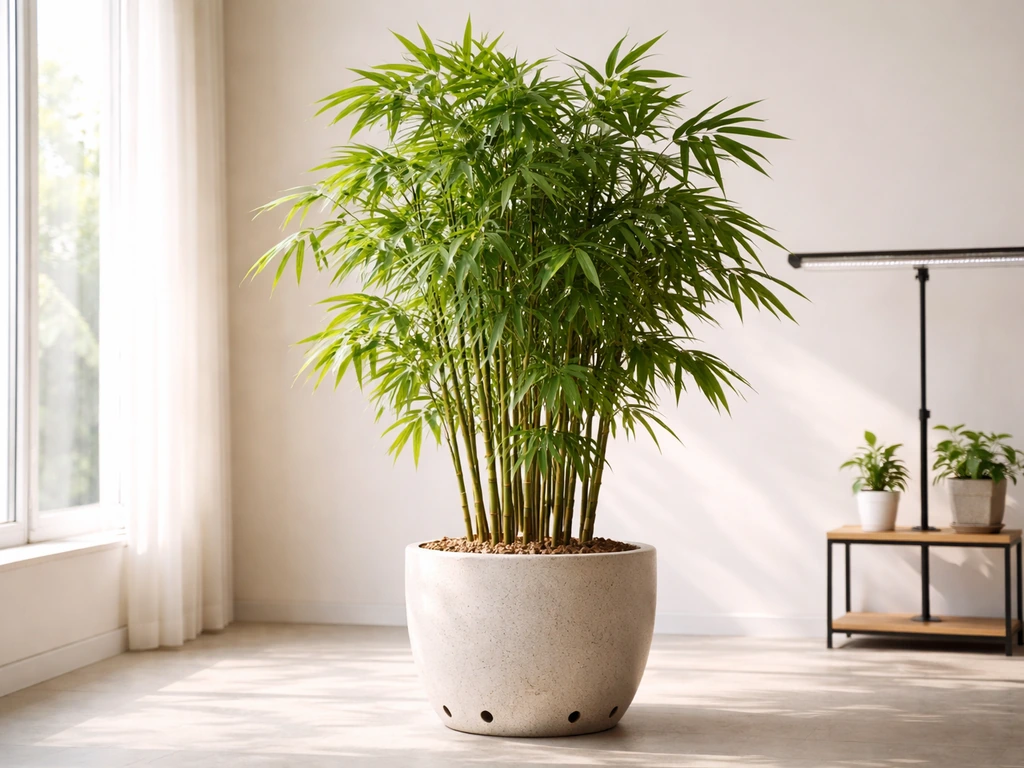
Yes, you can grow bamboo hydroponically, but with some important caveats. Bamboo roots survive and even grow in water-based systems, and peer-reviewed experiments have confirmed this with Phyllostachys seedlings in hydroponic containers. The real question is which species you choose and how well you manage oxygen, nutrients, and containment. Get those three things right and hydroponics becomes a genuinely useful way to grow bamboo indoors, in troughs, or in tight spaces where soil just isn't practical.
Can You Grow Bamboo Hydroponically: Best Methods & Tips for Indoor Bamboo

Marcus Hartwell
30 Jul 2026
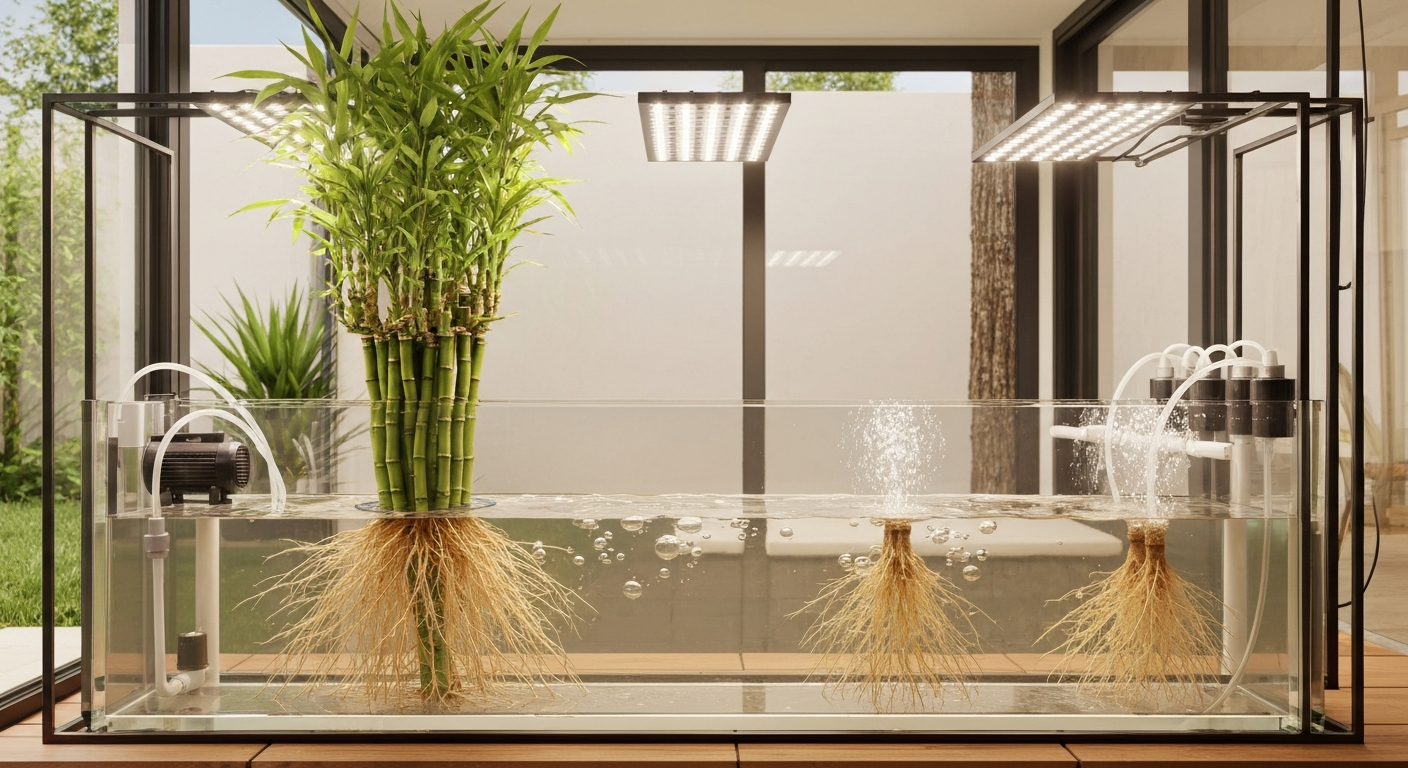
How hydroponics fits bamboo biology
Bamboo is a grass, not a tree, and that matters for hydroponics. Its root system is relatively shallow and fibrous compared to woody plants, which means roots can adapt to submerged or periodically flooded conditions better than you might expect. The rhizome, the horizontal underground stem that drives bamboo's spread and regrowth, stays within roughly the top 30 cm (about 1 foot) of substrate in most species, which aligns well with the root zones typical hydroponic containers provide.
That said, bamboo does have a genuine vulnerability in water-based systems: oxygen. A published study on Phyllostachys praecox seedlings tested dissolved oxygen (DO) levels ranging from about 2 to 8 mg per liter and found clear physiological stress at the low end, including leaf curling within 14 days under poor-oxygen hydroponic conditions. The peer‑reviewed article Effects of Hypoxia Stress on Growth, Root Respiration, and Metabolism of Phyllostachys praecox, Life (PMC) reports leaf curling after 14 days under hydroponic culture and measured plant responses at dissolved oxygen levels of about 2–8 mg·L⁻¹ Effects of Hypoxia Stress on Growth, Root Respiration, and Metabolism of Phyllostachys praecox — Life (PMC). The takeaway is that bamboo is not tolerant of stagnant, low-oxygen water. If you run a system where roots sit in poorly aerated solution, root respiration suffers and the plant declines fast. This is not a reason to avoid hydroponics for bamboo. It is a reason to take oxygenation seriously from the start.
The other biological consideration is rhizome containment. Running bamboos produce long, thin leptomorph rhizomes that push outward aggressively. In a hydroponic reservoir or trough, those rhizomes will find any gap and exploit it. Clumping bamboos, which grow pachymorph rhizomes (short, thick, curving outward slowly from the crown), are inherently more contained. That difference shapes almost every decision you make when designing a bamboo hydro setup.
Clumping vs running bamboo: which types work in hydroponics
University extension sources and horticultural literature consistently recommend clumping species for contained systems, and that advice holds for hydroponics too. Clumping bamboos like Fargesia and smaller Bambusa species expand gradually from a central crown without sending runners meters away into your reservoir walls or neighboring containers. They stay manageable. Running bamboos, primarily the Phyllostachys genus, are the ones most people picture when they think of tall, fast-growing bamboo, and they are genuinely harder to manage hydroponically because their leptomorph rhizomes are exploratory by nature.
Black bamboo (Phyllostachys nigra) is one of the most commonly asked-about species for indoor and contained growing, partly because of its striking dark culms. For more on indoor suitability, see can black bamboo grow indoors for details on size, containment, and care. It is a running Phyllostachys, and under good conditions it reaches 6 to 11 meters (roughly 20 to 35 feet) at maturity. That scale matters enormously for system planning. A young black bamboo plant in a hydroponic trough is manageable, but you need to go in knowing it wants to get large and spread widely. Its rhizomes will need active physical containment in any hydro or planter setup.
| Species | Type | Mature Height | Rhizome Habit | Hydro Suitability |
|---|---|---|---|---|
| Fargesia murielae (Umbrella bamboo) | Clumping | 2–4 m (6–13 ft) | Pachymorph, tight clump | Excellent — naturally contained, cold-hardy to -20°C |
| Fargesia robusta | Clumping | 3–5 m (10–16 ft) | Pachymorph, tight clump | Very good — vigorous but compact roots |
| Bambusa multiplex (Hedge bamboo) | Clumping | 3–6 m (10–20 ft) | Pachymorph, moderate spread | Good — prefers warmth, suits indoor troughs |
| Phyllostachys aureosulcata (Yellow groove) | Running | 5–8 m (16–26 ft) | Leptomorph, aggressive runner | Possible but needs strong containment |
| Phyllostachys nigra (Black bamboo) | Running | 6–11 m (20–35 ft) | Leptomorph, aggressive runner | Challenging — best in large reinforced troughs |
| Phyllostachys praecox | Running | 4–8 m (13–26 ft) | Leptomorph, runner | Studied in hydro experiments, manageable young |
Picking the right species for indoor, planter, and trough hydro setups
For indoor hydroponic growing, size and cold tolerance interact in ways that catch beginners off guard. A species that stays compact indoors is not just convenient, it is necessary when you are working with a fixed light footprint and limited reservoir volume. Fargesia murielae and Fargesia robusta are the standouts here. Both are cold-hardy down to around -20°C, which is irrelevant indoors but matters if you move plants outside seasonally. More importantly, they form tight clumps that do not aggressively colonize a reservoir, and their root mass stays proportional to the above-ground plant for years.
For outdoor troughs and semi-hydroponic planter boxes on patios or in courtyards, you have more flexibility on size but still want to match rhizome habit to your containment strategy. Bambusa multiplex works well in warmer climates (USDA zones 7 to 11) and produces a manageable clumping root structure suited to rectangular troughs. If you want the dramatic look of a running species like Phyllostachys nigra in a trough, you need a trough built like a barrier, not just a planter. Thick HDPE liners, solid-ended troughs, and active root monitoring are non-negotiable with runners.
One practical rule I use: match container depth to expected rhizome depth. Since most bamboo rhizomes stay within 30 cm of the surface, a trough or reservoir 40 to 50 cm deep gives adequate root volume with headroom for solution circulation. Going deeper wastes space and solution volume. Going shallower risks the rhizome hitting bottom and redirecting upward, which causes instability and stress on the plant.
Hydroponic and planter-style system options for bamboo
There are several hydroponic system types worth considering for bamboo, and each has real trade-offs. Deep Water Culture (DWC), ebb and flow, Nutrient Film Technique (NFT), troughs, and semi-hydroponic planter boxes all have a role depending on your space, budget, and how hands-on you want to be.
| System | How it works | Best for bamboo use | Main pros | Main cons |
|---|---|---|---|---|
| Deep Water Culture (DWC) | Roots suspended in oxygenated nutrient solution continuously | Young plants, seedlings, small clumping species | Simple, cheap, good oxygen control with air stones | Roots fully submerged — needs strong aeration at all times; not ideal for large rhizomes |
| Ebb and Flow (Flood & Drain) | Tray periodically flooded then drained on a timer | Established clumping bamboo in LECA or coarse media | Roots get wet-dry cycles that reduce rot risk; good for larger plants | Requires pump, timer, reservoir; tray must be sized for flood volume |
| Nutrient Film Technique (NFT) | Thin film of solution flows continuously over roots in channels | Small/dwarf bamboo varieties only | Very water-efficient, high oxygen exposure | Channels too narrow for mature rhizomes; roots can block flow |
| Trough systems | Long, sealed troughs filled with growing media and irrigated via drip or flood | Running bamboo with containment needs; outdoor setups | Mimics in-ground conditions with containment built in; scalable | Heavy, requires planning; running types still need root checks |
| Semi-hydroponic planter boxes | Containers with wicking reservoir at base; not fully soilless | Beginners, indoor bamboo, smaller clumping species | Forgiving, low maintenance, portable | Not true hydroponics; less control over nutrients; roots may waterlog if reservoir sits too high |
My honest recommendation for most home growers: start with ebb and flow in a medium-sized trough using LECA as your media. It gives roots the wet-dry rhythm bamboo prefers, it lets you inspect roots when the tray drains, and it scales up without complete system redesign. DWC works well for starting plants from divisions before moving them into a larger system. NFT is the hardest to make work with bamboo because mature rhizomes physically outgrow the channels.
Container and trough sizing: getting the dimensions right
Undersizing is the most common mistake I see with bamboo in hydro setups. People use containers sized for herbs or tomatoes and then wonder why their bamboo stalls out or tips over. Bamboo culms are tall and top-heavy, especially in the first two growing seasons when the root mass has not yet filled the container to anchor them.
For a single clumping bamboo in a DWC or ebb-and-flow container, aim for a minimum working volume of 5 gallons (about 19 liters) of nutrient solution per plant for small species like Fargesia, and 10 to 15 gallons (38 to 57 liters) for larger clumping or running species. Hydroponic sizing guidance for larger plants generally targets 2 to 2.5 gallons of solution per site as a starting baseline, but bamboo with its high transpiration and large canopy needs more buffer than most hydroponic crops.
For trough setups, match trough width to mature clump diameter plus 15 to 20 cm on each side for rhizome expansion. A clumping Fargesia reaching 60 cm in diameter at the base needs a trough at least 90 to 100 cm wide. Depth should be 40 to 50 cm as discussed earlier. For running bamboos in troughs, trough walls need to be sturdy enough to act as a rhizome barrier, at least as effective as the 45 cm deep HDPE barriers extension sources recommend for in-ground containment.
- Minimum container depth: 40 cm (16 inches) for most bamboo species
- Minimum solution volume: 5 gallons per plant for small clumping species; 10–15 gallons for larger plants
- Trough width: mature clump diameter plus 30–40 cm (12–16 inches) of clearance
- For ebb-and-flow trays, size the reservoir to hold 2–3x the flood volume of the tray
- Culm support: use stakes, trellis, or wall anchors until root mass fills the container — typically 1 to 2 growing seasons
Growing media and anchoring options
Bamboo roots need something to grip, and the media you choose affects drainage, oxygen availability, and how well rhizomes can spread and anchor. Soil is not compatible with true hydroponics because it breaks down in constant water contact and clogs systems. You need an inert, coarse substrate.
LECA (lightweight expanded clay aggregate) is my go-to for bamboo hydroponics. The round pellets leave large air gaps around roots, drain completely between flood cycles, and do not compact over time. They are pH-neutral, reusable after sterilization, and available in sizes from 4 mm to 16 mm. For bamboo, use the larger sizes (10 to 16 mm) in the bottom half of the container to allow rhizome movement, and finer LECA (4 to 8 mm) in the top layer to stabilize the plant base.
Coarse coconut coir chips work well as a LECA supplement or partial replacement, especially in semi-hydroponic setups. Coir retains slightly more moisture, which helps during establishment, but it eventually breaks down and needs replacement every 12 to 18 months. Washed pea gravel is an inexpensive alternative for outdoor troughs, though it is heavier and harder to work with if you need to divide plants.
For anchoring, net pots sized 6 to 10 inches work well for individual divisions placed into a larger reservoir. The net pot sits in the reservoir lid or trough partition and keeps the plant upright while roots grow through the mesh into the solution. For larger plants in troughs, a root collar, essentially a ring of packed LECA or gravel at the base of the culm cluster, provides physical support. Tall culms over 1 meter almost always need external staking until the root system matures.
Nutrients, pH, and dissolved oxygen for bamboo in hydro
Bamboo is a heavy feeder for a grass, and getting the nutrient solution right makes a real difference to growth rate and culm quality. For general hydroponic bamboo cultivation, target a pH of 5.8 to 6.5. The research experiment on Phyllostachys praecox used pH 5.2 in controlled conditions, but for home systems a slightly higher range of 5.8 to 6.5 gives better overall micronutrient availability without running into iron or manganese lockout problems. Check pH every two to three days early on, since bamboo roots can shift solution pH as they respire.
For nutrients, a balanced NPK hydroponic base solution works well, with nitrogen being the most important driver for bamboo growth. Bamboo responds well to higher nitrogen ratios during the shooting and leafing phases. EC (electrical conductivity) of around 1.4 to 2.2 mS/cm suits most bamboo species. Start at the lower end for young divisions and increase gradually as the plant establishes. The Phyllostachys praecox study used half-strength Yoshida nutrient solution successfully, which is consistent with starting lighter and ramping up.
Dissolved oxygen is arguably the most critical variable in bamboo hydroponics. Keep DO above 6 mg per liter at all times. In practice this means running air stones or diffusers sized to your reservoir, and the commonly cited rule of 0.5 to 1.0 liters of airflow per minute per gallon of solution is a solid starting point. For a 10-gallon reservoir, that means an air pump delivering at least 5 to 10 liters per minute. Keep your nutrient solution cool, below 20 to 22 degrees Celsius (68 to 72°F), because warmer water holds less oxygen and dramatically increases Pythium and root rot risk. This is a genuine challenge for indoor setups in warm rooms.
Light and temperature for indoor hydroponic bamboo
Bamboo grown indoors under hydroponics needs substantial light. Most bamboo species prefer full sun outdoors, so indoor setups require either a south-facing window with direct sun for most of the day, or supplemental grow lights. For artificial lighting, full-spectrum LED panels delivering 200 to 400 micromoles per square meter per second (PPFD) at the canopy are a reasonable target for smaller clumping species. Provide 14 to 16 hours of light per day during active growing periods.
Temperature for the root zone and air environment matters separately. Most bamboo species in hydroponics grow best with air temperatures of 18 to 28 degrees Celsius (65 to 82°F). Cold-hardy Fargesia species tolerate lower temperatures but grow slowly below 10°C. The nutrient solution temperature should stay in that cool 18 to 20°C range not just for pathogen control but because bamboo roots in that temperature range show optimal respiration rates.
How to propagate bamboo for hydroponic systems
You have three practical propagation options for getting bamboo into a hydroponic system: division of an established clump, rhizome cuttings, and transplanting an established potted plant. Tissue culture micropropagation exists commercially but is not realistic for home growers. Here is how to approach each method.
Division of an established clump
- Select a healthy clump with at least 3 to 5 culms and a visible rhizome connection. Spring, just before or at the start of shooting season, is the best time.
- Using a sharp spade or pruning saw, cut cleanly through the rhizome to separate a division with roots attached. Aim for a division with at least 2 to 3 culms and a root ball no smaller than a fist.
- Trim any damaged roots with clean pruners. Remove all but the top two or three leaf nodes on each culm to reduce transpiration stress while the plant re-establishes.
- Wash all soil completely from the roots using clean water. Residual soil particles will clog net pots and introduce pathogens into the hydroponic solution.
- Place the washed division into a net pot (6 to 10 inches) filled with pre-soaked LECA. Position it so the rhizome node sits just above the solution line in a DWC setup, or at mid-depth in an ebb-and-flow container.
- Run the system at half-strength nutrient solution for the first two weeks to reduce stress. Expect 1 to 3 weeks before you see new root growth extending beyond the net pot.
Rhizome cuttings
Rhizome cuttings work particularly well for running bamboos. Cut a section of healthy rhizome that includes at least two nodes and has some root buds visible. Lay the cutting horizontally in a shallow tray of moist LECA or coco coir, keeping the nodes just below the surface. Maintain high humidity and indirect light. Rooting typically takes 3 to 6 weeks. Once shoots appear and roots are visible, the cutting can be moved into a fully hydroponic setup using the same process as division transplanting above.
Transplanting an established potted plant into a hydro system
- Choose a potted bamboo that has been growing in a well-draining mix (not a peat-heavy soil) to make root washing easier.
- Water the plant well 24 hours before transplanting so roots are hydrated but not waterlogged.
- Remove the plant from its pot and gently loosen the root ball. Wash all growing media from the roots under running water — this step is critical and should be thorough.
- Inspect roots and trim any that are brown, mushy, or damaged. Healthy bamboo roots are white to pale tan and firm.
- Place into the hydroponic container as described for divisions above. Use LECA for support and position so the crown is at media level.
- For the first two weeks, flood the system more frequently if using ebb and flow (every 3 to 4 hours) to help roots adapt to the new moisture regime. Monitor for wilting and adjust solution strength if needed.
Maintenance schedule and realistic growth expectations
Hydroponic bamboo requires consistent attention, especially in the first season. Here is the routine that works in practice.
- Check pH and EC every 2 to 3 days for the first month, then weekly once the system stabilizes
- Top up nutrient solution as needed — do not let reservoir levels drop below the air-stone position in DWC
- Full reservoir replacement every 7 to 14 days (the Phyllostachys research used 4-day replacement cycles under experimental conditions; 7 days is a practical home grower target)
- Inspect roots monthly for signs of rot or algae buildup; check net pots and trough walls for rhizome escape in running species
- Prune old or dead culms at the base annually to improve airflow and redirect energy to new shoots
- Divide or thin clumps every 2 to 3 years as root mass fills the container — in hydroponics this is easier than in soil because you can wash and reposition divisions cleanly
Be honest with yourself about growth rates in hydroponic systems versus soil. Bamboo in the ground with optimal conditions can produce spectacular annual culm growth. Hydroponically, especially indoors, growth is slower. You are trading raw growth speed for control, containment, and the ability to grow bamboo where soil is not an option. A Fargesia in a well-managed indoor hydroponic setup might produce 30 to 60 cm of new culm growth per year. That is modest compared to a Phyllostachys in the ground in a warm climate, but it is steady, manageable growth in a contained system.
Containment and escape prevention
If you are growing a running bamboo in a trough or outdoor hydroponic system, containment is not optional. Rhizomes of running species have enough force to crack thin plastic reservoirs or find gaps around drain fittings. Use rigid HDPE or polypropylene troughs with no internal gaps. Seal all penetrations (drain fittings, inlet pipes) with foam or rubber gaskets and inspect them every three months. Rhizomes will probe joints and seams. In outdoor setups adjacent to open soil, treat the trough walls the same way you would an in-ground rhizome barrier, burying the trough walls at least 45 cm deep if it sits at soil level.
For indoor systems, running bamboos in DWC or ebb-and-flow setups are lower risk because the root zone is fully enclosed, but rhizomes can still push through net pot mesh and grow into the reservoir floor. Check net pot bases monthly and trim any rhizomes that have exited the pot before they anchor into the container base.
Troubleshooting common problems
Root rot
Root rot in hydroponic bamboo is almost always a dissolved oxygen or temperature problem. Brown, slimy roots with a sulfur smell are the giveaway. First step: increase aeration immediately by adding air stones or upgrading your air pump. Second: reduce solution temperature if it is above 22°C. Third: do a full reservoir flush with clean water, then refill at half-strength nutrients. If the plant has more than 50% of its roots affected, consider taking healthy culm cuttings and restarting.
Algae growth
Green algae in the reservoir competes for nutrients and oxygen. The fix is straightforward: block all light from reaching the nutrient solution. Use opaque reservoir lids, cover any clear tubing with foil or black tape, and wrap light-colored containers with a black sleeve. Algae cannot grow without light. Once you block the light source, existing algae dies off within a few days. If algae is heavy inside the reservoir, do a full clean-out and sanitize with diluted hydrogen peroxide solution before refilling.
Nutrient deficiencies
Yellowing leaves in hydroponic bamboo most often point to nitrogen deficiency (older leaves yellow first, uniformly) or iron deficiency (new leaves yellow with green veins). Nitrogen issues usually mean EC is too low or the solution is overdue for replacement. Iron chlorosis in bamboo hydroponics almost always comes from pH drifting above 6.5, which locks out iron even when it is present in solution. Check and correct pH before adding more iron chelate. Tip burn on young leaves can indicate calcium or potassium imbalance, usually tied to solution EC being too high or low relative to plant uptake.
Pests
Hydroponic bamboo is not immune to pests. Spider mites and mealybugs are the most common on indoor bamboo, attacking leaf nodes and culm bases regardless of growing system. Treat with neem oil solution or insecticidal soap applied to foliage, keeping it away from the nutrient reservoir. Fungus gnats can establish in moist LECA if the surface stays wet between flood cycles. Allowing the top layer of media to dry between floods and using a sticky trap nearby controls gnat populations without chemicals.
When to choose hydroponics over pots or in-ground growing
Hydroponics for bamboo makes most sense in specific situations. For step-by-step guidance on bringing bamboo indoors, see can I grow bamboo indoors. If you want bamboo indoors without soil mess, in a room without drainage, or in a space where weight is a constraint (soil-filled large containers are heavy), a well-designed hydroponic or semi-hydroponic setup is genuinely superior to a soil pot. For guidance on planter suitability and best practices, see can bamboo grow in planters. If you are growing bamboo on a balcony or rooftop where keeping the root system contained is essential, a sealed trough system gives you better control than a standard planter with drainage holes.
If your goal is maximum growth rate and large final size, soil or in-ground planting wins every time. Hydroponics for bamboo is about control and access, not about outperforming nature. For outdoor growers with decent garden soil and space, the complexity of a hydroponic setup rarely makes sense unless containment is the primary driver. For indoor enthusiasts, for those exploring bamboo in troughs or planter boxes in constrained spaces, and for anyone who wants to closely manage what their bamboo receives, hydroponics is a legitimate and workable approach. Just go in with realistic expectations, give your roots enough oxygen, and pick a clumping species if this is your first attempt.
FAQ
Can you grow bamboo hydroponically?
Yes — many bamboo species can be grown in hydroponic or semi‑hydroponic systems, and peer‑reviewed studies have successfully produced Phyllostachys seedlings in water culture. However, results depend on species, oxygenation, nutrient management and containment; some bamboo types tolerate hydroculture better than others.
Which bamboo types are best suited to hydroponic or contained water culture?
Clumping (pachymorph) species are generally easier to manage in containers and hydro systems because their rhizomes stay tight and predictable. Some running (leptomorph) species can be grown hydroponically but present higher escape and size challenges — large running bamboos such as Phyllostachys nigra (black bamboo) will grow tall and spread if not aggressively contained. For small/indoor hydroponics, compact clumpers (many Bambusa or Fargesia species and dwarf cultivars) are recommended.
Can running bamboos like black bamboo (Phyllostachys nigra) be grown hydroponically indoors?
Technically yes, but not usually recommended indoors unless you accept long‑term large size and invest in substantial containment, trough volume and regular division/root pruning. Phyllostachys nigra is a running bamboo that can reach several meters under good conditions; in hydroponics it will still produce long culms and extensive rhizomes, so plan accordingly.
Which hydroponic systems work for bamboo?
Practical systems include: - Deep Water Culture (DWC) or recirculating DWC for individual large rhizomes/planting sites - Ebb & flow (flood & drain) troughs for larger beds or long runs - Nutrient Film Technique (NFT) troughs for narrow/long planters (best for smaller specimens and controlled spacing) - Semi‑hydroponic planter boxes (inert media such as LECA/perlite with bottom nutrient reservoirs) - Troughs or sunken water‑beds modeled on nursery practices for rhizome propagation Each system must provide anchorage for culms, oxygenated root zone and access for division/pruning.
Step‑by‑step: How to set up a basic DWC system for a single bamboo plant or rhizome cutting
1) Choose a container sized for the plant: allow several gallons (4–20+ L) per bamboo crown depending on expected size; larger species need larger reservoirs and media. 2) Provide an inert anchor: use a net pot or wide collar and fill with LECA, washed gravel, or coarse perlite. 3) Fill reservoir with fresh nutrient solution (see nutrient guidance below) and adjust pH to the target. 4) Install strong aeration: air pump and weight tubing to provide at least ≈0.5–1.0 L·min⁻¹ per gal (scaled) to maintain DO >≈5 mg·L⁻¹. 5) Place rhizome segment, culm cutting with nodes, or rooted plant so roots contact the nutrient solution while crown is supported in media. 6) Maintain reservoir temperature 18–22 °C (64–72 °F) where possible to hold DO and reduce pathogens. 7) Monitor and top up solution, renew reservoir periodically, and provide structural support for emerging culms.
Step‑by‑step: How to set up an ebb & flow trough or semi‑hydroponic planter for bamboo
1) Size trays/troughs to match mature spread; allow at least 12–24 in (30–60 cm) depth for large clumps and 18–36 in (45–90 cm) depth of rhizome space if containing runners. 2) Install a reservoir sized ~2–3× the flood volume and an appropriately sized pump to fill trays in ~5–10 minutes. 3) Use coarse media (LECA, washed expanded shale, pumice) or a well‑draining soilless blend; include a layer or pockets for rhizomes. 4) Set flood schedule (e.g., 2–6 times daily for young plants, reduced frequency for larger crowns) and ensure good drainback. 5) Aerate the reservoir or use an air stone to maintain DO. 6) Anchor culms to stakes or trellises if needed; schedule routine divisions and root pruning to prevent overcrowding.
Next Article
Can I Grow Bamboo Indoors? Yes With the Right Setup
Yes, you can grow bamboo indoors. Get setup, care steps, potting, watering, and fixes for common indoor failures.