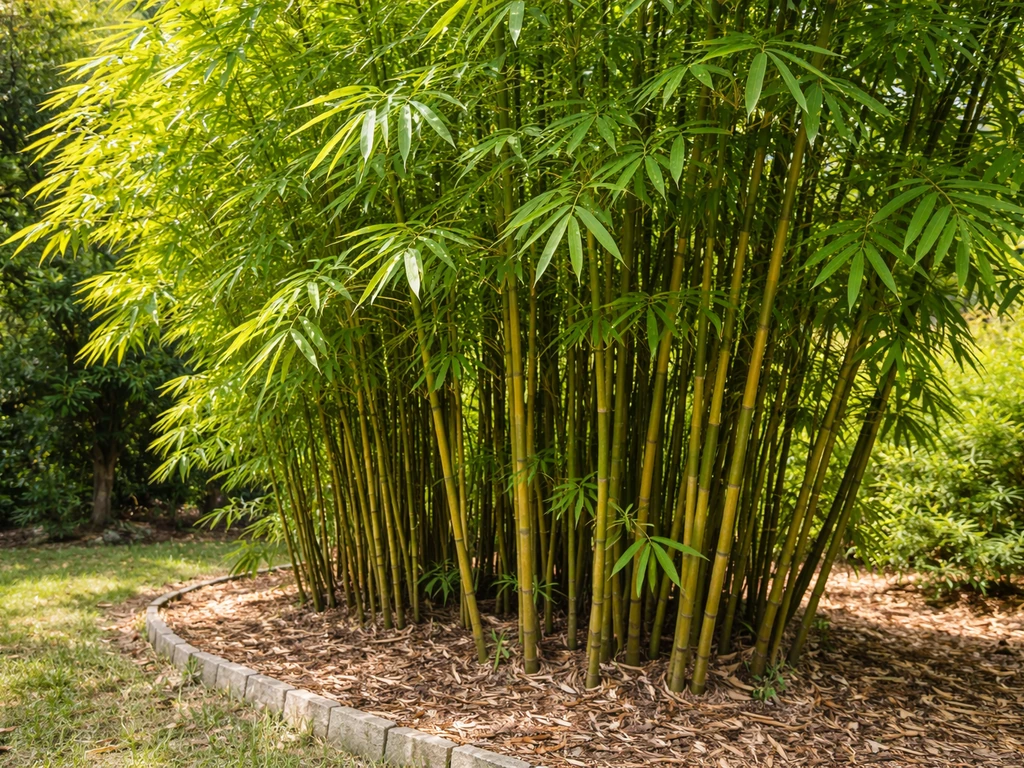
Title: Does Kelp Grow Faster Than Bamboo? Growth Rates Compared
Does Kelp Grow Faster Than Bamboo? Clear Growth Rates
Marcus Hartwell
22 Jul 2026
Description: Kelp vs bamboo growth rates compared with real numbers. See which grows faster, why the answer is complicated, and what it means for gardeners.
Quick answer: does kelp grow faster than bamboo?
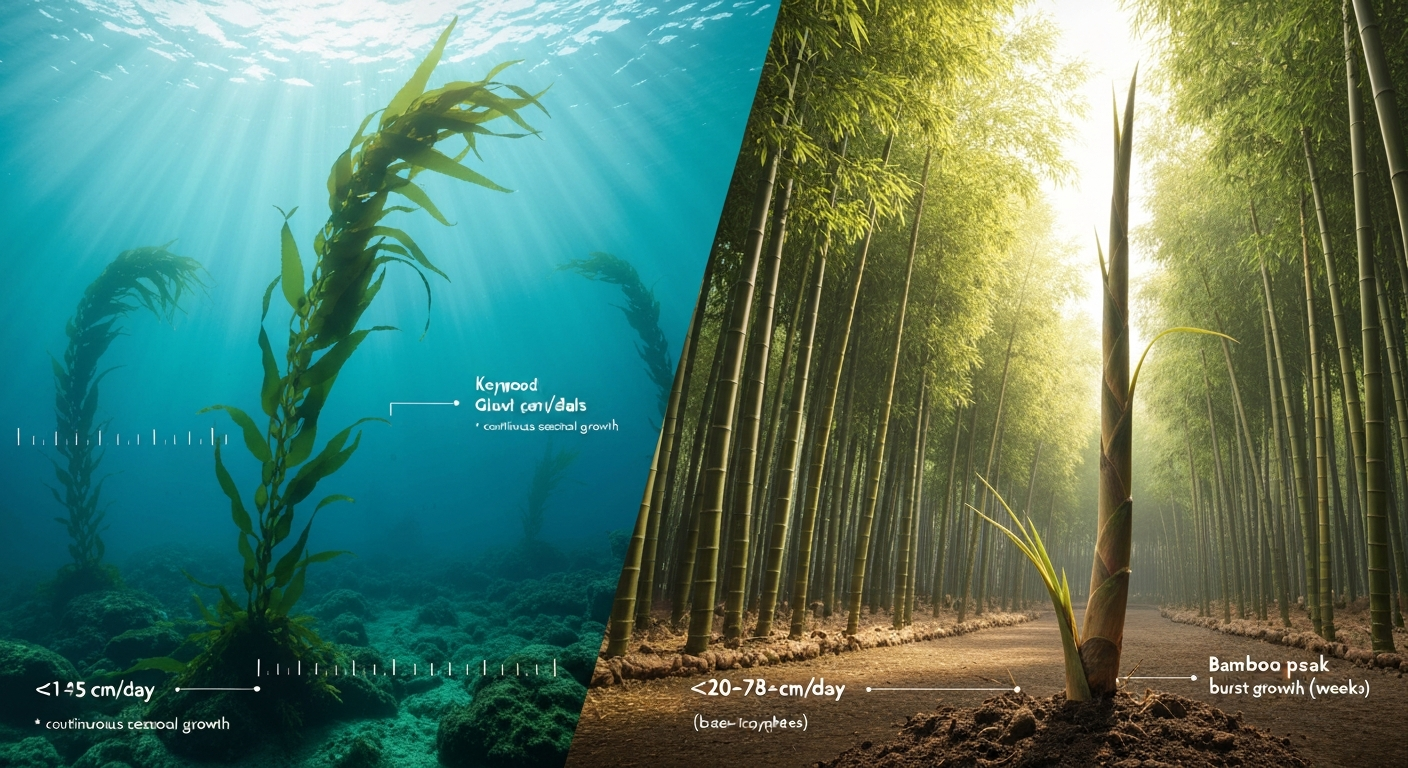
Under ideal conditions, bamboo wins. Peak daily elongation measurements for Moso bamboo (Phyllostachys edulis) during its shooting phase have reached 61 to 78 cm per day, with some historical records pushing past 90 cm in a single 24-hour period. Giant kelp (Macrocystis pyrifera) frond elongation typically runs 1 to 25 cm per day in the field, with exceptional peaks reported up to around 35 cm per day. So the fastest bamboos, during their brief explosive growth window, outpace even the fastest kelp. That said, kelp grows continuously across a long season in a way bamboo does not, and the comparison depends heavily on which species, which measurement method, and which growing conditions you use as your baseline. The full picture is worth understanding.
What is kelp?
Kelp is not a plant. That distinction matters when you are comparing it to bamboo. Kelp is a large brown macroalga belonging to the order Laminariales, within the class Phaeophyceae. Giant kelp specifically, the species most commonly cited in growth-rate comparisons, is Macrocystis pyrifera, a species so distinct it is treated as a monospecific genus on its own. It grows in cold, nutrient-rich coastal waters and can form towering submarine forests reaching 30 to 45 metres from the seafloor to the ocean surface.
Kelp lacks roots, stems, and leaves in the botanical sense. Instead it has a holdfast (which anchors it to rock), a stipe (the stem-like structure), and fronds (the blade-like photosynthetic tissue). Growth happens primarily at a meristem near the base of each frond, meaning the oldest tissue is at the tips and the newest is near the stipe. This is the opposite of how most terrestrial plants grow and it is one reason kelp responds so quickly to changes in light and nutrients.
Not all kelp is giant kelp. Species like Nereocystis luetkeana (bull kelp) and Lessonia spp. grow much more slowly. Short-term studies of juvenile Nereocystis report stipe elongation maxima of roughly 6 cm day−1, with some observations up to about 14 cm day−1 (blank" rel="noopener noreferrer">Scaling and Structural Properties of Juvenile Bull Kelp (Nereocystis luetkeana)). Field monitoring of bull kelp blade growth across multiple sites and years has recorded mean rates ranging from roughly 0.8 to 8.3 cm per day depending on site and season, while Lessonia blade elongation has been measured at just 0.08 to 0.65 cm per day in some seasonal studies. Other kelp genera show much lower elongation rates: Lessonia blade elongation measured seasonally ranged ~0.08–0.65 cm day−1 (species- and season-specific measurements reported in Laminariales studies) blank" rel="noopener noreferrer">Seasonal measurements for Lessonia blade elongation ranged from about 0.08 to 0.65 cm day−1 (Growth and loss of distal tissue in blades of Lessonia nigrescens and Lessonia trabeculata, 2005).. When people say 'kelp is the fastest growing organism on Earth,' they are almost always referring to Macrocystis pyrifera under optimal conditions, not kelp as a category.
What is bamboo?
Bamboo is a grass, not a tree. Taxonomically, bamboos belong to the subfamily Bambusoideae within the family Poaceae (the grass family), and the group contains roughly 1,600 to 1,700 species across 120 to 125 genera. The species relevant to fast growth comparisons fall mainly into two groups: the temperate woody bamboos (genera like Phyllostachys and Fargesia, which include the famous Moso bamboo and most cold-hardy garden species) and the tropical woody bamboos (genera like Bambusa and Dendrocalamus, which dominate warmer climates and commercial plantations).
What makes bamboo genuinely unusual among grasses is the way its above-ground culms are produced. A new shoot emerges from the rhizome system already containing all the internodes it will ever have, pre-formed inside the shoot casing. Growth is not the creation of new tissue from the tip, it is the rapid elongation of those pre-formed internodes, one after another from base to tip, driven by intercalary meristems within each node. This is why bamboo can put on dramatic height in a matter of weeks and why the growth feels so explosive. The full culm height, diameter, and wall thickness are essentially set by the time the shoot pokes above ground.
It is also why bamboo growth varies so much across species and conditions. Fargesia species (the clumping bamboos popular in cool-climate gardens) expand gradually and stay compact, with annual clump growth measured in decimeters rather than meters. Phyllostachys species (running bamboos) can produce culms several meters tall in a single shooting season. Tropical Bambusa and Dendrocalamus species grown in warm, humid conditions represent yet another performance tier. Comparing 'bamboo' as a single thing to kelp is like comparing 'seaweed' as a single thing to bamboo, species choice is everything.
How growth is measured: units and methods
Before diving into the numbers, it helps to understand that kelp and bamboo growth are measured in fundamentally different ways, and that difference can make comparisons misleading.
Measuring kelp growth
The standard method for measuring kelp frond elongation is called hole-marking or tag-and-measure. Researchers punch a small hole or attach a tag at a fixed distance from the meristem, then return after a set number of days and measure how far the hole or tag has moved. Because growth happens at the base, the hole travels upward as new tissue forms below it. This gives elongation in centimetres per day (cm day−1) or relative elongation rate (RER), expressed as the natural log of the ratio of final to initial length divided by elapsed time. Biomass productivity is sometimes reported separately, in grams of carbon per square metre per year (g C m−2 yr−1), which reflects the whole-forest production rather than single-frond elongation.
Measuring bamboo growth
Bamboo shoot growth is most commonly measured by marking a fixed point on a culm (often with paint or a physical stake reference) and recording height at regular intervals, typically daily or every few days during peak shooting phase. Results are reported as cm per day during active growth, metres per season, or metres per year for the mature culm. Annual culm production for whole stands is sometimes expressed in tonnes of dry biomass per hectare per year in forestry and plantation contexts, which is the equivalent of the kelp productivity measure but on land. The key caveat: bamboo's cm-per-day rates are measured during a brief, explosive window (usually four to eight weeks) and are not maintained year-round.
Kelp growth rates: what the research actually says
Field studies of Macrocystis pyrifera in Baja California have measured seasonal 100-day averages of 12.8 to 20.8 cm per day, which is already impressive. Short-term peaks in field and cultivation studies are commonly reported up to around 35 cm per day, with some summary literature citing exceptional single-day observations in the range of 45 to 60 cm per day, though those upper figures come with thin methodological documentation and should be treated as extreme outliers rather than representative performance.
What kelp does that bamboo absolutely cannot is sustain growth across a whole season. A Macrocystis frond is not racing to full height in four weeks and then stopping. It is elongating continuously, adding new tissue day after day for months as long as water temperature stays below roughly 18 to 20°C and dissolved nitrate stays above about 1 µM. In southern Monterey Bay, daily canopy-area net primary production has been measured at up to roughly 7 g of carbon per square metre per day for a dense kelp canopy. That is sustained biological productivity at a remarkable rate. Marine heatwaves disrupt this pattern severely, reducing juvenile Macrocystis growth and survival measurably, which is one reason kelp forests are considered sensitive indicators of ocean warming.
The critical context for gardeners: you cannot grow kelp. It requires cold, nutrient-upwelled ocean water, a rocky substrate, and a specific salinity and light environment. These numbers are interesting for the comparison, but they have no practical application to what you plant in your yard or pot.
Bamboo growth rates: what the research actually says
Modern experimental work on Moso bamboo shoots has recorded daily height increments with measured peaks of 61 to 78 cm per day over multi-day intervals during peak shooting phase. One study recorded a first peak of 77.8 cm per day, with sustained high rates in the 61 to 78 cm per day range during the fastest phase. Historical records push higher: a measurement at Kew Gardens in 1855 recorded 91.3 cm of growth in 24 hours for a Bambusa specimen, and reports from Japan in the late 19th and mid-20th centuries documented single-day maxima ranging from roughly 88 to 121 cm. Those historical figures have limited methodological documentation and represent extreme single-observation events, but they are consistent with the biology of intercalary elongation during peak shooting.
In practical garden settings, the numbers are more modest and depend heavily on species, climate, and establishment age. Temperate Phyllostachys species in warm, well-watered garden plots can produce culms of 1 to 5 metres or more in a single shooting season, with daily rates averaging tens of centimetres per day at peak. Tropical Bambusa species in warm climates can be faster per shoot but behave differently in terms of rhizome spread. Clumping Fargesia species, which are popular in cool temperate gardens (and relevant for gardeners in cooler parts of Australia or the UK), grow much more conservatively, with annual clump expansion measured in decimetres. If you are thinking about bamboo for screening or fast privacy, species selection matters more than any headline growth-rate figure. How fast bamboo grows in a pot, for instance, is a very different question from its growth in open ground, and establishment year performance is typically far below peak.
Head-to-head comparison: kelp vs bamboo growth
| Attribute | Giant Kelp (Macrocystis pyrifera) | Moso Bamboo (Phyllostachys edulis) | Notes |
|---|---|---|---|
| Organism type | Brown macroalga (not a plant) | Woody grass (subfamily Bambusoideae) | Fundamentally different biology |
| Typical daily elongation (field) | ~1–25 cm/day | ~20–78 cm/day (shooting phase only) | Kelp is continuous; bamboo is episodic |
| Reported field averages | ~12.8–20.8 cm/day (seasonal 100-day avg, Baja California) | Commonly 20–50 cm/day at peak shooting | Both are site- and condition-specific |
| Reported peak maxima | Up to ~35 cm/day (well-documented); ~45–60 cm/day cited as outliers | ~78 cm/day (modern experiment); ~91–121 cm/day (historical records) | Historical records have limited methodology detail |
| Growth duration (per year) | Continuous across growing season (months) | 3–8 weeks of rapid shoot elongation, then stops | Kelp sustains rate; bamboo bursts then stabilises |
| Annual height/length produced | Up to 30–45 m total canopy height (mature forest) | 2–25 m new culm height per shoot in one season (species-dependent) | Different contexts; kelp in ocean, bamboo on land |
| Growth measurement method | Hole-marking / tag-and-recapture on fronds | Stake reference + daily height recording of culm | Both use linear elongation in cm/day |
| Key environmental requirements | Cold ocean water (<18–20°C), high nitrate, rocky seafloor | Warm soil, adequate moisture, established rhizome | Kelp ungrowable in gardens |
| Canopy/stand productivity | ~800–3,000 g C/m²/yr (Macrocystis forest) | Varies widely; plantation Moso ~10–20 t dry biomass/ha/yr | Different productivity metrics; not directly comparable |
Reading that table straight, bamboo's peak daily elongation rates exceed kelp's measured field averages by a significant margin, and even kelp's well-documented peak figures (around 35 cm per day) fall short of what Moso bamboo does during prime shooting phase. But the table also reveals why the comparison is somewhat artificial. Kelp grows continuously for months; bamboo sprints for a few weeks and stops. Kelp's productivity measured across an entire forest is ecologically enormous. And kelp lives in an ocean, it is a completely different growth context to anything a gardener can create or compare to.
Why the environment changes everything
Both kelp and bamboo are extremely sensitive to environmental conditions, and the headline growth figures only occur when everything lines up correctly.
What drives kelp growth (and what kills it)
- Water temperature: Most temperate kelp species grow best below about 18–20°C. Above that threshold, growth rates decline and mortality increases, particularly for juveniles during marine heatwave events.
- Nitrate availability: Growth in southern California kelp forests has been shown to become nutrient-limited below roughly 1 µM dissolved nitrate. Upwelling events that flush cold, nutrient-rich water into kelp zones trigger growth pulses.
- Light penetration: Kelp growth is depth-limited by light attenuation. Turbid water, algal blooms, or canopy shading above can all reduce available light at the meristem.
- Water motion: Wave exposure and current affect nutrient delivery to fronds and mechanical stress on stipes, both of which influence growth and survival.
What drives bamboo growth (and what limits it)
- Soil temperature and air temperature: Shooting is triggered by warming soil temperatures in spring (for temperate species) or by seasonal rainfall in tropical climates. Cold soil dramatically delays and reduces shooting.
- Rhizome establishment: A bamboo plant in its first one to two years is building underground rhizome mass, not producing impressive above-ground culms. The 'year one sleep, year two creep, year three leap' pattern is real and well-documented.
- Moisture availability: Bamboo needs consistent moisture during shooting phase. Water stress during that critical window stunts culm height permanently — you cannot recover lost height in a bamboo culm once shooting is complete.
- Soil nutrients: Nitrogen particularly affects shoot production and culm height. Well-composted, fertile soil with a slightly acidic to neutral pH produces measurably taller culms than nutrient-poor conditions.
- Container or pot growth: Bamboo grown in pots is constrained by root volume and available soil moisture. Pot-grown bamboo can thrive and even produce impressive culms, but maximum heights and growth rates are lower than in-ground performance.
- Latitude and climate: Bamboo performance in a warm, humid climate like coastal Queensland or southern China looks nothing like performance in a cool temperate region. Species matched to local climate conditions consistently outperform species grown at the edge of their tolerance range.
Setting realistic expectations as a gardener
If you are reading this because you want to grow something fast, bamboo is genuinely one of the fastest options available to land-based gardeners. But the numbers that circulate online, '90 cm in a day,' 'fastest growing plant on Earth', describe peak performance under optimal conditions in established plants during a narrow window. Your first-year bamboo will not do that. Your second-year bamboo might not either. By year three or four in suitable conditions with the right species, you may well see shooting-phase daily growth that astonishes you. The key variables are species selection, climate match, soil preparation, and patience during establishment.
If you are growing bamboo in a pot, results will be slower than in-ground performance but absolutely achievable for screening and ornamental purposes. A container-grown Phyllostachys or Bambusa in a large pot with good watering and feeding can produce several new culms each season, gradually building an impressive specimen over three to five years. For gardeners in warmer climates, including much of coastal and subtropical Australia, tropical and subtropical bamboo species often outperform the temperate species that dominate northern hemisphere gardening guides, so local species recommendations matter. For region-specific growth rates and species recommendations, see how fast does bamboo grow in Australia. For region-specific advice, see does bamboo grow in Australia for species recommendations and local growing tips.
It is also worth putting bamboo's speed in perspective against trees. For a focused comparison on that topic, see the article 'does bamboo grow faster than trees' which examines growth rates, lifecycle differences, and long-term height outcomes. Bamboo does not build woody trunk tissue over decades the way a tree does. Its culms reach full height in weeks, but they do not add girth or height in subsequent years. A fast-growing tree species can exceed bamboo's total canopy height given enough years. Bamboo's advantage is not lifetime growth, it is the speed at which it produces usable screening height and the efficiency with which it does so in a relatively small footprint.
Bamboo vs trees vs kelp: putting the numbers in context
Kelp, bamboo, and fast-growing trees all claim 'fastest growing' status in various sources, and the reason is that each claim is measured differently and under different conditions. Kelp's continuous daily elongation rates are impressive but apply only in the ocean. Bamboo's peak shooting-phase rates are genuinely extraordinary but last only weeks. Fast-growing trees like eucalypts and paulownias can put on 2 to 5 metres per year over multiple consecutive years, which on a per-year basis competes seriously with many bamboo species in non-peak conditions. The honest answer is that 'fastest' depends entirely on the timeframe, the metric, and the species you choose.
What this means if you are deciding whether to plant bamboo
Plant bamboo if speed of screening, texture, sound, or a tropical-feel aesthetic is the goal, it delivers on those fronts better than almost any other land plant in the right conditions. Do not plant it expecting to match the kelp-style headline figures in year one, and do not choose a species based on extreme records without checking whether that species suits your climate and site. Moso bamboo, which holds many of the peak growth records, is a large-scale timber bamboo that needs space and warm conditions to perform well. For most suburban gardens, a well-chosen Phyllostachys, Bambusa, or (in cool climates) Fargesia species will give you the combination of growth speed, containability, and visual impact you are actually after.
The kelp comparison is genuinely interesting from a biological standpoint, but it does not change the practical calculus of what to plant. Bamboo remains one of the most impressively fast-growing organisms you can actually cultivate on land, and understanding why it grows the way it does, episodic, rhizome-powered, species-specific, is the foundation for getting the best out of it in your own garden.
FAQ
Concise answer: does kelp grow faster than bamboo?
Short answer: It depends on how you compare them. On a per‑day elongation basis, giant kelp (Macrocystis pyrifera) and the fastest bamboo species (e.g., Moso/Phyllostachys and some tropical Bambusa) overlap: kelp blades commonly elongate ~1–25 cm/day in field studies with reported cultivation peaks up to ~35 cm/day (exceptional single‑day records higher), while fast bamboo culms have measured peak shoot elongation commonly in the range ~50–78 cm/day in modern studies and historical single‑day reports even higher. So the fastest bamboos can outpace most kelp on peak daily elongation, but typical kelp days and many garden bamboos are comparable. Variability by species, environment and measurement method is large, so neither group is uniformly “faster.”
What are kelp and bamboo (simple definitions)?
Kelp: a common name for large brown marine macroalgae in the order Laminariales (class Phaeophyceae). Giant kelp currently treated as Macrocystis pyrifera is a fast‑growing canopy kelp species that forms underwater forests. Bamboo: common name for members of the grass subfamily Bambusoideae (Poaceae). Bamboo includes ~1,600–1,700 species across temperate woody (e.g., Phyllostachys, Fargesia) and tropical woody (e.g., Bambusa, Dendrocalamus) genera; many are fast‑growing, clumping or running perennial grasses that form woody culms.
Measured growth‑rate ranges and reported maxima — kelp (representative values)
Representative measured ranges for kelp elongation (frond/blade or stipe): - Macrocystis pyrifera (giant kelp): commonly ~1–25 cm/day in field studies; seasonal/field averages often ~8–21 cm/day at productive sites; cultivation/experimental peaks reported up to ~35 cm/day, with occasional exceptional single‑day historical records cited higher. - Nereocystis luetkeana (bull kelp): site/season means reported from ~0.8 to ~8.3 cm/day (blades) with stipe values showing similar site‑to‑site variation; episodic peaks can be higher. - Lessonia spp. and other kelps: much lower blade elongation in many studies (e.g., ~0.08–0.65 cm/day for some Lessonia measurements). Caveats: values vary by site, time of year, nutrient and light conditions, measurement interval and whether studies measure canopy vs juvenile fronds.
Measured growth‑rate ranges and reported maxima — bamboo (representative values)
Representative measured ranges for bamboo culm (shoot) elongation: - Fast tropical/temperate woody bamboos (e.g., Moso Phyllostachys edulis): modern studies report peak daily increases in the range ~61–78 cm/day during the rapid shooting phase; sustained multi‑day peak intervals have been measured in that range. - Other fast Bambusa/Phyllostachys species: many report tens of cm/day at peak (commonly 20–60 cm/day) during the brief shoot period. - Garden/temperate species and clumpers (Fargesia and slower Phyllostachys): daily peak rates are lower and clump expansion measured per season is often in decimeters to a few meters. Caveats: most final culm height is made during a short shooting window (weeks), and historical single‑day exceptional records (e.g., >90 cm/day) exist but lack methodological detail.
Head‑to‑head comparison table (plain text)
Measure | Typical range (field) | Reported peak(s) | Notes Kelp (Macrocystis pyrifera) | ~1–25 cm/day | cultivation/field peaks up to ~35 cm/day (exceptional reports higher) | Continuous canopy frond elongation; influenced by light, nutrients, depth Bull kelp (Nereocystis) | ~0.8–8 cm/day | episodic higher short‑term peaks | large spatial/temporal variability Slow kelps (Lessonia etc.) | ~0.08–0.65 cm/day | lower maxima | species dependent Fast bamboo (Moso & fast Bambusa/Phyllostachys) | tens of cm/day during shoot phase | measured peaks ~61–78 cm/day (modern); historical single‑day records >90 cm/day | most height gained in brief shooting period (weeks) Garden clumpers (Fargesia, many Bambusa) | lower daily peaks; seasonal height in meters | lower maxima than fastest running species | clump habit limits spread Explanation: On per‑day elongation peaks, the fastest bamboos can exceed typical kelp days; many kelp days overlap with garden bamboo rates. Differences in life history (continuous elongation vs a short shooting window), measurement method, and environment make direct comparisons context‑dependent.
Why raw cm/day numbers don’t tell the whole story
Raw elongation rates ignore important context: - Timeframe: kelp can elongate continuously throughout the growing season while bamboo puts on most height during a short shooting pulse. Comparing a single fast day of bamboo to a typical kelp day misses seasonality. - Units and biomass: a cm/day of kelp blade is different tissue and biomass than a cm/day of bamboo culm (woody material). - Measurement methods: mark‑and‑recapture on fronds vs daily shoot height logging can produce different apparent rates. - Environmental constraints: nutrient upwelling, water motion and temperature control kelp growth; soil, moisture, and rhizome energy reserves control bamboo shooting. Therefore use multiple metrics (daily elongation, seasonal height or annual biomass) for meaningful comparisons.
Next Article
Does Bamboo Grow in Australia? Where and How to Grow It
Find out if bamboo grows in Australia and where, plus step by step tips to grow and contain it outdoors or indoors.