No, bamboo is not a prickly fruit. Bamboo is a grass, not a fruit-bearing plant in any everyday sense of the word. It belongs to the subfamily Bambusoideae within the grass family Poaceae, and while it can technically produce a seed-containing fruit called a caryopsis, that happens rarely, briefly, and bears no resemblance to the spiky fruits people might picture. The 'prickly' association likely comes from handling experience, bamboo does have sharp leaf edges, stiff branch tips, and jagged cut ends that can scratch or splinter. But those are mechanical hazards, not botanical thorns or fruit structures. If you're growing bamboo in a garden and wondering whether it's dangerous, edible, or just misunderstood, here's everything you need to know.
Is Bamboo a Prickly Fruit in Grow a Garden? Quick Guide

What bamboo actually is, a quick botanical reality check
Bamboo is a grass. Specifically, it belongs to Bambusoideae, one of the subfamilies of Poaceae, the grass family. There are roughly 1,600 to 1,700 described bamboo species spread across around 136 genera worldwide, making it a remarkably diverse group. What sets bamboo apart from your lawn grass is its woody culms (the hollow canes you're familiar with), its rapid growth potential, and its unusual reproductive strategy.
Unlike most plants, bamboo does not flower and set seed on a regular annual cycle. Many species flower once every several decades, sometimes at 20-year, 60-year, or even 120-year intervals, then often die after that mass seeding event. This is called gregarious or mast flowering, and reviews compiling over 600 bamboo flowering records confirm just how unpredictable and species-specific these cycles are. The takeaway for home gardeners: you are almost certainly never going to see your bamboo flower. What you'll observe instead are vegetative shoots pushing up from rhizomes underground, which is how bamboo spreads and sustains itself in practice.
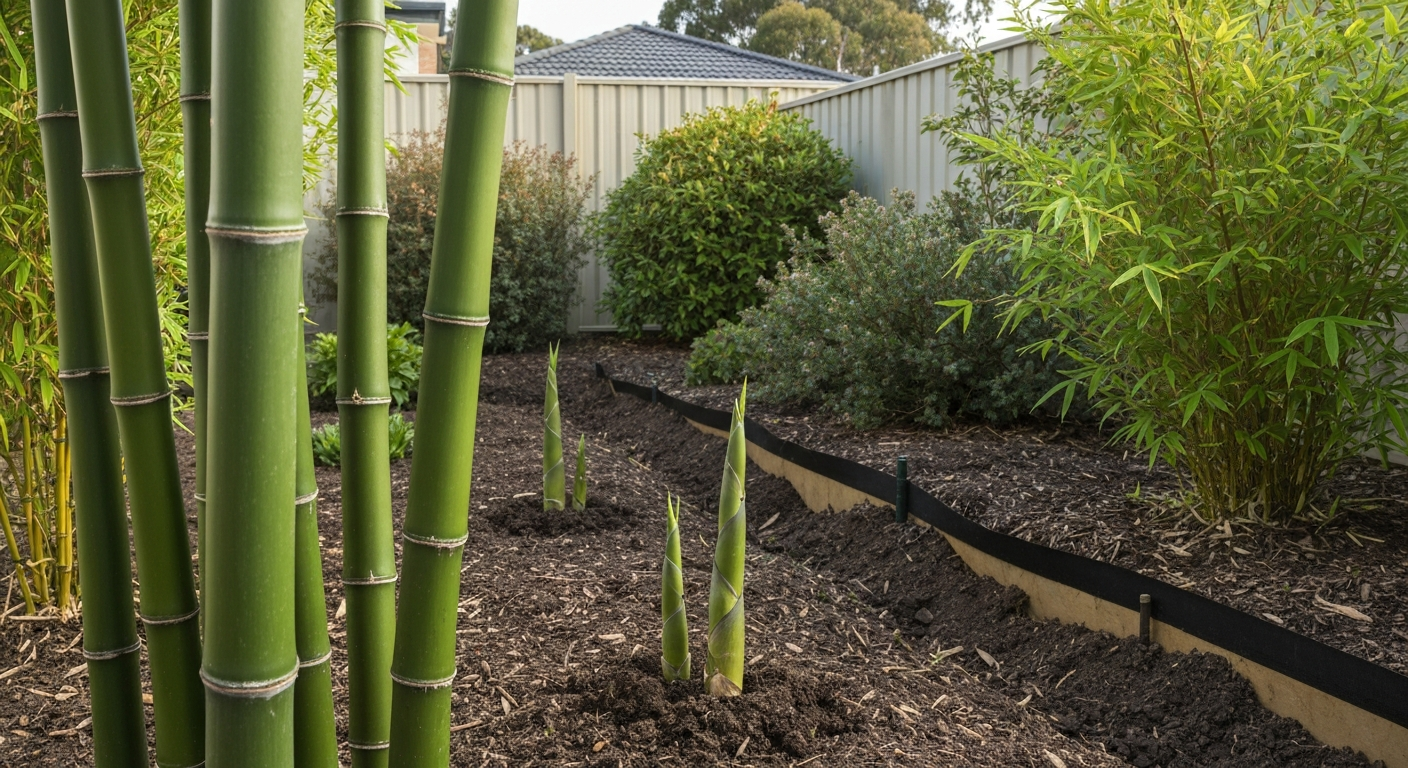
The bamboo 'shoot' that people eat or that emerges in spring is simply a new culm in its early growth stage. It is not a fruit. It is not a seed. It is a vegetative stem emerging from the root system. Understanding this distinction matters a lot once you start thinking about edibility, safety, and garden management.
Does bamboo produce fruit or thorns?
Technically, yes, bamboo can produce fruit. But probably not in the way you're imagining. The botanical fruit of grasses, bamboo included, is called a caryopsis: a dry, one-seeded structure in which the seed coat is fused to the outer pericarp layer. In most bamboos, this is a small, dry grain-like thing, functionally similar to a wheat or rice grain, which makes sense given that they're all in the same plant family.
A small handful of bamboo genera do produce something meatier. Melocanna, Dinochloa, Melocalamus, and Sphaerobambos are among the exceptions, bearing what botanists call baccate or bacciform caryopses, essentially thickened, fleshy fruits that look more like berries than typical grass seeds. Melocanna baccifera is the most documented example; its massive, irregular flowering events in northeast India are historically linked to rodent population explosions and crop failures known as Mautam events, because the fruit crops feed rats in enormous numbers. But you are almost certainly not growing Melocanna baccifera in your suburban garden.
As for thorns: most bamboos do not have them. Thorns and prickles are epidermal structures found in plants like roses and hawthorns. The vast majority of ornamental bamboos you would plant at home, species from genera like Phyllostachys, Fargesia, or Pleioblastus, have no thorns whatsoever. That said, a minority of tropical Bambusa species, including Bambusa bambos and Bambusa blumeana, are genuinely described in botanical literature as spiny or thorny, with branch tips modified into hard, sharp points capable of puncturing skin. These species are more common in tropical agricultural or forestry contexts than in temperate home gardens, but it's worth knowing they exist.
The parts of bamboo that are actually sharp or abrasive
Even without thorns, bamboo can absolutely hurt you if you handle it carelessly. The sharpness you feel around bamboo is real, it's just not coming from thorns or fruit. Here's where the hazards actually live:
- Leaf margins: bamboo leaves contain silica phytoliths — microscopic mineral deposits that stiffen and sharpen the leaf edges. Running your fingers along a bamboo leaf the wrong way is a reliable way to get a thin, stinging cut.
- Lower branch stubs and branch tips: as culms mature, the lateral branches get stiff. Trimmed or naturally broken branch stubs on older culms can be hard and pointed enough to poke through skin.
- Cut culm ends: a freshly cut bamboo culm end can be almost razor-sharp, especially on larger-diameter species. This is where most garden injuries happen — accidental contact with cut ends at eye level or while crouching.
- Splinters: bamboo splinters differently from wood. The fibrous, silica-rich culm walls can produce long, thin splinters that are difficult to see and tend to break off under the skin.
- Dried sheaths and leaf debris: old bamboo sheaths that drop from the culm and dried leaf litter are abrasive and can irritate skin during raking or cleanup, particularly if you're bare-handed.
None of these are botanical prickles in the rose sense, they're mechanical hazards produced by the plant's physical structure and silica content. But they're genuinely worth respecting, especially when you're doing maintenance work like cutting, thinning, or harvesting culms.
Garden implications: edibility, irritation risks, and safe cleanup
Eating bamboo shoots safely
Young bamboo shoots are edible across many species and are a staple food in large parts of Asia. But there's an important caveat: raw shoots from most species contain cyanogenic glycosides, particularly taxiphyllin, which can release cyanide when metabolized. You should never eat bamboo shoots raw straight from the ground. Slicing and boiling the shoots in fresh water, changing the water at least once during cooking, substantially reduces cyanide content to safe levels. Traditional preparation methods like fermentation also achieve this. The risk isn't reason to panic, but it is reason to process properly before eating, especially with varieties like Phyllostachys edulis (moso bamboo) which are popular for harvest.
Allergy and skin irritation
If your bamboo ever does flower, be aware that bamboo pollen belongs to the Poaceae grass-pollen complex, which is one of the most common causes of seasonal allergic rhinitis globally. People already sensitized to grass pollen may react to bamboo pollen. This is a rare concern in most gardens since flowering is so infrequent, but if you're working around a bamboo stand that has flowered, a mask is a reasonable precaution if you know you have grass pollen sensitivity.
Contact dermatitis specifically attributed to bamboo is not well-documented in clinical literature. The more common skin issue is simple mechanical irritation from silica-laden leaves and sheaths, which can cause itching or redness after prolonged exposure, much like working with fiberglass insulation. Wear long sleeves and gloves during heavy pruning or raking work.
Wound care and tetanus
Bamboo puncture wounds deserve the same treatment as any other puncture wound. Clean thoroughly, watch for signs of infection, and make sure your tetanus vaccination is current. Tetanus boosters are recommended every 10 years for adults, and a dirty puncture wound is exactly the scenario where you want to be up to date. Don't dismiss a bamboo splinter or cut end puncture as trivial just because it's from a plant.
Regrowth: what happens after you cut bamboo
One of the most common questions from new bamboo growers is whether bamboo grows back after cutting. It absolutely does, and understanding why shapes your entire management approach. Bamboo spreads and regenerates from its rhizome system, the horizontal underground root network. When you cut a culm, that individual cane is gone and won't regrow. But the rhizomes remain active and will push up new shoots in spring, often more vigorously in subsequent seasons than the first year after planting.
The one exception to robust regrowth is after gregarious flowering. Many bamboo species die following a mass flowering event, because the plant exhausts its stored energy to produce seeds. The rhizomes themselves can die, meaning the grove does not recover the way it would after routine cutting. This is well-documented in species like Phyllostachys bambusoides and multiple Fargesia species. If you have a stand that flowered and appears to be dying, it may be undergoing this natural monocarpic die-off rather than suffering from disease or drought.
Containment and moving bamboo: what actually works
Before you plant bamboo, the single most important decision you'll make is whether you're planting a running or clumping type. Running bamboos (mostly Phyllostachys and Pleioblastus) spread aggressively via long horizontal rhizomes and can invade neighbouring properties within a few years without containment. Clumping bamboos (mostly Fargesia and Bambusa in temperate climates) expand slowly outward from their central mass and are far easier to manage in a typical residential garden.
For running bamboos, install an HDPE (high-density polyethylene) root barrier at least 60 to 90 cm (24 to 36 inches) deep, leaving 5 to 8 cm above the soil surface so rhizomes can't sneak over the top. Inspect the perimeter every spring and sever any escaping rhizomes before they establish. This is a non-negotiable step, not an optional upgrade.
Moving established bamboo is possible, but it requires timing and physical effort. Spring, just as new shoots are starting to emerge, is the best window, the plant is metabolically active and recovers well. For clumping types, dig out a section that includes a good chunk of rhizome and at least a few attached culms. Cut back the top growth by roughly one-third to reduce moisture stress on the disturbed root system. For running types, you can cut out a rhizome section, but expect the original plant to send up new shoots from remaining rhizomes, one transplanting doesn't remove the stand.
Watering, fertilizing, and everything in between
Do sprinklers work on bamboo?
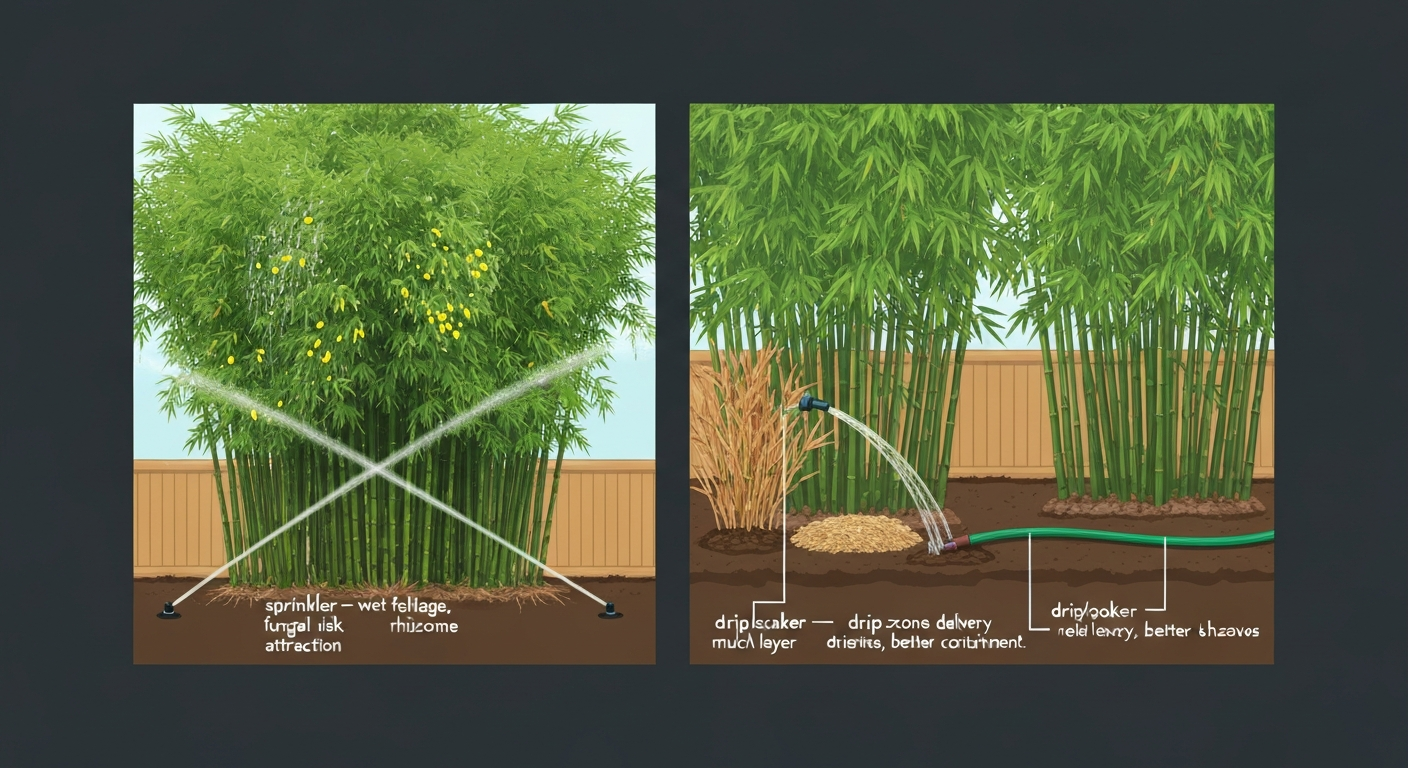
Overhead sprinklers can work for bamboo, but they're not the ideal setup. Bamboo generally wants consistent moisture at the root zone, not wet foliage. In humid climates, overhead watering can encourage fungal issues on culms and leaves. Drip irrigation or soaker hoses that deliver water at the base are more efficient and reduce foliar moisture. That said, if you're already running sprinklers for a lawn or mixed garden and your bamboo is in the zone, it will usually cope fine as long as drainage is adequate. Standing water around bamboo roots (wet feet) is the real danger, bamboo does not tolerate waterlogged soil and will show yellowing, culm dieback, and root rot if drainage is poor. Make sure your soil drains well regardless of your irrigation method.
Is Miracle-Gro good for bamboo?
Bamboo has a high nitrogen demand, particularly during the active growing season in spring and early summer when new shoots and culms are forming. Miracle-Gro products that are nitrogen-forward (the standard all-purpose formula is 24-8-16, for example) can absolutely be used on bamboo and will produce a visible response in new shoot vigor and leaf color. Apply according to label directions during the active growing months, roughly March through July depending on your climate, and taper off or stop fertilizing by late summer. Late-season nitrogen fertilization pushes tender new growth that won't harden off before winter in temperate zones, leaving it vulnerable to frost damage. A slow-release granular formula applied once in spring is a lower-maintenance alternative to liquid feeding and tends to produce more even growth.
Is bamboo a tropical plant? Climate and variety notes
Bamboo is not exclusively tropical. This is one of the most persistent misconceptions I encounter. There are both tropical and temperate bamboo species, and their climate requirements differ substantially. Tropical species like Bambusa vulgaris or Dendrocalamus asper are frost-sensitive and suited to USDA zones 9 to 12. Temperate species, particularly many Fargesia and Phyllostachys species, are genuinely cold-hardy, with some Fargesia varieties tolerating temperatures down to -20°C (-4°F) or lower, placing them squarely in zones 5 or 6. Before choosing a species, match it to your hardiness zone rather than assuming bamboo means tropical.
Within the ornamental bamboo world, rainbow bamboo (typically referring to Phyllostachys aureosulcata 'Spectabilis' or similar yellow-grooved/striped varieties) is popular but not especially rare in the horticultural trade. However, in the context of the gardening game 'Grow a Garden,' rainbow bamboo is treated as a rare item. True variegated and colour-streaked bamboo species exist in the real world too, though they can be harder to source from specialist nurseries than standard green varieties.
The largest bamboo species in the world is Dendrocalamus sinicus, native to Yunnan province in China and parts of Southeast Asia, with culms documented at up to 37 metres (about 121 feet) tall and diameters of 30 cm (around 12 inches). For most home gardens, giant species like Phyllostachys edulis (moso) reaching 15 to 20 metres under good conditions are more relevant as an upper limit.
Comparing running vs. clumping bamboo for home gardens
| Feature | Running Bamboo (e.g., Phyllostachys) | Clumping Bamboo (e.g., Fargesia) |
|---|---|---|
| Spread behavior | Aggressive lateral rhizomes, can spread metres per year | Slow, compact outward expansion from central mass |
| Containment needed? | Yes — root barrier essential | Usually not required |
| Cold hardiness | Many species hardy to zone 5–6 | Some species hardy to zone 5 or below |
| Growth height | Can reach 5–20 m in many species | Generally 2–5 m for most ornamental types |
| Transplanting ease | Moderate — rhizomes re-establish readily | Easier — compact root mass moves cleanly |
| Thorny species risk | Low — most are non-spiny | Very low |
| Best garden use | Screening, large properties with barrier | Small gardens, containers, urban settings |
Planting checklist: before you put bamboo in the ground
- Choose running or clumping based on your space and willingness to manage containment.
- Match the species to your USDA hardiness zone — confirm the variety's cold tolerance before purchasing.
- Select a site with full sun to partial shade and well-draining soil. Avoid low-lying areas where water pools.
- Test soil pH: bamboo prefers a range of 5.5 to 6.5. Amend with sulfur to lower pH or lime to raise it if needed.
- If planting a running type, install an HDPE rhizome barrier at least 60–90 cm deep before planting.
- Dig a hole roughly twice the width of the root ball and amend the backfill with compost to improve drainage and nutrition.
- Water thoroughly at planting and keep consistently moist for the first growing season — bamboo establishes slowly in year one.
- Apply a nitrogen-rich fertilizer (or slow-release granular) in early spring of year two onward. Avoid fertilizing in late summer or fall.
- Mulch the root zone with 5–8 cm of organic mulch to retain moisture and moderate soil temperature.
- Plan for first-year patience: most bamboo follows the maxim 'first year sleeps, second year creeps, third year leaps.'
Inspecting and handling bamboo safely
Whenever you're cutting bamboo, harvesting culms, or doing serious pruning work, treat it the way you'd treat any sharp yard material. Containing and Removing Bamboo (University of Maryland Extension), includes handling and control notes recommends using cut‑resistant gloves, long sleeves, and eye protection when cutting or harvesting culms, and advises prompt wound cleaning and ensuring tetanus boosters are current Containing and Removing Bamboo (University of Maryland Extension) — includes handling and control notes. The combination of hard culm ends, silica-sharp leaves, and the potential for splinters is enough to cause real injury if you're careless.
- Wear cut-resistant gloves — standard gardening gloves provide some protection but leather or reinforced gloves are better for heavy culm work.
- Long sleeves protect against leaf margin cuts and abrasive dried sheaths during raking and cleanup.
- Eye protection is worth it when cutting culms at any height — bamboo can spring back and sharp culm edges can be at face level.
- Use sharp loppers or a pruning saw rather than tearing or snapping culms, which increases splinter risk.
- After cutting, immediately trim any exposed culm ends that are at eye or face height in the remaining stand.
- If you get a splinter, remove it completely with tweezers, clean the wound thoroughly, and apply antiseptic. A bamboo splinter left in skin can cause infection.
- For puncture wounds, follow standard wound care and confirm your tetanus vaccination is current.
- Dispose of cut bamboo by bundling it and placing in green waste or chipping — loose bamboo pieces with sharp ends in a pile are a hazard for animals and bare feet.
Maintenance and what to expect long-term
Bamboo maintenance is not passive, especially for running types. Here is a realistic picture of what the seasonal cycle looks like once your stand is established:
- Spring (March–May in temperate zones): New shoots emerge rapidly — some species can add 30–90 cm per day in optimal conditions during this phase. Walk the perimeter of running bamboo to spot and cut escaping rhizomes. Apply fertilizer.
- Early summer: New culms harden off and reach their full height. Bamboo does not grow taller after the initial shoot season — a culm that emerged at 3 metres will stay at 3 metres. Prune lower branches for aesthetics and airflow.
- Late summer: Growth slows. Stop fertilizing. Check moisture — this is when drought stress shows up as yellowing or leaf curl.
- Autumn: Thin the stand by removing old, discolored, or damaged culms at ground level. Most stands look better with selective culling rather than leaving every culm in place.
- Winter: For temperate species, little visible activity above ground. Mulch the root zone in colder climates (zones 5–6) to protect rhizomes from hard freezes.
- Annual containment check: For running bamboo, probe the soil around the barrier annually to ensure no rhizomes have escaped over or under it.
Should you grow bamboo in your backyard?
Bamboo can be a genuinely excellent garden plant or a long-term headache, depending entirely on which species you choose and how prepared you are for its growth habits. Here's an honest breakdown:
| Consider it if... | Think twice if... |
|---|---|
| You want fast-growing privacy screening | You have small urban lot with no containment budget |
| You're in zone 5–9 and want a low-water screen once established | Your neighbours are close and you're planting a running type |
| You want a clumping type that stays manageable | You want zero maintenance — bamboo needs seasonal attention |
| You're willing to install a rhizome barrier upfront | You're expecting it to behave like a shrub and stay put |
| You want to harvest edible shoots from species like Phyllostachys edulis | You won't remember to process shoots before eating them raw |
| You like unusual ornamentals and have temperate climate options available | You live in zone 4 or below without cold-hardy variety availability |
My honest recommendation: go with a clumping Fargesia species for most residential gardens in temperate climates. They're cold-hardy, non-invasive, genuinely ornamental, and don't require the infrastructure of a barrier system. If you specifically want the dramatic height and fast screening of a running type like Phyllostachys, install the barrier before planting, not as an afterthought.
Quick answers to common bamboo questions
Does bamboo grow back after cutting? Yes. Individual culms don't regrow from the cut point, but the rhizome system produces new shoots each spring. The stand regrows unless the rhizomes are removed or the plant undergoes post-flowering die-off.
Do sprinklers work on bamboo? They work, but drip irrigation or soaker hoses at the root zone are more effective and reduce foliar disease risk. The priority is consistent root-zone moisture and good drainage, avoid waterlogged conditions.
Can you move bamboo? For step-by-step guidance on transplanting timing, how much rhizome to take, and aftercare, see can you move bamboo in grow a garden. Yes, and spring is the best time. Dig up a section with intact rhizome and several culms, cut back the top growth by a third, replant promptly, and keep it well-watered through the first season.
How rare is rainbow bamboo in Grow a Garden? In the game context, rainbow bamboo is a rare drop. In real-world horticulture, colourful-culmed and variegated bamboos exist but are generally available through specialist bamboo nurseries rather than standard garden centres.
Is bamboo a tropical plant? No, not exclusively. There are both tropical and temperate species. Many Fargesia varieties handle temperatures well below freezing, and several Phyllostachys species are reliably hardy in zones 5 and 6.
Is Miracle-Gro good for bamboo? Yes, particularly nitrogen-forward formulas applied in spring and early summer. Taper off fertilizing by late summer to avoid promoting frost-vulnerable new growth.
What is the biggest bamboo? Dendrocalamus sinicus holds documented records at around 37 metres tall with culms up to 30 cm in diameter. For garden-scale 'giant' bamboo, Phyllostachys edulis (moso) is more commonly encountered and can reach 15–20 metres under ideal conditions. For a fuller comparison and game-specific details, see what is the biggest bamboo in Grow a Garden.
What type of plant is bamboo? Bamboo is a grass, a member of the family Poaceae, subfamily Bambusoideae. It is not a tree, shrub, or fruit-bearing plant in the horticultural sense, even though its woody culms can reach tree-like heights.
Where to go from here
If this article has piqued your interest in growing bamboo, the most useful next steps are finding a reputable specialist bamboo nursery in your region and asking specifically about species proven in your hardiness zone. National bamboo societies in the US, UK, and Europe maintain lists of species with confirmed cold-hardiness data and can point you toward cultivars that have actually been tested in climates similar to yours, not just ones that theoretically should survive.
This site covers a range of related bamboo growing questions in depth, from understanding how bamboo regrows after cutting to the specifics of watering approaches, transplanting successfully, and identifying which species and varieties suit your climate and space. Working through those topics systematically will give you a solid foundation before any bamboo goes in the ground.
FAQ
Is bamboo a prickly fruit?
No — bamboo is not a fruit in the common sense you might think of (berries or drupes), and it is not a 'prickly fruit.' Botanically bamboo is a grass (subfamily Bambusoideae) whose true fruit is a grass caryopsis (a dry one‑seeded fruit). A few tropical bamboo species produce fleshy, berry‑like pericarps (e.g., Melocanna baccifera), but these are exceptions and are not ‘prickly’ fruits.
Are any bamboo parts prickly or hazardous for home gardeners?
Some bamboo parts can be sharp or abrasive, but they are mechanical hazards rather than botanical thorns. Common issues are: sharp leaf margins, stiff/pointed branch tips on some species, sharp cut culm ends and splinters, and abrasive dried sheaths/ leaves due to silica (phytoliths). A minority of Bambusa species are described as having thorn‑like branch tips. Use protective gear when handling.
Does bamboo produce fruit, flowers, or seeds? How often?
Yes — bamboo flowers and (when it does) produces grass fruits (caryopses). Flowering frequency varies hugely by species: some flower sporadically, others in partial events, and some in synchronized mass (mast) flowering which can occur at long multi‑decadal intervals. Many species die after gregarious flowering; seeds are often short‑lived and therefore unreliable for propagation.
Are bamboo shoots edible and safe to eat?
Many bamboo species produce edible shoots, but raw shoots commonly contain cyanogenic glycosides (e.g., taxiphyllin). Traditional processing (slicing, soaking, boiling, fermentation) substantially reduces cyanide levels and is recommended before consumption. Do not eat raw shoots without proper preparation.
Can bamboo cause allergic reactions?
Bamboo is a grass, so its pollen is part of the Poaceae pollen complex and can contribute to grass‑pollen allergies during flowering. Documented contact dermatitis uniquely due to bamboo is rare; however, splinters and puncture wounds are possible and carry ordinary wound and infection/tetanus risks.
What personal protective equipment and handling practices should gardeners use?
Wear cut‑resistant gloves, long sleeves, eye protection and sturdy footwear when cutting or clearing bamboo. Use long‑handled tools, avoid bare‑hand contact with cut ends, promptly clean and disinfect puncture wounds and follow tetanus booster guidance as appropriate.
Do Sprinklers Work on Bamboo? Practical Guide for Gardeners
Do sprinklers work on bamboo? Practical guide: when to use sprinklers, alternatives, schedules, and troubleshooting.