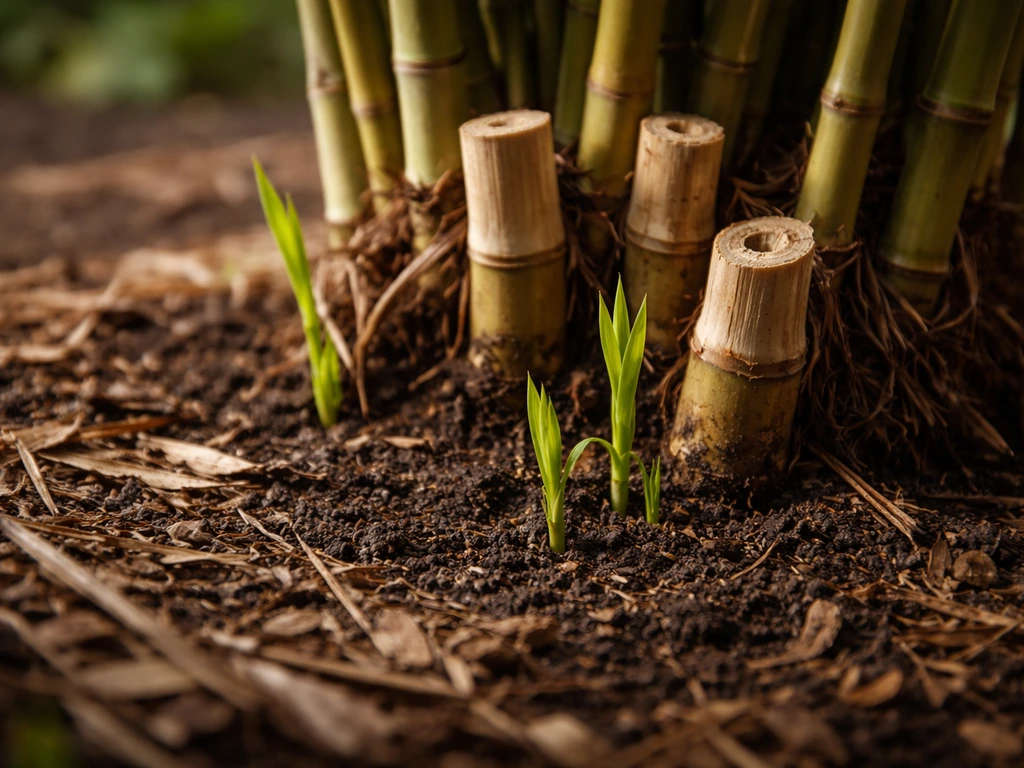
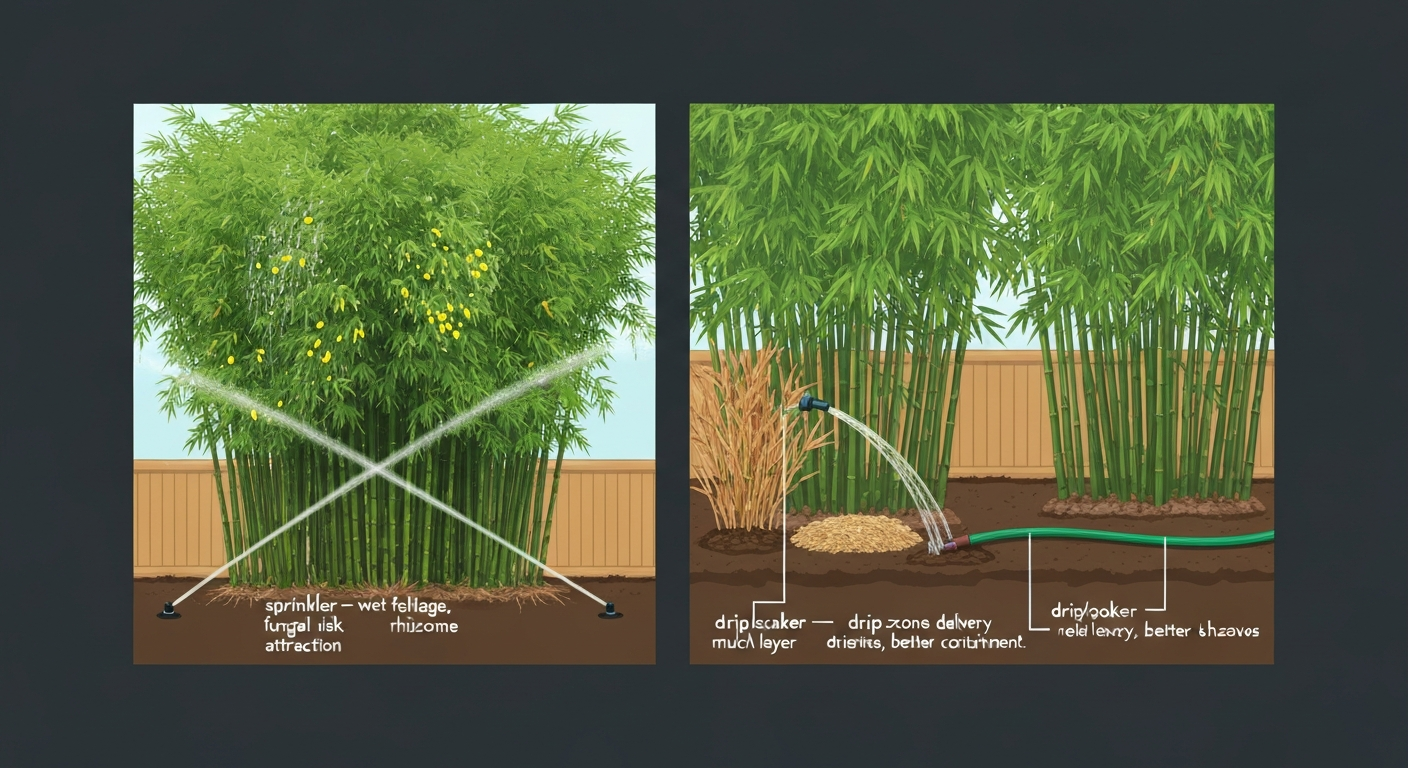
Yes, sprinklers can work on bamboo, but they are not the ideal irrigation method for most setups. Sprinklers deliver water, and bamboo certainly needs water, but overhead irrigation introduces real risks: prolonged wet foliage that invites fungal disease, uneven coverage over a dense canopy, and, for running bamboo species, irrigation placement that can actively encourage rhizome spread in directions you do not want. Used correctly, with the right sprinkler type, proper timing, and an understanding of your specific bamboo species, sprinklers are a workable tool. Used carelessly, they create more problems than they solve.
Do Sprinklers Work on Bamboo? Practical Guide for Gardeners

Marcus Hartwell
20 Jul 2026
How Bamboo Water Needs Actually Differ
Not all bamboo drinks the same. The biggest split is between running bamboos (monopodial, leptomorph species like Phyllostachys) and clumping bamboos (pachymorph species like Fargesia and Bambusa). Running species are generally high water-use plants. Moso bamboo (Phyllostachys edulis), probably the most studied bamboo on the planet, has documented annual stand-scale transpiration around 567 mm, which puts it in league with water-hungry conifers. Under tropical high-radiation conditions, mature Bambusa and Phyllostachys plantations have measured evapotranspiration rates in the range of 9 to 13 mm per day. That is a meaningful daily water demand. For guidance on large bamboo species and choosing the biggest varieties suitable for a garden, see what is the biggest bamboo in grow a garden.
Clumping species like Fargesia are more modest water users, more drought-tolerant, and because their pachymorph rhizomes stay tight to the clump, they are less sensitive to irrigation placement. You have more flexibility with how and where you water a clumper. With running bamboo, as I will explain shortly, irrigation placement matters a lot.
Season matters too. During the shooting season in spring, bamboo is pushing massive amounts of energy into new culm production and water demand spikes. A newly shooting Phyllostachys grove can look visibly stressed within days of a dry spell. By late summer and autumn, established stands are less sensitive and can tolerate more infrequent watering. Research on sap-flow in Phyllostachys pubescens also found that younger culms transpire more per culm than older ones, which means a young, newly established planting has different irrigation demands than a mature grove, even if both look the same from the outside.
What Sprinkler Irrigation Actually Does to Bamboo
Growth and root health
Bamboo roots and rhizomes are shallow. Research using ground-penetrating radar and excavation studies on Moso bamboo consistently shows the highest rhizome density concentrated in the top 0 to 15 cm of soil, with virtually all rhizomes found within the upper 30 cm. A sprinkler system that wets the surface zone consistently keeps that rhizome layer moist and encourages lateral growth. In a contained planting, that is fine. In an uncontained situation, consistent surface irrigation from sprinklers can actively pull running bamboo rhizomes toward the water source, which can mean toward a neighbor's fence, under a barrier, or into a flower bed you wanted to keep bamboo-free.
Spread and containment
Industry containment guidance is pretty direct on this: irrigation placement near a rhizome barrier or across a property boundary can undermine containment by drawing rhizomes toward moisture. The practical advice I follow is to avoid running irrigation lines directly along barrier seams, and to make sure that any sprinkler coverage does not extend significantly beyond the zone you want bamboo to colonize. See the guide can you move bamboo in Grow a Garden for detailed advice on relocating bamboo and managing unwanted spread. If you are growing running bamboo, this is not a minor detail. Physical root barriers are recommended at 60 to 90 cm (24 to 36 inches) deep for a reason, and strategic irrigation is part of the containment picture. The University of Maryland Extension guide "Containing and Removing Bamboo (University of Maryland Extension)" recommends physical root barriers 60–90 cm (24–36 in) deep because bamboo rhizomes concentrate in the upper soil and can hop over or under inadequate barriers.
Fungal disease risk
This is the risk most gardeners underestimate. Overhead sprinklers wet foliage and keep it wet. Most foliar fungal and bacterial pathogens, including the Alternaria and Pestalotiopsis leaf-spotting fungi documented on bamboo, require a continuous leaf wetness window of roughly 4 to 12 hours to infect. A sprinkler run in the evening that leaves bamboo leaves wet overnight hands those pathogens exactly what they need. Morning irrigation is better, giving leaves time to dry before nighttime, but even morning runs on dense bamboo canopies can leave inner foliage wet for longer than you want. If you already see yellowish or brown leaf spots on your bamboo, switching away from overhead irrigation is one of the first things to try.
Nutrient leaching
Heavy, prolonged sprinkler runs can push water (and soluble fertilizer) past the rhizome zone and into deeper soil layers where shallow-rooted bamboo cannot access it. Since bamboo's root zone sits primarily in the top 30 cm, you want water applied slowly enough to infiltrate and stay in that zone, not drain through it. Applying nitrogen fertilizer through overhead irrigation on bamboo amplifies this risk because nitrogen is highly mobile in soil water. If you are using soluble fertilizers or fertigation with your irrigation system, drip delivery into the root zone is far more efficient than sprinkler application over the canopy.
Sprinkler Types: What Works and What Does Not
| Sprinkler Type | Precipitation Rate | Best Use Case for Bamboo | Key Drawbacks |
|---|---|---|---|
| Fixed pop-up spray heads | 1.0–2.0 in/hr | Small, contained clumping bamboo borders | High rate causes runoff on clay; heavy leaf wetness; poor penetration of dense canopy |
| Gear-driven rotors | 0.20–1.50 in/hr | Larger bamboo groves where overhead watering is unavoidable | Still wets foliage; uneven coverage under dense canopy; can over-apply on clay soils |
| Rotary nozzle retrofits (e.g., MP Rotator) | 0.40–1.0 in/hr | Where spray heads are already installed; lower rate reduces runoff | Still overhead; better than standard sprays but not as efficient as drip |
| Micro-sprays / micro-sprinklers | 0.25–0.75 in/hr | Young plants, container bamboo, clumping species in beds | Low throw radius; can still wet low foliage; needs more heads for coverage |
If you are going to use overhead sprinklers, rotary nozzle retrofits and gear-driven rotors at lower precipitation rates are the most practical choices because they apply water more slowly, giving soils more time to absorb it before runoff. Standard fixed spray heads at 1.0 to 2.0 inches per hour are almost always too fast for clay soils and create standing water around shallow rhizomes, which is a recipe for root rot. Micro-sprays work well for smaller, younger plants and container bamboo but require more heads and more careful placement to avoid constant foliage wetting.
Better Options: Drip, Soaker Hoses, and Hand-Watering
For most bamboo situations, drip irrigation is genuinely the better tool. Drip delivers water directly to the soil at the root zone, keeps foliage dry, and allows you to deliver fertilizer precisely where bamboo can use it. Standard drip emitters run at 0.5 to 2.0 gallons per hour (GPH), with 1 GPH emitters being the most common in landscape drip systems. For bamboo, I typically space emitters every 12 inches along drip line within the established grove area, or place two to three emitters around each plant for new plantings. Pressure-compensating emitters are worth the extra cost on sloped sites because they maintain consistent output regardless of pressure variation across the line.
Soaker hoses are the budget-friendly alternative that many home gardeners already have on hand. They do a decent job in a bamboo hedge or border, especially for clumping species where you can lay the hose in a rough circle or line along the planting. They are less precise than drip emitters and degrade faster in sunlight, so they need to be covered with mulch or replaced every few seasons. For running bamboo, be mindful of where you run the hose: laying a soaker hose right along a property line is an invitation for rhizomes to follow it.
Hand-watering is underrated for newly planted bamboo and container bamboo. It lets you see exactly how much water the soil is receiving, check soil moisture at the same time, and adjust in real time. For the first growing season after transplanting, I hand-water my bamboo more than any other method because I can monitor establishment closely. Once a plant is established and the root system is well-developed, an automated drip or soaker setup takes over.
Sprinkler Placement and Coverage Tips
If sprinklers are what you have or what you choose, placement discipline makes the difference between a workable setup and a problematic one. Head spacing should follow the standard head-to-head coverage principle: each head should reach the adjacent head. For rotors on a 15-foot radius, that means heads no more than 15 feet apart. For a bamboo grove specifically, aim coverage to wet the root zone soil, not to drench the canopy. This means placing heads at the perimeter of the planting rather than inside it, and angling throw inward and downward rather than upward through foliage.
Overspray onto paths, structures, or neighboring property is both wasteful and a potential liability if you are growing running bamboo. Keep coverage contained to the intended bamboo zone. Avoid placing heads where water will pool near rhizome barriers, as consistently wet soil near barrier edges is exactly what encourages rhizomes to probe for a way around. Finally, always program sprinklers for early morning runs (starting at 4 to 6 AM is ideal), so foliage has the full day to dry and leaf wetness windows stay short.
Practical Watering Schedules by Soil and Climate
How often and how long you run sprinklers depends on your soil texture and climate. USDA-NRCS soil data gives us clear guidance on available water capacity by texture: loam holds around 26% volumetric water content at field capacity, sandy loam around 23%, and clay around 34 to 36%. Clay holds more water but absorbs it slowly, which is why cycle-and-soak scheduling (two or three short runs separated by 30 to 60 minute intervals) is standard practice for clay soils under sprinklers. Sandy soils drain fast and need more frequent but shorter runs.
| Soil Type | Climate | Sprinkler Frequency | Run Time per Cycle | Cycle-and-Soak? | Notes |
|---|---|---|---|---|---|
| Sandy / Sandy Loam | Temperate (moderate summers) | Every 2–3 days in summer; weekly in spring/fall | 15–20 min | Not usually needed | Soil dries fast; monitor closely in heat waves |
| Sandy / Sandy Loam | Hot / Dry (e.g., Southwest US) | Daily or every other day in peak summer | 10–15 min (more frequent, shorter) | Not usually needed | Mulch is critical to reduce surface evaporation |
| Loam | Temperate | Every 3–4 days in summer; every 5–7 days in spring/fall | 20–25 min | Sometimes on slopes | Most forgiving soil; bamboo thrives with consistent moisture |
| Loam | Hot / Dry | Every 2–3 days in summer | 20–25 min | Sometimes | Morning-only irrigation; watch for drought stress on new shoots |
| Clay | Temperate | Every 4–5 days in summer; weekly or less in spring/fall | 3 x 8 min (cycle-soak) | Yes, required | Slow infiltration rate; always cycle-and-soak to avoid surface runoff |
| Clay | Hot / Dry | Every 3–4 days in summer | 3 x 8–10 min (cycle-soak) | Yes, required | Compaction risk; aerate annually; drip is strongly preferred on clay |
These schedules assume established bamboo (at least one full growing season in the ground). Established running bamboo is surprisingly drought-resilient once its rhizome network is developed, but it will show stress (rolling or yellowing leaves) when consistently under-irrigated. Established clumping species like Fargesia generally tolerate less frequent watering than Phyllostachys, especially in cooler climates. Always adjust these schedules based on rainfall: if you receive 1 inch of rain in a week, skip a cycle.
Spotting trouble: over- and under-watering signs
- Overwatering signs: yellowing lower leaves, soft or mushy culm bases, standing water near roots, leaf-spot fungal lesions appearing on lower foliage, sour smell from soil
- Underwatering signs: leaves rolling inward along the midrib (bamboo's classic drought response), dry and crinkly leaf tips, slow or stunted new shoot emergence, dry soil below the top 5 cm
- Fix for overwatering: reduce run frequency before shortening run duration; improve drainage with organic matter or raised planting if soil is compacted clay; switch to drip
- Fix for underwatering: increase frequency first, not duration; check emitter or head output is actually reaching the root zone; add 2 to 3 inches of mulch to retain moisture
Watering Newly Planted and Transplanted Bamboo
The establishment period, roughly the first 6 to 12 months after planting, is when bamboo is most vulnerable to irrigation mistakes in either direction. A newly transplanted bamboo has had its rhizome network disrupted and its capacity to redistribute water internally is reduced. Research on rhizome integration in Phyllostachys shows that rhizome connectivity is what allows established plants to share water between culms, and a fresh transplant does not have that network yet. This means you cannot rely on the plant to self-regulate during stress the way an established grove can.
For the first two weeks after planting, water daily regardless of method. After that, step down to every other day for the next four to six weeks, then transition to your normal schedule based on soil type and climate. The goal is to keep the root zone consistently moist (not waterlogged) during this window. Stick your finger 5 to 8 cm into the soil: it should feel like a wrung-out sponge. If it is dry at that depth, water immediately. If it is soggy, hold off and check drainage.
Mulch is not optional for newly planted bamboo. A 3 to 4 inch layer of shredded bark, wood chips, or straw over the root zone dramatically reduces surface evaporation, keeps soil temperature stable (critical for rhizome recovery), and reduces the irrigation frequency you need to maintain. Pull mulch a few inches away from the culm bases to prevent moisture buildup at the stem, which can invite rot. Mulch also suppresses weeds that would otherwise compete for the water you are putting down.
Container-grown bamboo deserves special mention. Containers dry out dramatically faster than in-ground soil, especially in warm weather. A bamboo in a 15-gallon container in a sunny spot on a hot day may need watering every single day in summer. Sprinklers are generally impractical for containers (coverage is too inconsistent), so hand-watering or drip with a dedicated emitter per container is the practical approach. Check the container weight or use a moisture probe before watering: container bamboo is surprisingly tolerant of brief drying, but root damage from repeated severe drying is cumulative and hard to reverse.
Fertilizer and irrigation together
If you plan to apply soluble fertilizer through your irrigation system, drip is the right delivery method. Applying soluble nitrogen through overhead sprinklers onto bamboo foliage risks foliar burn (especially on young leaves during shoot emergence) and wastes fertilizer to volatilization and runoff. When using drip fertigation, a dilute nitrogen solution applied during active growth in spring gives the best results because it goes directly into the shallow rhizome zone where bamboo can use it immediately. Avoid fertigation in late summer and autumn when you want bamboo to harden off rather than push new soft growth before winter.
The Bottom Line on Sprinklers and Bamboo
Sprinklers work on bamboo when you use the right type (rotors or rotary nozzle retrofits over standard spray heads), schedule them in the early morning to limit leaf wetness, match precipitation rate to your soil's infiltration capacity, and place heads to avoid directing water along barrier seams or beyond the intended planting zone. They are a reasonable compromise if drip infrastructure is not practical. But for most home gardeners, a drip system or soaker hose setup is genuinely less work, less disease risk, and more water-efficient. For recommendations on commercial fertilizers, see Is Miracle-Gro good for bamboo for pros and cons of using Miracle-Gro on bamboo. For related information, see is bamboo a prickly fruit in grow a garden for details. If your bamboo is a running species, the additional spread-control benefits of keeping surface irrigation contained make drip an even clearer choice. See the Grow a Garden guide 'Is bamboo a tropical plant' for how bamboo's climate preferences affect planting and care. For information on unusual bamboo varieties and their availability, see how rare is a rainbow bamboo in Grow a Garden. New plantings need attentive daily watering regardless of method, and mulch does more work per dollar than almost any upgrade to your irrigation hardware. For a basic identification and overview, see the Grow a Garden piece on what type of plant bamboo is what type of plant is bamboo in Grow a Garden. See the related guide 'Does bamboo grow back in grow a garden' for details on regrowth and managing bamboo in garden settings.
FAQ
Do sprinklers work on bamboo?
Short answer: Yes — but conditionally. Sprinklers can supply adequate water for bamboo stands when matched to species, soil and climate. However, overhead sprinkling increases leaf wetness (raising disease risk), can encourage rhizome spread if water is placed near barriers, and may waste water on sandy soils or compacted clays unless run in short cycles. Use sprinklers when coverage, convenience and established‑stand water needs matter; prefer lower‑wetting or sub‑surface methods (drip/soaker) where disease risk, containment or water efficiency are priorities.
How does sprinkler irrigation affect bamboo growth, roots and spread?
Sprinklers keep the upper soil moist where most bamboo rhizomes and feeder roots concentrate (0–30 cm, often 0–15 cm). That encourages vigorous culm and rhizome production and can accelerate lateral spread in running species. Overhead wetting increases leaf‑wetness duration and foliar disease risk. Poorly matched sprinkler rates can cause runoff on clay soils or deep percolation and nutrient leaching on sandy soils. In short: sprinklers support growth but can promote spread and disease if not managed.
Are there differences in irrigation needs between clumping and running bamboos?
Yes. Clumping species (Fargesia, Bambusa) keep roots and rhizomes near the clump and need regular but localized moisture — they respond well to targeted drip/soaker. Running species (Phyllostachys, Pseudosasa) have shallow, spreading rhizomes that seek water; frequent moist upper soil favors faster lateral spread and can undermine containment. Both groups need more water during shoot emergence and hot, dry periods; running bamboos are the ones you must avoid over‑watering near barriers or property edges.
What are species‑ and season‑specific water requirements?
General guidance: newly planted bamboo: keep root ball and upper 15–30 cm consistently moist. Established clumpers: 25–40 mm (1–1.5 in) water per week in warm seasons depending on rainfall. Established runners: similar or slightly higher total use because stands can have high ET — plan 30–50 mm (1.2–2 in)/week during peak growth in hot climates. Reduce to maintenance watering in cool/wet seasons. In drought or heatwaves increase frequency; in rainy seasons cut back. Exact needs vary with species, stand density, age and local evapotranspiration.
Which sprinkler types are recommended or discouraged for bamboo?
Prefer low‑precipitation, low‑wetting options when overhead is necessary: micro‑sprays or rotary low‑rate rotary nozzles (0.4–1.0 in/hr) over high‑rate fixed sprays (1–2 in/hr). Avoid high‑pressure, high‑precipitation spray heads that saturate foliage and cause runoff on slow soils. Best overall for bamboo landscapes: drip emitters (0.5–2.0 GPH) or soaker lines, micro‑bubblers for root‑zone wetting. Use pressure‑compensating emitters and emitter spacing to match root zone width.
How should I place sprinklers relative to bamboo and containment barriers?
Do not run sprinkler lines or place emitters directly adjacent to rhizome barriers or property edges. Keep irrigation emitters several feet (0.5–1 m) inside the barrier to avoid creating a moist path that rhizomes will follow. For running bamboo, position drip lines or soaker lines around the crown and avoid wetting soil along fence lines. If using pop‑ups, angle heads to wet the clump area but not the barrier seams.
Next Article
Does Bamboo Grow Back? Regrowth Guide for Home Gardens
Yes, most bamboo regrows from rhizomes after cutting if roots live; learn clumping vs running, checks, and care tips.