Yes, you can grow bamboo in troughs, and it works really well when you match the right species to the right container design. For container-specific advice, see our guide on growing bamboo in planter boxes for tips on planter depth, drainage, and species selection. If you’re asking can bamboo grow in planters, the short answer is yes, many bamboo species do well in planters when you match species, container size, and containment methods. Clumping species like Fargesia rufa thrive long-term in troughs with at least 18–24 inches (45–60 cm) of depth and a volume of 75 litres or more per clump. Running bamboos like Phyllostachys nigra can also succeed in troughs, but only with sealed-bottom containment or an internal rhizome barrier, because their horizontally spreading rhizomes will escape through drainage holes if the container sits on open soil. Get those two things right, species choice and containment design, and a trough is a genuinely excellent way to grow bamboo in restricted spaces, on balconies, or where you simply do not want bamboo spreading into the rest of your garden.
Can You Grow Bamboo in Troughs? Practical Guide for Planters

Troughs, planter boxes, or indoor bamboo: which suits you?
The main reason people reach for a trough rather than ground planting comes down to one of three things: space control, aesthetic use, or site constraints. A trough or planter box gives you the ability to position bamboo precisely, move it if needed, and, crucially, contain species that would otherwise spread across your entire garden. That last point matters more than most new bamboo growers realise. Running species like Phyllostachys can extend rhizomes several metres per season in open ground. A well-designed trough converts that energy into upward, visible growth instead.
That said, containers are not always the best choice. In-ground bamboo grows faster, requires less irrigation management, and rarely becomes root-bound. If you have open garden space and want maximum height and vigour, the ground wins every time. Troughs, planter boxes, and indoor containers are a trade-off: you gain control and placement flexibility, but you take on a higher-maintenance watering and feeding schedule and a more limited root volume that caps growth potential. Container-grown bamboos consistently grow slower and stay shorter than the same species in the ground, which is often exactly what a patio or courtyard planting needs.
Indoor bamboo growing is a related option worth mentioning here. Most outdoor bamboo species, including the cold-hardy Fargesia types, prefer outdoor conditions and struggle with low indoor light and dry indoor air over the long term. Black bamboo (Phyllostachys nigra) is often tried indoors, but it really needs a bright, cool position and does far better as a sheltered outdoor container plant. If you are specifically considering indoor culture, the species requirements and light demands shift considerably compared to outdoor trough growing. If you’re asking “can I grow bamboo indoors”, check the indoor bamboo section for species selection and light and temperature requirements.
Is a trough actually right for your site? A practical checklist
Before you buy a trough and a bamboo plant, run through these questions honestly. I have seen too many people install large troughs in unsuitable spots and then struggle to maintain the plants, or find the structure cannot handle the load. Each question points to a specific practical constraint.
- Space: Do you have at least 30–40 cm of clear width and length per clump, with room for a trough that is 45–60 cm deep? Undersized troughs cause stress within two to three seasons.
- Load bearing: A filled trough 1.2 m long by 45 cm deep by 40 cm wide weighs roughly 150–200 kg once planted and saturated. Balconies, decks, and flat roofs must be checked against their rated load — typically 150–200 kg/m² for most residential balconies. Spread the weight and consult a structural engineer for larger installations.
- Climate: Winter hardiness matters more in a container than in the ground. Container soil freezes faster and deeper than in-ground soil. In USDA Zones 6 and below, even cold-hardy Fargesia species need insulation or overwintering protection when grown in exposed above-ground troughs.
- Water access: Container bamboo needs consistent, deep irrigation. In hot summers, a 75-litre trough can need 5–10 litres of water several times per week. Do you have a tap, drip system, or hose close enough to manage this reliably?
- Drainage: Can the trough drain freely without saturating a structure below it? And — critically for running bamboos — does the base sit on open soil or a sealed surface? Open soil beneath drainage holes is a rhizome-escape risk.
- Long-term access: Bamboo in a trough needs root division or repotting roughly every 3–5 years for clumpers, and annual rhizome pruning for runners. Can you access all sides of the trough to do this work?
- Maintenance commitment: Containers dry out and leach nutrients faster than ground soil. Are you prepared for a feeding schedule (typically every 4–6 weeks through the growing season) and regular watering?
- Sunlight: Most outdoor bamboos need at least 4–6 hours of direct sun for good culm production. Shade from walls, fences, or overhangs is a common reason trough-grown bamboos stay thin and sparse.
Clumping vs running bamboo: the choice that shapes everything
This is the single most important decision in container bamboo growing. Running bamboos (genera Phyllostachys, Pseudosasa, and others) produce long, horizontally spreading rhizomes that can travel a metre or more per season in each direction. In open ground they are notorious for invading neighbouring gardens. In a trough, those same rhizomes hit the container wall and push hard against it, and if there is any weakness, a gap, or a drainage hole over open soil, they will find it. Clumping bamboos (Fargesia, most Bambusa species) produce short, tufted rhizomes that extend only a few centimetres per year from the central clump. They are intrinsically better suited to containers because their root habit matches the bounded space.
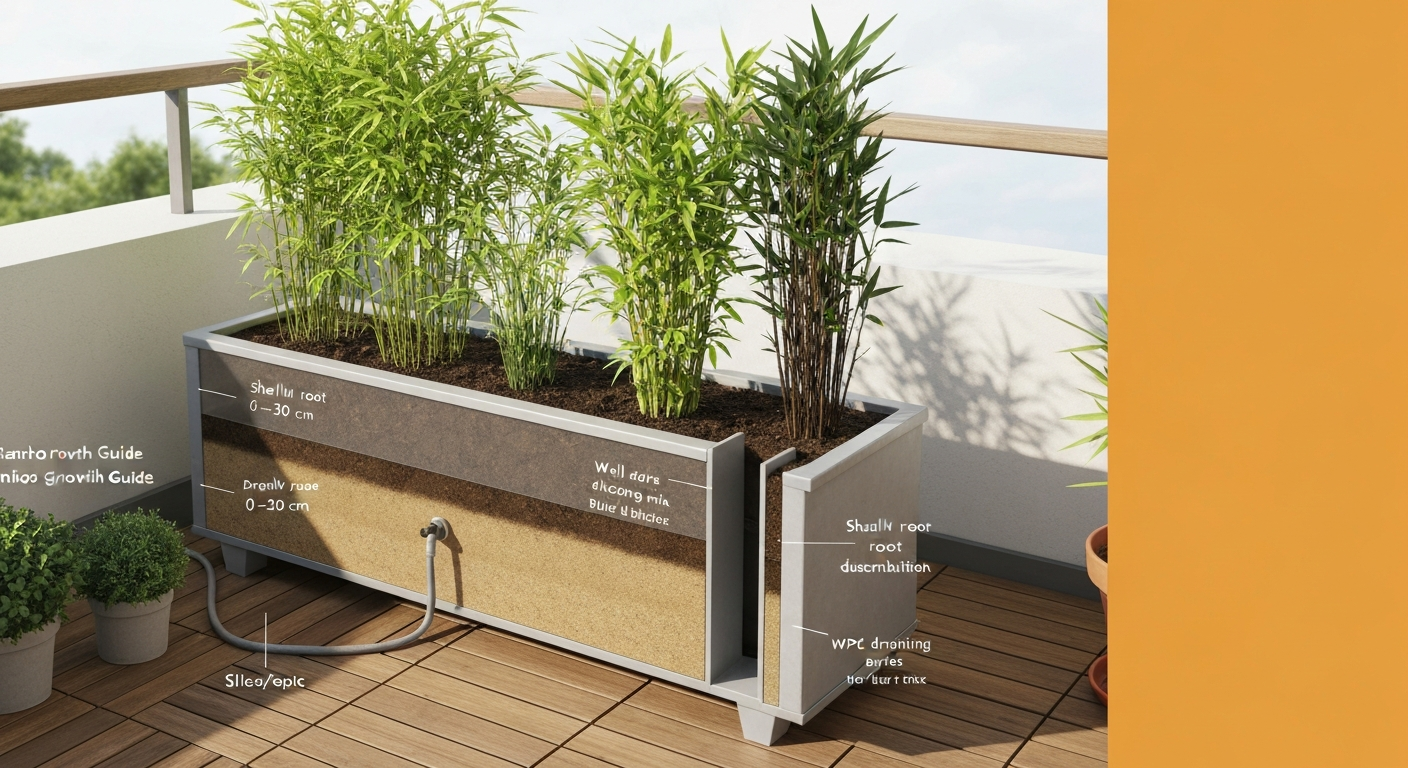
Research on bamboo root distribution supports why troughs can work for both types but in different ways. The majority of bamboo rhizomes and roots concentrate in the top 0–30 cm (0–12 inches) of soil regardless of species. That shallow, horizontal distribution means a trough does not need to be enormously deep to capture the root system, but it absolutely needs strong lateral containment for running types. For clumping types, the trough walls simply define the boundary and the plant fills inward, making management much simpler.
My honest advice: if you are new to container bamboo, start with a clumping Fargesia. If you want the visual drama of Phyllostachys nigra or another runner, go ahead, but plan your containment strategy before you plant, not after. Retrofitting containment to an established running bamboo in a trough is genuinely difficult.
Best bamboo species for troughs and containers
Species selection for troughs comes down to three variables: growth habit (clumping or running), mature height and culm diameter relative to your trough size, and cold hardiness for your climate zone. Here is how the main candidates stack up.
| Species | Type | Mature height in containers | Cold hardiness (USDA) | Container suitability |
|---|---|---|---|---|
| Fargesia rufa | Clumping | 1.5–2.5 m (5–8 ft) | Zone 5 (-26°C / -15°F) | Excellent — RHS recommended for patio/container |
| Fargesia murielae | Clumping | 2–3 m (6–10 ft) | Zone 5 (-26°C / -15°F) | Excellent — tolerates partial shade, stays tidy |
| Bambusa multiplex 'Alphonse Karr' | Clumping (tropical) | 2–4 m (6–13 ft) in containers | Zone 8+ (-12°C / 10°F) | Very good — smaller culms, reliable in warm climates |
| Phyllostachys nigra (black bamboo) | Running | 2–4 m (6–13 ft) in containers | Zone 7 (-18°C / 0°F) | Good with sealed containment — needs vigilant root management |
| Phyllostachys aureosulcata | Running | 2–4 m in large troughs | Zone 5 (-26°C / -15°F) | Moderate — requires very large, sealed trough; not ideal for beginners |
A note on black bamboo in troughs and indoors
Phyllostachys nigra is one of the most requested container bamboos because of its striking near-black culms, and it does perform well in large troughs outdoors. The key caveat is that it is a runner. In a well-sealed trough it behaves itself for several years, but it will eventually become root-bound or attempt to push rhizomes through any opening. Annual inspection of drainage holes and the container perimeter is non-negotiable. For indoor use, black bamboo needs very bright light (a south or west-facing window minimum) and cool winter temperatures, it is not a typical houseplant, and most indoor environments are too warm and too dim for it to thrive long-term.
Trough design: the dimensions and materials that actually matter
Getting the physical design of your trough right from the start saves a lot of frustration later. These are the specifications I recommend based on practical experience and the root-depth research data available.
Depth
Minimum effective depth is 45 cm (18 inches) for short-term culture of one to three years. For a permanent installation you want 50–60 cm (20–24 inches). The 0–30 cm zone is where most bamboo roots concentrate, but giving that extra 20–30 cm below provides a buffer zone for water retention and reduces how quickly the plant becomes pot-bound. Anything shallower than 40 cm will stress most medium-sized bamboos within two seasons.
Width and volume
Volume matters more than any single dimension. A minimum of 75 litres (roughly 20 US gallons) per clump is a commonly recommended starting point for established Fargesia plants, with 100–150 litres preferred for longer intervals between repotting. For a screening trough, the long, narrow format used along fences or walls, aim for at least 40 cm of internal width. Narrower than that and the root mass fills the trough laterally within two to three years and the plant begins to stress. Long troughs shared by multiple plants should be thought of as providing that 75-litre minimum per individual plant along the trough's length.
Shape
Rectangular troughs outperform round pots for most screening and privacy applications because they maximise soil volume relative to footprint and allow multiple plants to share root space in a linear arrangement. Tapered or V-shaped cross-sections reduce effective root volume at depth and are worth avoiding. Straight-sided or slightly flared walls are best.
Materials
Material choice affects insulation, weight, and longevity. Here is a practical comparison.
| Material | Weight | Insulation | Durability | Best for |
|---|---|---|---|---|
| Galvanised steel | Heavy | Poor (conducts cold/heat) | Excellent (20+ yrs) | Permanent courtyard/garden installations |
| Corten steel | Heavy | Poor | Excellent (weathers to rust patina) | Architectural, statement troughs |
| Powder-coated aluminium | Light–medium | Moderate | Very good (15+ yrs) | Balconies, rooftops, moveable planters |
| Fibreglass / GRP | Light | Moderate | Good (10–15 yrs) | Large lightweight troughs, balconies |
| Hardwood timber (treated) | Medium | Good | Good (10–15 yrs with maintenance) | Traditional garden aesthetics, good insulation |
| Concrete / reconstituted stone | Very heavy | Good | Excellent | Permanent ground-level installations only |
| Plastic / polyethylene | Light | Moderate | Moderate (5–10 yrs) | Budget option, functional but less attractive |
For outdoor troughs exposed to freezing winters, timber and fibreglass offer the best natural insulation for roots. Steel and aluminium look great but conduct cold efficiently, and in Zone 6 or colder, the root mass in a metal trough can freeze solid. Lining metal troughs internally with 25–50 mm of closed-cell foam insulation makes a meaningful difference in harsh winters.
Drainage, insulation and weight on balconies and outdoor structures
Drainage is the single most common failure point in trough-grown bamboo. Bamboo is surprisingly sensitive to waterlogged roots, it will drop leaves and decline within weeks if the root zone stays saturated. Every trough must have multiple drainage holes spaced across the base. For a trough 1.2 m long, I recommend at least four 20–25 mm holes, not one central one. Cover holes with coarse mesh or pot feet to prevent blockage and allow free flow.
On balconies and decks, weight is the constraint most people underestimate. A saturated growing medium weighs roughly 1.0–1.2 kg per litre. A 150-litre trough fully planted and watered can weigh 180–220 kg including the container itself. Spread that load with trough feet, frames, or flat boards to distribute pressure across structural joists rather than concentrating it at single points. For any installation exceeding 200 kg or spanning more than one joist bay, get a structural load assessment. This is especially important on older residential balconies, which in many countries are rated to 150–200 kg/m².
Insulation for outdoor troughs in cold climates goes beyond the container material. In USDA Zones 5–6, wrapping trough sides with hessian, bubble wrap, or foam lagging in November and removing it in March gives roots meaningful freeze protection. For Fargesia species (hardy to around -26°C in the ground), the greater risk in containers is not the air temperature per se but the freeze-thaw cycling of the root mass when it has no insulating soil buffer around it. A layer of mulch on top of the soil surface inside the trough also helps retain moisture and moderate soil temperature.
Stopping running bamboo from escaping your trough
If you choose a running bamboo like Phyllostachys nigra for your trough, containment is not optional, it is the design brief. The research here is clear: running bamboo rhizomes concentrate in the top 0–30 cm of soil and spread horizontally, not deeply. That means lateral barriers and sealed bases matter far more than trough depth alone. Ground-level containment guidelines from university extension services recommend HDPE rhizome barriers buried to at least 60 cm (24 inches) for in-ground planting. In a trough, you are recreating that containment artificially.
Sealed-bottom trough design
The cleanest solution is a trough with a fully impermeable base, no drainage holes that open directly over soil. Water drainage must exit via holes in the lower sides rather than the base, or the trough must sit on a sealed hard surface (concrete, paving, decking) so that any rhizome reaching a drainage hole has nowhere to go. For guidance on why bottom drainage alone can permit rhizome escape and on long-term containment options, see Bamboo Control, Clemson University Home & Garden Information Center Bamboo Control — Clemson University Home & Garden Information Center. If your trough sits on open soil or grass, fit a solid impermeable liner inside (thick HDPE sheeting, at least 2 mm gauge) that covers the base completely before filling with growing media.
Internal rhizome barriers and liners
For very large troughs shared between a runner and other plants, or where you want to use a decorative trough that cannot be modified, install an internal HDPE rhizome barrier as a sleeve before planting. Commercially available rhizome barrier rolls (typically 60–70 cm tall, 2–3 mm thick HDPE) can be cut and formed into an internal box or cylinder. Overlap joints by at least 30 cm and secure with HDPE tape, any gap is a potential escape route. This approach mirrors exactly what professional landscapers do in ground installations, just scaled to the container.
Annual rhizome pruning
Even in a perfectly contained trough, running bamboos need annual root management. In autumn or early spring, before growth resumes, cut vertically around the inside perimeter of the trough with a sharp spade or pruning saw to sever any rhizomes that have reached the container wall. Remove the severed sections and check that no rhizomes have pushed through drainage holes. This yearly maintenance, it takes 20–30 minutes once you are used to it, is what keeps a running bamboo manageable in a container for a decade or more.
One important caution: if a running bamboo has pushed rhizomes through a drainage hole into open soil beneath the trough, removing those sections requires getting every fragment out. University extension research is consistent on this, even small rhizome fragments left in soil can resprout. Lift the trough, excavate any escaped material thoroughly, and seal the drainage point before repositioning.
Soil mix, planting, and getting established
Never fill a trough with straight garden soil. It compacts in containers, drains poorly, and does not support healthy bamboo roots. The mix I use and recommend is roughly: 50% quality potting compost or coir-based mix, 30% coarse pine bark fines or aged bark, and 20% perlite or pumice. This gives good moisture retention without waterlogging, structural stability so the mix does not collapse over time, and adequate aeration at the root zone. Target a pH of 5.5–6.5, which suits most bamboo species. Most commercial peat-free potting mixes land around pH 6.0–6.5, which is close enough for Fargesia and Phyllostachys without amendment.
When planting, set the bamboo at the same depth it was growing in its nursery pot, do not bury the culm base deeper. Water thoroughly after planting to settle the media and eliminate air pockets. In the first growing season, trough-planted bamboo typically puts most of its energy into root establishment rather than producing new culms. Do not panic if growth is modest in year one. By year two, once the root system has filled the available volume, you will see noticeably stronger and taller culm production.
Watering, feeding, and ongoing care
Watering is where most trough-grown bamboos fail, and the failure usually goes in one of two directions: either chronic underwatering in hot weather, or chronic overwatering in winter. The approach that works is deep, infrequent watering rather than light daily surface wetting. Water until you see flow from the drainage holes, then allow the top few centimetres to dry before watering again. In a hot, dry summer climate, a 100-litre trough may need 8–12 litres of water two to three times per week. In a cool, wet maritime climate, the same trough may need watering only once a week or less. A drip irrigation system on a timer is genuinely worth the investment for outdoor troughs, consistent moisture is far more important than the exact volume delivered.
Feeding in containers matters more than in the ground because nutrients leach out with every watering. LawnGearLab's container-care guide notes that containers dry and leach nutrients faster than the ground, so it recommends potting mixes with stable structure (pine bark fines or coconut coir combined with perlite or pumice) and advises regular feeding and periodic repotting to maintain plant health potting mixes with pine bark fines or coconut coir plus perlite or pumice. A balanced slow-release granular fertiliser applied in early spring (NPK around 10-10-10 or a dedicated bamboo/grass fertiliser with a higher nitrogen component) supports culm production through the shooting season. Follow up with liquid feeds every four to six weeks from April through August. Reduce or stop feeding from September onwards to allow the plant to harden off before winter. In the ground, bamboo in fertile soil can largely feed itself; in a trough, you are the supply chain.
Repotting and division
Clumping species in troughs typically need dividing every three to five years, when you notice culm size diminishing, the trough lifting, or visible roots emerging from drainage holes. Division is straightforward: remove the plant, use a saw or sharp spade to split the root mass, replant one division back with fresh media, and use or rehome the rest. Running species need the annual perimeter root pruning described above rather than full division, though they too will eventually outgrow any fixed container volume.
Troubleshooting common trough bamboo problems
- Yellowing leaves across the whole plant: usually nitrogen deficiency (fertilise with a high-nitrogen feed) or waterlogging (check drainage holes are clear and reduce watering frequency).
- Leaf curl or leaf roll during the day: classic dehydration signal. Water immediately and deeply. In extreme heat, temporary shade cloth can reduce transpiration stress.
- No new culms after year one: often root-bound conditions or insufficient nitrogen. Check whether roots are circling the container base — if so, it is time to divide or move to a larger trough.
- Mite damage (tiny webbing, speckled yellowing on leaves): spider mites are the most common pest on container bamboo, especially in dry indoor or sheltered conditions. Increase humidity around the plant, remove heavily affected stems, and treat with horticultural oil or insecticidal soap if needed.
- Rhizome pushing out of drainage holes: immediate action required for running species. Remove the trough from its position, cut and remove escaped rhizome, seal drainage holes with mesh or reposition over a solid surface.
- Culms lean badly to one side: insufficient light from one direction or pot tipping from root pressure. Rotate the trough 180 degrees and check it is sitting level.
- Wilting despite wet soil: possible root rot from overwatering or poor drainage. Unpot, inspect roots, trim any blackened or mushy sections, treat with a fungicide drench, and repot in fresh, well-draining media.
Can you grow bamboo hydroponically in a trough?
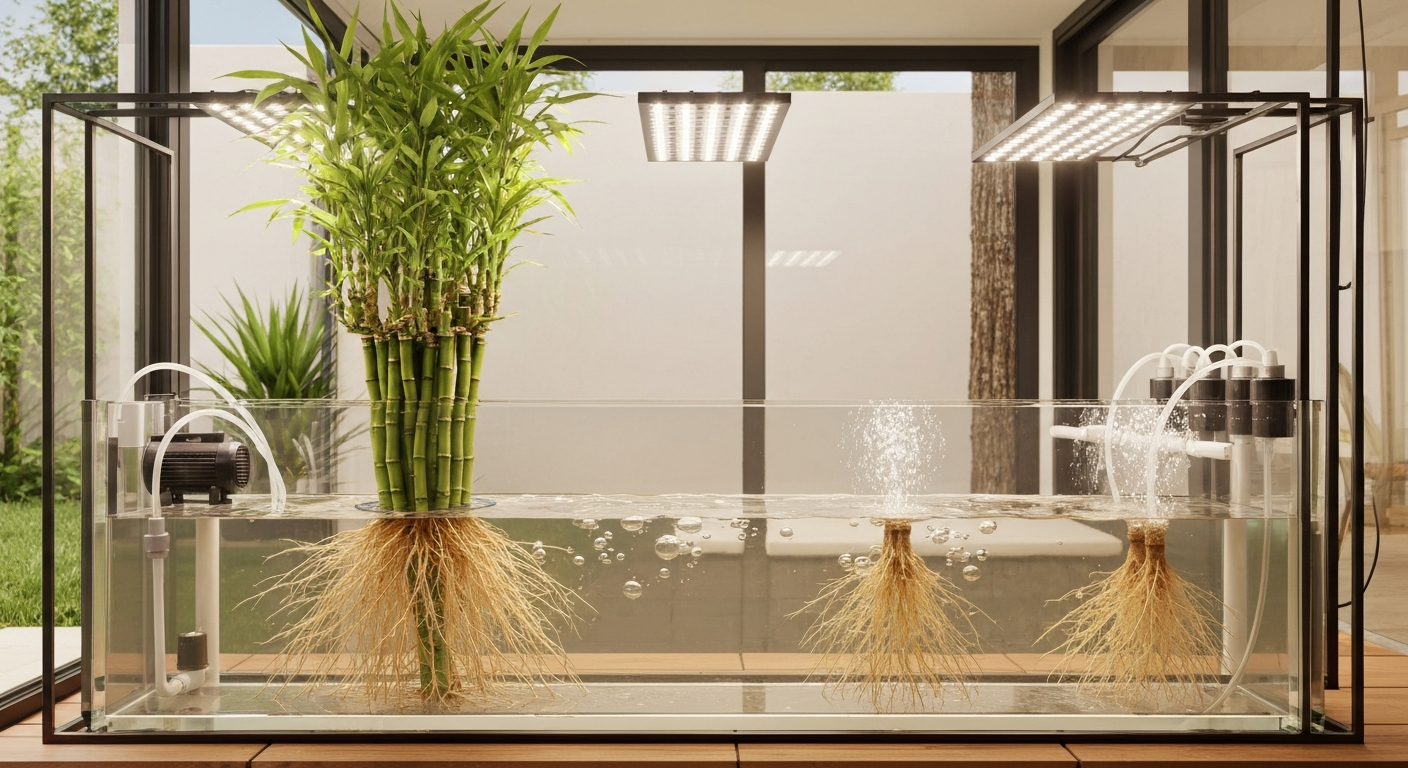
This comes up more often than you might expect, and the honest answer is: partially yes, but with significant limitations. Small ornamental bamboos sold as 'lucky bamboo' are actually Dracaena sanderiana, not true bamboo, and are the ones most often grown in water or hydroponic setups. True bamboos (Phyllostachys, Fargesia, etc.) have not been widely adopted in commercial hydroponics, and there are practical reasons for that. Their rhizome-based growth habit, demand for a large stable root zone, and preference for slightly acidic, oxygen-rich media make standard deep-water or NFT hydroponic systems poorly suited to them. Some enthusiasts have grown small bamboo divisions in semi-hydroponic or ebb-and-flow systems with an inert substrate like expanded clay aggregate, and reported some success in the early stages, but long-term results at any meaningful scale remain limited and undocumented at a scientific level. If hydroponic growing is your main interest, true bamboo is not the best candidate, and this is a topic worth exploring separately given how different the growing mechanics are from soil-based trough culture. For a focused discussion on whether bamboo grows in hydroponics, see does bamboo grow in hydroponics. See the detailed discussion in “Can you grow bamboo hydroponically?” for more on methods, limitations, and why true bamboos are usually unsuitable for standard hydroponic systems.
Troughs vs ground planting: the honest comparison
| Factor | Trough growing | In-ground growing |
|---|---|---|
| Growth rate | Slower — root volume limits vigour | Faster — unrestricted root expansion |
| Maximum height | Typically 50–70% of in-ground potential | Full species potential |
| Spread control | Excellent — physical containment | Requires rhizome barriers or regular management |
| Watering demand | High — containers dry quickly | Low to moderate — ground buffers moisture |
| Feeding demand | High — nutrients leach with watering | Low to moderate — soil provides baseline nutrition |
| Winter hardiness | Lower — roots exposed to freezing air | Higher — ground insulates roots naturally |
| Portability | Good — can be moved (weight permitting) | None |
| Establishment time | 1–2 seasons before strong growth | Often strong growth in first season |
| Long-term maintenance | Repotting/division every 3–5 years | Occasional rhizome management |
| Best use case | Patios, balconies, rooftops, restricted spaces, screening without spread | Large gardens, hedging, groves, fast-growing screens |
If you have the option of in-ground planting with a properly installed rhizome barrier, that will always give you a more vigorous and lower-maintenance bamboo. But for the many situations where that is not possible, a balcony, a paved courtyard, a rented property, or a garden where you genuinely cannot risk spread, a well-designed trough is not a compromise. It is the right tool for the job, and bamboo genuinely thrives in it when the species, dimensions, and care routine are matched correctly.
FAQ
Can you grow bamboo successfully in troughs, planter boxes, or indoors?
Yes — provided you choose the right species and design the trough for root containment, drainage, adequate soil volume and ongoing care. Clumping bamboos are far easier to manage long‑term in troughs; some running bamboos can work short‑to‑medium term or in very well‑constructed sealed troughs but have higher escape and maintenance risk.
Which bamboo types are best for troughs and indoor planters?
Clumping species (Fargesia spp., many Bambusa spp.) are the top choice for troughs and indoor/terrace culture because they have short, non‑invasive rhizomes. Small/medium clumpers like Fargesia rufa, F. murielae, and some Bambusa multiplex cultivars perform reliably. Select smaller cultivars of running Phyllostachys (e.g., P. nigra) only if you use a very large, sealed trough and accept more frequent repotting and containment vigilance.
What about black bamboo (Phyllostachys nigra) indoors or in troughs?
Black bamboo is a running species. It can be grown in large troughs for ornamental effect, but it will try to spread and will become root‑bound if the trough is undersized. Use a sealed, impermeable bottom, large soil volume, frequent inspection of drainage holes, and expect more pruning/repotting than clumpers. For long‑term low‑maintenance containment, choose a clumper instead.
What are recommended trough/planter dimensions and soil volume?
Minimum practical depth: ~45–50 cm (18–20 in) for short‑term comfort; 50–60 cm (20–24 in) or deeper is preferred for multi‑year growth. Aim for large lateral volume: at least 75–100+ L (20+ gallons) per mature clump where possible. Longer troughs help distribute rhizomes and support multiple culms. The larger the container, the less often you'll need to repot and the healthier the bamboo will be.
How should bases and drainage be designed to prevent rhizome escape?
Do not rely on bare drainage holes over open soil for running bamboo. For long‑term containment either: (a) use a sealed impermeable bottom liner (HDPE/plastic/metal) with internal drainage layers so rhizomes cannot pass through, or (b) keep the container elevated on feet and sit on an impermeable pad, or (c) install an internal vertical barrier inside the trough. Multiple drainage holes are fine for water flow, but ensure they don't open directly onto loose soil where rhizomes can push through.
What potting mix should I use for bamboo in troughs?
Use a high‑quality, well‑draining mix: a stable base (coconut coir or quality potting compost) + 20–30% coarse organic matter (aged bark/compost) + 10–30% perlite/pumice or washed grit for aeration. Keep pH slightly acidic to neutral (~5.5–6.5). Avoid heavy garden soil; it compacts and reduces drainage in containers.
Can You Grow Bamboo Hydroponically: Best Methods & Tips for Indoor Bamboo
Grow bamboo hydroponically: which species work, systems (DWC, ebb&flow, NFT), setup, care, and containment.