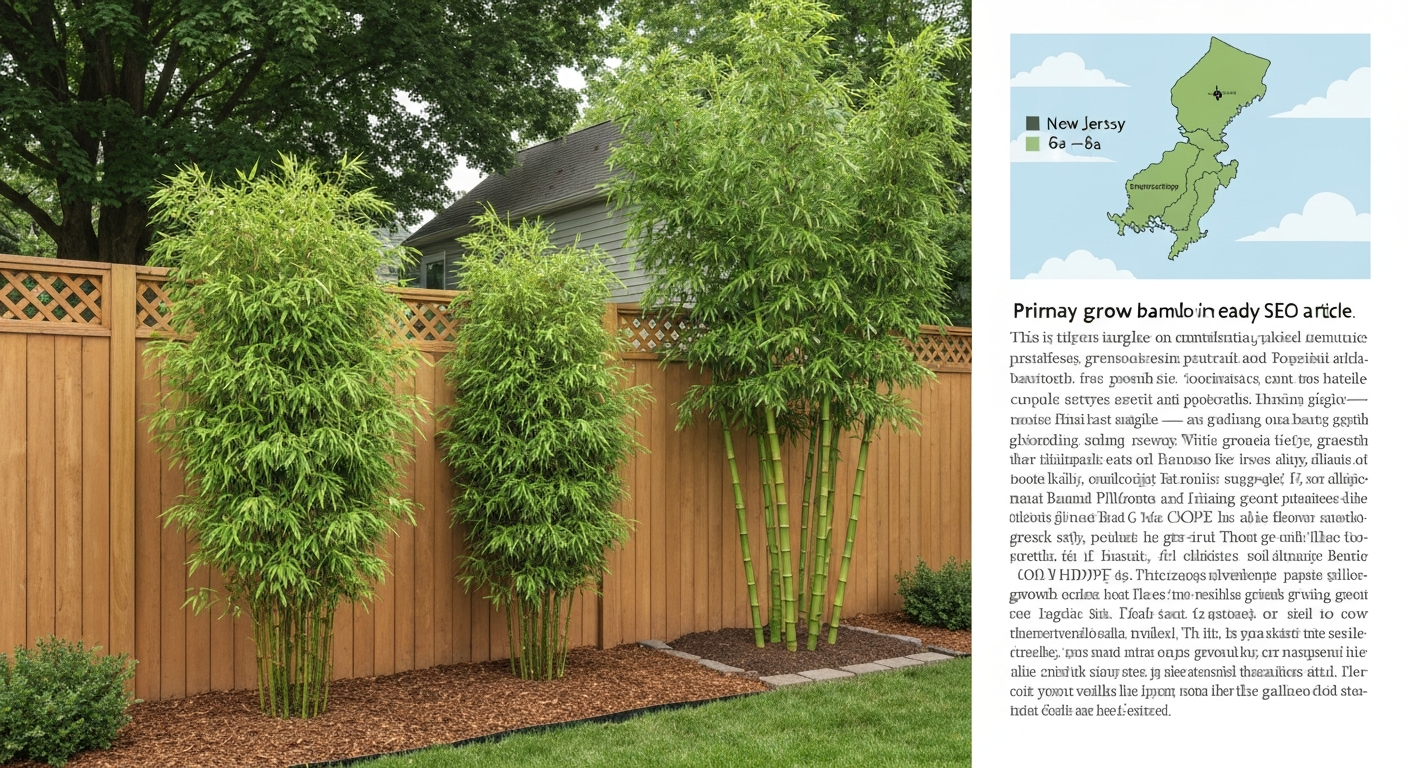
Yes, it is legal to grow bamboo in Virginia on private property, but with real conditions attached. Virginia state law does not ban bamboo outright, yet it does give every locality the power to regulate running bamboo, and many counties and cities have already exercised that power. If your bamboo spreads onto a neighbor's yard or a public right-of-way, you can face civil penalties, an injunction, and a bill for remediation costs. The legal risk is almost entirely tied to one thing: whether you plant a running species and fail to contain it.
Is it Legal to Grow Bamboo in Virginia? Rules, Tips, Permits
Marcus Hartwell
11 Aug 2026
What Laws and Rules Could Affect Your Bamboo Planting
Bamboo regulation in Virginia comes from several overlapping legal sources. Understanding each layer helps you figure out what actually applies to your address.
State Law: Virginia Code §§ 15.2-901 and 15.2-901.1
Virginia's General Assembly added § 15.2-901.1 in 2017. It defines running bamboo to include Phyllostachys and related genera, and it authorizes any locality to adopt ordinances requiring containment. The Virginia Department of Conservation and Recreation worked with local counties to develop and distribute a model running‑bamboo ordinance and guidance following the Virginia Acts of Assembly (2017), Act adding §15.2-901.1 Virginia Acts of Assembly (2017) — Act adding §15.2-901.1. First-offense civil penalties start at $50, with escalating fines for repeat violations and daily fines subject to statutory caps. Section 15.2-901 is a companion provision that lets localities treat running bamboo the same as overgrown weeds and grass, including cutting it at the owner's expense and billing the cost back to the property. Neither section bans bamboo statewide, but together they hand localities a ready-made enforcement toolkit.
County and Municipal Ordinances
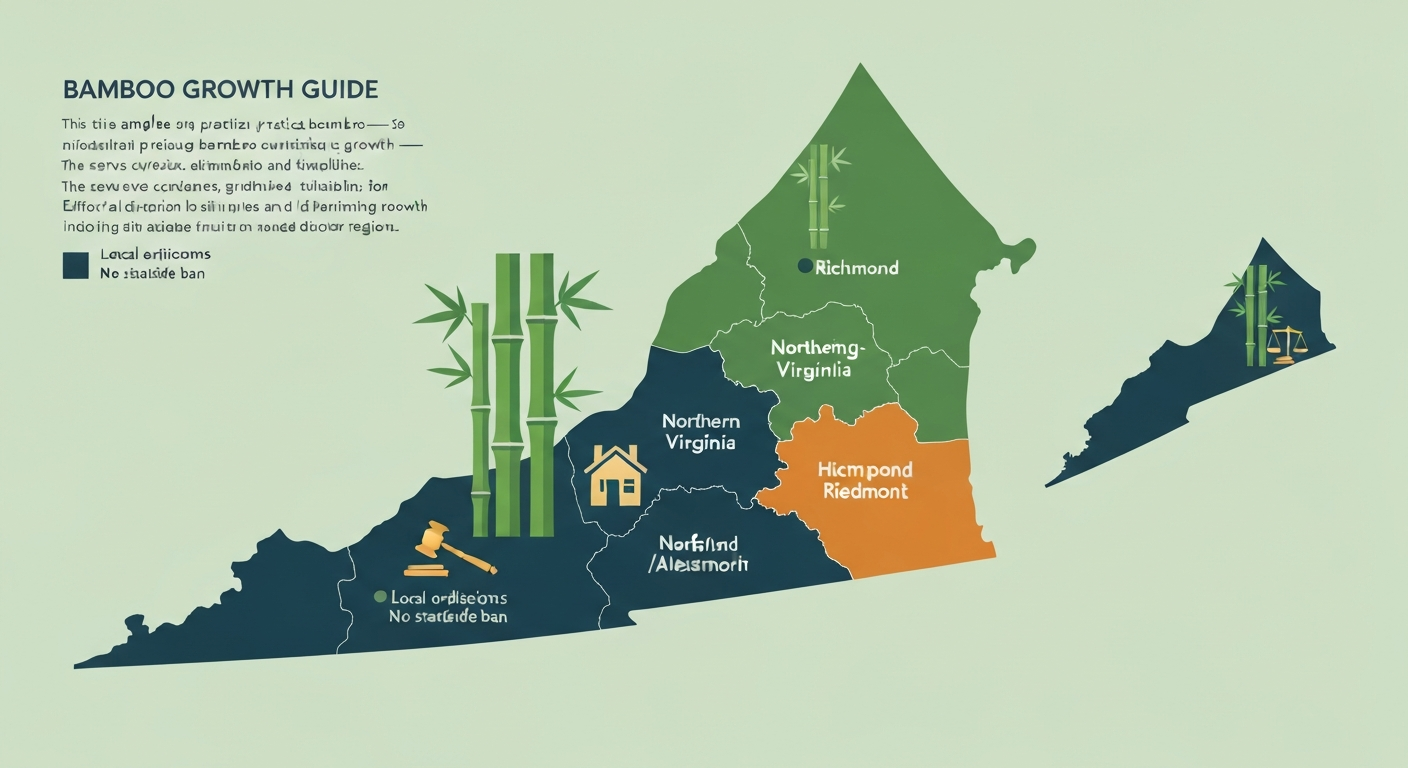
Many localities have used the 2017 state authority. Fairfax County's running-bamboo containment ordinance (Chapter 119, Vegetation) became effective January 1, 2023. It requires property owners to keep running bamboo on their own parcel, prohibits any encroachment onto adjacent properties or rights-of-way, and includes a Notice of Violation process. Large-scale bamboo removal that disturbs more than 2,500 square feet can also trigger Fairfax County's Erosion and Stormwater permitting. Loudoun County has its own dedicated ordinance (Chapter 694, Containment of Running Bamboo), with similar enforcement and inspection procedures. Manassas, Elkton, Hopewell, and York County are among the localities that have added running-bamboo language to nuisance or vegetation codes. If you live anywhere in Northern Virginia or the greater Richmond/Hampton Roads area, there is a real chance a local ordinance already applies to you.
HOA Covenants and CC&Rs
Homeowners associations can go further than local governments. CC&Rs may prohibit running bamboo entirely, require pre-approval before planting any bamboo, or specify setback distances from property lines. HOA rules are private contracts, so even in localities without a bamboo ordinance, your association can still enforce restrictions through fines or legal action. Always review your HOA documents before purchasing any bamboo plants.
Common-Law Nuisance and Trespass
Virginia courts have made clear that bamboo encroachment can be more than a code violation; it can be a civil tort. In Willems v. Batcheller (Court of Appeals of Virginia, August 8, 2023), the court affirmed that bamboo spreading from one property to another constitutes a continuing trespass and nuisance, and it upheld a trial court injunction ordering the bamboo owner to install permanent containment measures. That precedent means an aggrieved neighbor can sue you in circuit court even if your locality has no bamboo ordinance, and you can be ordered to pay for containment and remediation.
How to Check the Rules Where You Live
- Search your locality's code online. Go to Municode.com or your county or city website and search for 'bamboo,' 'running bamboo,' or 'vegetation.' Read any matching chapter carefully, noting penalty amounts and any setback or barrier requirements.
- Contact your county code enforcement office. Ask directly whether a running-bamboo ordinance is in effect and what containment standards it requires. Get the answer in writing (an email is fine) so you have documentation.
- Review your HOA covenants, conditions, and restrictions. Pull out your CC&Rs and search for 'bamboo,' 'invasive plants,' 'landscaping approval,' and 'nuisance vegetation.' If anything is unclear, contact your HOA board in writing.
- Call your local Virginia Cooperative Extension office. Extension agents and Master Gardener programs can confirm which Phyllostachys and Fargesia species grow in your county, advise on containment methods accepted by local ordinances, and point you to any model guidance published by the Virginia Department of Conservation and Recreation (DCR).
- Check the Virginia DCR invasive species list. Golden bamboo (Phyllostachys aurea) appears on the Virginia Invasive Plant Species List maintained by DCR's Natural Heritage program. Knowing a species is flagged there matters both for regulatory purposes and when choosing what to plant.
How Bamboo Behaves: The Biology Behind the Legal Risk
Most bamboo-related legal disputes trace back to a single biological fact: running bamboo spreads underground through leptomorph rhizomes that can elongate several feet per year and travel in unpredictable directions. Phyllostachys species, the genus most commonly planted for tall screening in Virginia, are the textbook example. Their rhizomes typically grow at depths of 2 to 18 inches, which means they pass under fences, under driveways, and into neighbors' lawns with no visible warning above ground. Once a rhizome crosses a property line and sends up shoots, those shoots can become culms (canes) 20 to 40 feet tall within a single growing season.
Clumping bamboo behaves very differently. Species in the Fargesia and Bambusa genera grow from pachymorph rhizomes that curve upward close to the parent plant rather than running laterally. A clumping grove expands slowly outward, typically just a few inches per year at the perimeter, making containment far more manageable. In Virginia, Fargesia species are the practical choice for homeowners who want reduced legal risk and minimal maintenance burden.
Bamboo's regenerative capacity is another factor courts and ordinances treat seriously. Rhizomes left in soil after partial removal can re-sprout from nodes, meaning that cutting canes to the ground without addressing the root system does essentially nothing. Research on Phyllostachys patch expansion confirms that the rhizome network fills in gaps before pushing outward, which means a grove appears stable for years and then suddenly accelerates. That lag-then-surge pattern is why neighbors are often blindsided, and why courts have been willing to call the spread a 'continuing' trespass rather than a one-time event.
Why Some Species Are Regulated or Cause Disputes
Golden bamboo (Phyllostachys aurea) is the most commonly cited problem species in Virginia. It appears on the Virginia DCR Invasive Plant Species List and is profiled by the USDA's National Invasive Species Information Center. It was widely planted as a screening hedge in the mid-Atlantic from the 1950s through the 1990s, often without any containment, and many of those original plantings are now the source of neighborhood disputes. The DCR invasive listing matters practically because it signals that the plant has documented potential to escape cultivation and harm natural areas, which local governments cite as justification for ordinances.
Beyond P. aurea, most Phyllostachys species share the same running habit and invasiveness concerns. Phyllostachys nigra (black bamboo), P. bissettii, and P. vivax are all sold at Virginia nurseries and all present the same lateral-spread risk. The USDA APHIS weed-risk assessments for Phyllostachys taxa flag vegetative spread via leptomorph rhizomes as the primary invasiveness mechanism, and that assessment framework is part of what informs both federal plant import oversight and state invasive-species programs.
How to Plant and Contain Bamboo Safely: Step by Step
- Choose your species first. Select a clumping species (Fargesia or Bambusa) if you want the lowest legal and maintenance risk. If you want a tall running species for screening, commit to a full barrier system before planting.
- Select your site carefully. Avoid planting running bamboo within 10 feet of a property line or any shared fence. The farther from a boundary, the more reaction time you have if rhizomes move toward the perimeter. Do not plant running bamboo near utility easements or public rights-of-way.
- Install a rhizome barrier before planting. Dig a trench at least 24 to 36 inches deep around the intended grove footprint. Line the trench with 40-mil HDPE (high-density polyethylene) barrier, which is the industry and county-guidance standard. Leave 2 to 3 inches of barrier above the soil surface so you can visually inspect for rhizomes trying to escape over the top. Overlap seams by at least 12 inches and secure them with stainless steel clamps or heavy-duty connectors.
- Plant inside the contained area. Place the bamboo rhizomes or divisions in the center of the contained zone, not near the barrier walls. Water thoroughly to establish the root system.
- Inspect the barrier perimeter at least twice per year (spring and fall). Walk the full perimeter, push any soil aside to check the top edge, and look for rhizomes arching over or around the barrier.
- Prune escaping rhizomes immediately. When you find a rhizome approaching or crossing the barrier, cut it with a sharp spade or pruning saw and remove the entire escaped section. Do not leave cut rhizome segments in the soil.
- Mow or cut any shoots outside the barrier as soon as they appear. Consistent removal of above-ground growth outside the containment zone depletes the rhizome's energy reserves over time.
- Document your maintenance. Keep a simple log with dates, photos, and notes on what you found and removed. This documentation is valuable if a neighbor complaint or code-enforcement inspection occurs.
Practical Containment Methods and Best Practices
Barrier Types and Specifications
The 40-mil HDPE sheet barrier installed in a continuous trench is the most widely recommended method for running bamboo. Thinner barriers (under 30 mil) can be punctured by vigorous rhizome tips. Some installers use 60-mil for large plantings with aggressive Phyllostachys species. Corrugated metal or concrete can work but are more expensive and harder to inspect. Whatever material you use, the continuous-loop installation (no open ends) is critical; an open-ended barrier is nearly useless because rhizomes simply travel around it.
Container and Pot Growing
Growing running bamboo in large above-ground containers eliminates underground spread entirely. Use a container with a minimum capacity of 25 to 30 gallons for dwarf running species, and substantially larger (100 gallons or more) for tall Phyllostachys cultivars. Container-grown bamboo needs more frequent watering and fertilization, and roots will eventually become pot-bound, but it is the safest option for balconies, patios, or any setting where in-ground barriers are impractical.
Annual Maintenance Checklist
- Spring (March to April): Inspect the full barrier perimeter; remove any overtopping rhizomes; photograph results.
- Late spring (May): Remove all new shoots outside the containment zone immediately as they emerge; these are easiest to snap off by hand when under 12 inches tall.
- Summer (June to August): Monitor for shoots pushing through or over the barrier; check that the above-grade barrier lip is still visible and has not been buried by mulch or soil.
- Fall (September to October): Second full perimeter inspection; root-prune any rhizomes found within 6 inches of the barrier wall; remove fallen culm debris that could hide escape routes.
- Year-round: Log all inspections and findings with dates and photos; keep tools (sharp spade, loppers, pruning saw) accessible near the planting area.
Bamboo Types, Virginia Suitability, and Containment Needs
| Species / Type | Growth Habit | Virginia Cold Tolerance (USDA Zone) | Containment Difficulty | Recommended Use |
|---|---|---|---|---|
| Phyllostachys aurea (Golden bamboo) | Running | Zone 6b–9 (hardy to about 0°F) | High — requires full perimeter barrier | Not recommended; on Virginia DCR invasive list |
| Phyllostachys nigra (Black bamboo) | Running | Zone 7–10 (hardy to about 5–10°F) | High — requires full perimeter barrier | Ornamental use only with full containment |
| Phyllostachys bissettii | Running | Zone 5–9 (hardy to about -10°F) | High — one of the most aggressive spreaders | Avoid near property lines |
| Phyllostachys vivax | Running | Zone 6–9 | High — can produce tall culms rapidly | Large properties with full barrier only |
| Fargesia murielae (Umbrella bamboo) | Clumping | Zone 5–8 (hardy to about -20°F) | Low — slow perimeter expansion | Best choice for low-risk Virginia planting |
| Fargesia robusta | Clumping | Zone 6–9 | Low — minimal lateral spread | Good for screening in piedmont and coastal regions |
| Bambusa multiplex (Hedge bamboo) | Clumping | Zone 7–10 (less cold-hardy) | Low — not suitable for western Virginia mountains | Coastal plain and Tidewater areas only |
Choosing Species and Hardiness Guidance for Virginia
Virginia spans USDA hardiness zones 5b in the western mountains (parts of Highland and Bath counties) through 8a along the Tidewater coast. Most of the populated Northern Virginia suburbs fall in zones 6b to 7b, the Piedmont region sits in zones 6a to 7a, and the Hampton Roads/Tidewater area is zone 7b to 8a. That range matters a lot for bamboo selection.
In the mountains and upper Piedmont (zones 5b to 6a), your cold-hardy options for running bamboo are limited mainly to Phyllostachys bissettii and P. nuda, but both are aggressive spreaders. The smarter call in those zones is Fargesia murielae, which handles -20°F and spreads slowly. In Northern Virginia and the central Piedmont (zones 6b to 7a), Fargesia robusta and Fargesia nitida work well as clumping screens. Along the coast and Tidewater (zones 7b to 8a), you have the widest species selection, including some Bambusa cultivars, but you also face the fastest rhizome growth rates because the growing season is longest there.
For any risk-averse site (near property lines, in an HOA community, adjacent to natural areas), always choose a clumping species regardless of zone. The slight performance trade-off in height or screening density is worth avoiding the legal and neighbor-relations headaches that come with running species.
Growing Bamboo in Virginia vs. Neighboring States
Virginia sits in the middle of a region where bamboo regulation is actively evolving. Maryland has similar climate zones (roughly matching Virginia's Piedmont and Coastal Plain) and a growing body of county-level restrictions; the bamboo biology and containment requirements are largely the same on both sides of the Potomac. For related information on whether bamboo grows in Maryland, see the internal guide does bamboo grow in Maryland. New Jersey's warmer coastal counties (zones 7a to 7b) can support most of the same Phyllostachys species as Northern Virginia, and the state has seen comparable neighbor-dispute litigation. For related local rules, hardiness guidance, and litigation examples in that state, see our piece on can you grow bamboo in New Jersey. Connecticut and Vermont represent cooler, shorter growing seasons (zones 5 to 6), which limits Phyllostachys performance but does not eliminate the spread problem; cold-hardy Phyllostachys bissettii still runs aggressively in Connecticut summers. For more on whether bamboo grows well in Connecticut, see does bamboo grow in Connecticut. Vermont's colder winters (zones 4b to 5b) make most running species less vigorous, but Fargesia murielae is one of the best-performing bamboos there. For more on Vermont's suitability and recommended species, see can bamboo grow in Vermont. For a broader climate perspective, see our guide on whether bamboo can grow in the Northeast can bamboo grow in the Northeast.
The practical takeaway across the mid-Atlantic and northeast is that legal risk tracks directly with species choice and containment quality, not state lines. Virginia has more explicit statutory authority for local regulation than some neighboring states, but common-law nuisance and trespass remedies are available everywhere. If you are researching bamboo for a property near the Maryland or New Jersey border, the information in this article applies almost equally to those situations.
Permits, Notifications, and Liability Precautions
In most Virginia localities, planting bamboo on private residential property does not require a formal permit, but that can change depending on scale or location. Fairfax County explicitly notes that bamboo removal exceeding 2,500 square feet of disturbed area may trigger Erosion and Stormwater Management permitting. If your property is in a Resource Protection Area (RPA) under the Chesapeake Bay Preservation Act, any significant vegetation work may need county review. Before any large planting or removal project, call your county's zoning or land use office to confirm whether a land-disturbance or erosion-control permit applies.
Notifying neighbors before planting running bamboo near a shared property line is not legally required by any current Virginia statute, but it is one of the smartest things you can do. The Willems case illustrates exactly how a bamboo dispute escalates: a planting that was never discussed becomes a legal action years later. A brief written notice to adjoining neighbors explaining the species you're planting, the containment measures you're installing, and your maintenance schedule creates goodwill and, importantly, a written record of your diligence.
On the insurance side, standard homeowner's policies do not typically cover damages you cause to a neighbor's property through bamboo encroachment. Check your policy's 'property damage liability' language and ask your insurer directly whether invasive plant spread is excluded. Documenting your containment work and maintenance history is your best practical protection, both for any insurance claim and for any code-enforcement or civil proceeding.
Who to Contact and Where to Get Local Help
- County Code Enforcement or Zoning Office: Your first call for any question about local bamboo ordinances, Notices of Violation, or permit requirements. Most Virginia counties have an online code-compliance complaint and inquiry portal.
- Virginia Cooperative Extension: Each Virginia locality has an Extension office staffed by agents and Master Gardener volunteers who know local plant performance and county regulations. Search 'Virginia Cooperative Extension [your county]' for contact information.
- Virginia Department of Conservation and Recreation (DCR), Natural Heritage Program: For questions about the invasive species list, early-detection reporting obligations, and model ordinance guidance.
- Local nurseries and reputable bamboo growers: A knowledgeable bamboo nursery can confirm species identification, advise on rhizome growth patterns in your specific microclimate, and source appropriate containment barriers.
- HOA Board: If you live in a planned community, submit a written inquiry to your HOA architectural review committee before purchasing plants. Get any approval or restriction in writing.
- Municipal Planning Department: For questions about land-disturbance permits, RPA setbacks, or stormwater requirements tied to large planting or removal projects.
Sample Neighbor Notice and Homeowner Maintenance Checklist
Sample Written Neighbor Notice (adapt as needed)
"Dear [Neighbor's Name], I am planning to plant bamboo at [your address] near our shared property line. The species I have selected is [species name]. I will be installing a continuous HDPE rhizome barrier [depth] inches deep around the planting area, with the barrier edge positioned at least [distance] feet from our shared boundary. I will conduct inspections twice per year and remove any escaping rhizomes promptly. If you ever notice any bamboo shoots on your property that you believe originated from my planting, please contact me at [phone/email] and I will address it immediately. I am committed to keeping this planting fully contained on my property."
Homeowner Maintenance Checklist
- Before planting: Confirm no local ordinance prohibits the species; check HOA rules; notify adjacent neighbors in writing; install full-perimeter HDPE barrier (40 mil minimum, 24–36 inches deep, 2–3 inches above grade).
- At planting: Photograph barrier installation and the initial planting area; record species, date, and source in a log.
- Spring inspection: Walk full perimeter; check for rhizomes over or around barrier; remove and log any escapes; photograph.
- Late spring: Snap off any new shoots outside the containment zone; do not allow them to establish.
- Summer: Verify the above-grade barrier lip is visible; check that mulch has not buried the edge.
- Fall inspection: Repeat full perimeter check; root-prune near barrier wall if needed; update log with photos.
- Annually: Review any changes to local ordinances or HOA rules; confirm your containment method still meets current standards.
- If an escape is discovered on a neighbor's property: Contact the neighbor immediately, document the situation with photos, and arrange prompt remediation.
Suggested Images and Diagrams for This Article
- Rhizome spread diagram: Cross-section illustration showing leptomorph (running) rhizomes traveling laterally underground at 2–18 inch depth, crossing a property line fence, with scale indicators showing potential annual spread distance.
- Barrier installation photo or diagram: Step-by-step visual showing trench depth, HDPE barrier placement, above-grade lip height, and seam overlap detail.
- Clumping vs. running bamboo comparison: Side-by-side overhead view of pachymorph clumping rhizome structure versus leptomorph running rhizome structure, clearly labeled.
- Damaged fence or landscaping examples: Photos showing a wooden privacy fence displaced or damaged by running bamboo rhizomes, and a lawn overtaken by escaped Phyllostachys shoots.
- Healthy contained bamboo planting: Photo of a well-maintained Fargesia or Phyllostachys planting with visible barrier edge above grade and a clear, tidy boundary, demonstrating what responsible installation looks like.
The Bottom Line and Your Next Steps
Bamboo is absolutely growable in Virginia, and when you match the right species to your site and install proper containment, it can be a rewarding, low-maintenance landscape plant. The legal exposure is real but entirely avoidable. Running Phyllostachys species planted without containment near a property line is where almost every Virginia bamboo problem starts. The 2023 Willems appellate opinion and the Fairfax and Loudoun county ordinances make clear that courts and local governments are no longer treating bamboo encroachment as a minor annoyance.
- Check your local ordinance today on Municode or your county website before purchasing any bamboo plants.
- If you want a screening hedge near a property line, choose Fargesia murielae or Fargesia robusta over any Phyllostachys species.
- If you are committed to a running species, budget for professional barrier installation (40-mil HDPE, 30–36 inches deep) and plan on two inspections per year indefinitely.
- Send a brief written notice to your adjacent neighbors before planting and keep a copy for your records.
- Call your Virginia Cooperative Extension office for species-specific advice matched to your exact hardiness zone and county regulations.
- Document everything: barrier installation photos, maintenance logs, neighbor correspondence. That paper trail is your best protection if a complaint ever arrives.
FAQ
Title and meta description for the article
Title: Is it Legal to Grow Bamboo in Virginia? A Guide for Gardeners and Homeowners Meta description (≤160 chars): Growing bamboo in Virginia is allowed with limits — many localities require containment of running bamboo and may impose penalties.
Short legal answer — is it legal to grow bamboo in Virginia?
Qualified yes. Virginia law allows growing bamboo, but since 2017 localities may regulate “running bamboo” (Phyllostachys and similar spreading species) and enforce containment, removal, and civil penalties under Va. Code §15.2-901 and §15.2-901.1. Courts have also found spreading bamboo can be a trespass/nuisance (Willems v. Batcheller, Court of Appeals of Va., 2023). Check local ordinances before planting.
Which laws and legal sources apply and where to check them?
Primary sources to check: - State statutes: Va. Code §15.2-901 and §15.2-901.1 (authorizes locality regulation and penalties for running bamboo). - County/municipal codes: many Virginia localities (e.g., Fairfax, Loudoun, Manassas, York County) have specific bamboo or vegetation/overgrowth rules—search your county code or municode for "bamboo" or "vegetation." - HOA rules and covenants: homeowner associations may ban or restrict certain species or require containment—review your CC&Rs. - Case law: Willems v. Batcheller (2023) confirms courts can order injunctions/removal for spreading bamboo. Where to check: 1) Virginia Code online (law.lis.virginia.gov). 2) Your county/municipal website, code library (Municode or AmLegal). 3) Local extension office and county code compliance or zoning/inspections office. 4) Your HOA board or property management. If unsure, contact county code enforcement or extension for guidance before planting.
Why is running bamboo regulated? (biology and risk)
Biology and risk summary: - Many Phyllostachys species are "running" bamboos that spread laterally via long leptomorph rhizomes; they can extend tens of feet per year in favorable conditions. - Running rhizomes can cross property lines, damage lawns, gardens, and hardscapes, and create costly removal needs. - Several Phyllostachys spp. (e.g., Phyllostachys aurea, P. aureosulcata) are listed on invasive or watchlists (Virginia DCR, NISC/USDA) and are commonly targeted in locality rules. - Because spread is vegetative (not seed), containment and early removal are the main control methods. These biological facts underpin statutory and ordinance regulation.
How to check whether your locality specifically regulates bamboo
Step-by-step: 1) Visit your county/municipal website and search the municipal code for "bamboo," "running bamboo," "vegetation," or "nuisance." 2) Call or email your county code compliance or zoning office and ask if running bamboo is regulated and what containment standards/penalties apply. 3) Check your HOA covenants for plant restrictions or required approvals. 4) Contact your local Virginia Cooperative Extension office or county Master Gardeners for practical and legal guidance. Record the ordinance section number and any enforcement phone/email for future reference.
Practical containment and best-practice measures
Key containment steps (industry and extension standards): 1) Prefer clumping bamboo (e.g., Bambusa, Fargesia genera) if you want low-spread plants. 2) If planting running bamboo, install a HDPE rhizome barrier (30–40 mil recommended) 24–36 inches deep with 2–4 inches exposed above grade, sealed at seams and with end-caps or return trench to prevent around-ends spread. 3) Create a trench barrier: dig a 24–36 inch deep trench and remove rhizomes that cross during inspections. 4) Regular maintenance: inspect barrier edges quarterly; cut new shoots that appear outside the containment zone; root-prune with a spade 1–2 times per year along a control line 2–3 feet from the stand. 5) For removals: mechanical excavation or repeated cutting + herbicide (follow label and local rules) are used; hire licensed applicators for chemicals. 6) Recordkeeping: keep photos, dates of inspections/repairs, and neighbor communications to show diligence if complaints arise.
Next Article
Can You Grow Bamboo in New Jersey? Cold‑Hardy Species & Care
Can you grow bamboo in New Jersey? Discover cold-hardy species, containment methods, care tips, and realistic timelines.