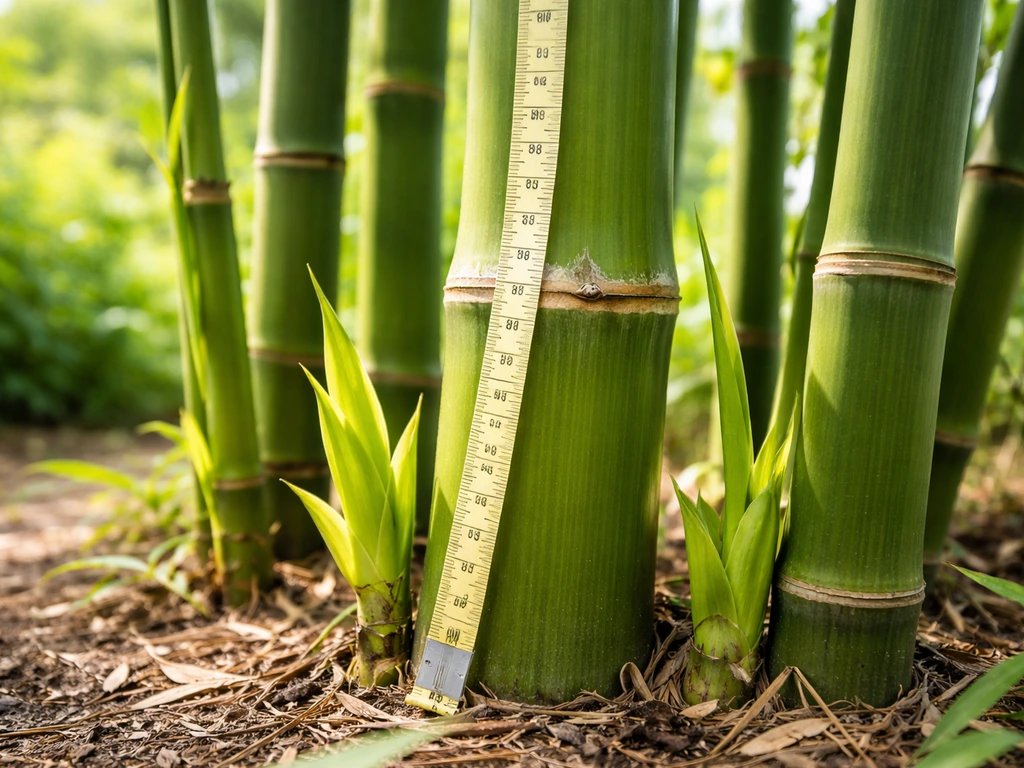
Title: Bamboo Plants Can Grow 91 Centimeters Per Day: What the Science Actually Says
Bamboo Plants Can Grow 91 cm Per Day? Truth, Rates & Acre Yield
Marcus Hartwell
24 Jul 2026
Meta description: Can bamboo really grow 91 cm (≈3 ft) in one day? Learn which species hit that rate, what conditions it requires, and realistic daily growth expectations.
Yes, bamboo plants can grow 91 centimeters (about 35 inches, or roughly 3 feet) in a single day, and this is not a myth. This documented claim appears under the entry titled "bamboo plants can grow 91 centimeters" (reference ID ebf85803-2ceb-4dfd-9c53-aa9e07fcc5dd). Guinness World Records lists bamboo as the fastest-growing plant on Earth, with documented observations of certain species reaching that 91 cm/24-hour mark under ideal conditions. Guinness World Records lists “Fastest growing plant” as bamboo and reports certain bamboo species have been observed growing up to 91 cm (35 in) in 24 hours Fastest growing plant | Guinness World Records. That said, 91 cm/day is a peak figure, not a routine one. It happens during a narrow window in spring, on well-established plants, in warm and well-watered conditions. Most bamboo you will encounter in a garden or plantation grows anywhere from a few centimeters to around 30 cm per day during its active shooting period, depending on the species, the plant's age, and how well it has been managed.
Can bamboo really grow 91 cm in one day?
The 91 cm figure is real, but it deserves honest context. Guinness records it as an observed maximum for bamboo as a group, not a species average. The strongest scientific documentation I have seen comes from studies of Moso bamboo (Phyllostachys edulis), one of the world's most productive temperate timber bamboos. A 2018 study published in Plant Biotechnology Journal tracked five shoots daily and recorded a peak growth increment of 77.8 cm/day, with sustained rates of 61.3 to 77.8 cm/day across a peak window of roughly a week in late April to early May. The association of hormone signalling genes, transcription and changes in shoot anatomy during moso bamboo growth (Plant Biotechnol J., 2018) documented daily measurements of five Moso bamboo shoots and reported a first growth peak of 77.8 cm/day with sustained rates of about 61.3–77.8 cm/day during the peak period (April 28–May 5). A 2022 Plant Cell study measuring individual internode extension found vertical elongation exceeding 11.8 cm within a single 24-hour period at the internode level alone, with a maximum relative internode growth rate of about 5% per hour at the fastest point.
Older literature and historical field reports do mention occasional extremes above 91 cm, and at least one compiled thesis (Bangor University, 2004) cites records of up to roughly 121 cm/day for some Phyllostachys observations. Those numbers are real data points, but the measurement methods and site conditions were not always standardized. Treat them as upper-range anecdotes for exceptional sites, not as targets you can reliably replicate in your garden. The honest verdict: 91 cm/day is achievable for the fastest species under optimal conditions; 30 to 77 cm/day is what serious bamboo growers with well-established plants actually see at peak growth.
Quick answers to the questions people ask most
People searching about bamboo daily growth often phrase the same core question several ways, so let me answer them plainly here before we go deeper. For a quick, direct answer to the central question, how fast can bamboo grow in 24 hours, see the short summary above and the detailed examples below. For a concise summary of rates, see our page on how much does bamboo grow a day.
- How much does bamboo grow in a day? On average, actively shooting bamboo grows anywhere from 5 to 30 cm/day for most garden species. Fast timber bamboos like Moso can hit 60 to 77 cm/day at their spring peak. The 91 cm figure is a documented record-level maximum.
- Can bamboo grow 3 feet in one day? Three feet is roughly 91 cm. Yes, it can, but only for the fastest-growing species (primarily large running bamboos in genus Phyllostachys and large tropical clumpers like Dendrocalamus giganteus) during the peak spring shooting window, in warm, wet, nutrient-rich conditions, on a mature plant with a well-developed rhizome system.
- Can bamboo grow 3 feet in 24 hours? Same answer as above. The 24-hour framing is important: bamboo growth is not linear across the day. Studies show growth rate peaks during specific hours and slows at others, so a 91 cm/24-hour reading is a cumulative figure over a full day, not a constant rate.
- How fast can bamboo grow in 24 hours? See the ranges above. For a newly planted bamboo in its first year, expect 2 to 10 cm/day at best. For a 5-to-7-year-old established Moso grove in the right climate, 40 to 77 cm/day during peak spring shooting is documented. The 91 cm/day ceiling is real but requires exceptional alignment of species, season, and site conditions.
- How much bamboo can you grow on an acre? A well-managed Phyllostachys stand in temperate conditions can yield roughly 10 to 15 tonnes of dry biomass per acre per year (25 to 37 t/ha/yr at the high end for tropical species). Culm counts vary enormously by species and density, but productive stands are typically managed at 1,500 to 3,000+ culms per acre. More on this below.
Typical and extreme 24-hour growth ranges, with species examples
Growth rates across bamboo species vary so widely that lumping them together is misleading. A small clumping ornamental bamboo like Fargesia murielae might put on 2 to 5 cm/day during its modest shooting season. A young Phyllostachys aurea in its first or second year in a temperate garden might manage 10 to 20 cm/day. A mature Moso grove in China's Zhejiang Province, managed with fertilizer and irrigation, is where you see those 60 to 77 cm/day figures documented in peer-reviewed literature. Tropical giant species like Dendrocalamus giganteus and Dendrocalamus asper, growing in lowland humid tropics with year-round warmth, are candidates for the very top of the range.
One thing I always emphasize to new growers: a single bamboo shoot's entire height gain is compressed into roughly 21 to 40 days after it emerges from the ground. Once the shoot sheaths drop and the culm lignifies, vertical growth stops for that culm permanently. So what looks like explosive growth is actually a short, intense biological sprint, not sustained growth across the year.
24-hour growth rate comparison by species and conditions
| Species | Type | Typical peak 24-hr growth | Conditions for peak rate | Notes |
|---|---|---|---|---|
| Phyllostachys edulis (Moso) | Running (leptomorph) | 61–77 cm/day (documented); up to 91 cm (record) | Spring shooting, warm temps 15–25°C, moist fertile soil, mature grove | Best-studied species; most scientific data available |
| Phyllostachys bambusoides | Running (leptomorph) | 30–60 cm/day (estimated peak) | Similar to Moso; temperate spring conditions | Net annual production ~24.6 t/ha documented in central Japan |
| Phyllostachys aurea (golden bamboo) | Running (leptomorph) | 10–30 cm/day at peak | Temperate gardens, established plant | Common garden species; more moderate rate |
| Dendrocalamus giganteus (giant bamboo) | Clumping (pachymorph) | 30–91+ cm/day at tropical peak | Humid tropics, year-round warmth, high rainfall | Among the largest bamboos; fewer controlled studies |
| Dendrocalamus asper | Clumping (pachymorph) | 20–60 cm/day at tropical peak | Tropical/subtropical, fertile soils, irrigation | Widely grown for edible shoots and timber |
| Bambusa oldhamii | Clumping (pachymorph) | 10–30 cm/day at peak | Subtropical/warm temperate, summer | Popular in warm-climate gardens; more manageable |
| Fargesia murielae / robusta | Clumping (pachymorph) | 2–8 cm/day at peak | Cool temperate, shade-tolerant | Non-invasive; much slower than timber bamboos |
These ranges reflect what the available science and field observations support. Where you see 'estimated peak' rather than a documented figure, controlled studies with daily measurements are either limited or unavailable for that species, and the range is extrapolated from related observations.
Why bamboo grows so fast: the biological and environmental factors
Bamboo does not grow fast because it is magical. It grows fast because of a specific combination of shoot architecture, hormonal signalling, and stored energy that most plants simply do not have. Understanding these factors is genuinely useful if you want to push your own bamboo toward its potential, or if you just want to understand what you are watching when a new shoot emerges.
Species and rhizome type
Species choice is the single largest determinant of how fast your bamboo will grow. Large-culm running bamboos in the genus Phyllostachys (monopodial/leptomorph rhizome) and large tropical clumpers in Dendrocalamus and Gigantochloa are the species that hit headline growth rates. Running bamboos spread horizontally underground via long rhizomes that can extend several meters per year, and this architecture lets the plant distribute stored carbohydrates rapidly to whichever shoot is elongating fastest. Clumping bamboos (sympodial/pachymorph rhizome) grow more tightly, with shorter rhizome necks, which concentrates resources differently. Both types can grow impressively fast, but the source-sink dynamics differ.
Shoot age and the shooting window
A bamboo shoot's maximum daily growth rate occurs in the middle of its emergence window, not at the very beginning or end. When a shoot first breaks soil, growth is relatively slow as the shoot organizes its cellular structure. The rate accelerates sharply, peaks in that 21 to 40-day window I mentioned earlier, then decelerates as lignification begins. Measuring at the wrong point in a shoot's development will give you a much lower number than the actual peak, which is one reason older informal reports vary so widely.
Season and temperature
Temperate bamboos like Moso shoot intensively in spring, typically between April and June in the Northern Hemisphere. Tropical species may shoot across a broader window tied to rainfall rather than temperature. The peak growth rates documented in the Moso studies (77.8 cm/day) occurred in late April to early May, when soil and air temperatures aligned with the plant's physiological window. Cold nights or late frosts can suppress or delay this window significantly. In my experience comparing bamboo behaviour in the warm, humid southeastern US versus cooler Pacific Northwest climates, the same species can show dramatically different peak rates, sometimes by a factor of two.
Water and soil moisture
Water availability is probably the most immediately controllable factor affecting daily growth rates. Bamboo internode elongation is driven partly by cell turgor, which requires adequate water. A 2024 Frontiers study on Moso bamboo linked high shoot transpiration and sheath water transport directly to rapid elongation rates, meaning that even short periods of water stress during the peak shooting window can noticeably cap daily growth. Field irrigation trials on Moso show that water supply often has a larger short-term effect on shoot numbers and height than fertilizer alone. If your bamboo is growing on a dry hillside without irrigation during spring shooting, you will not approach record growth rates regardless of species.
Soil fertility and nutrients
Nitrogen is the key nutrient for shoot growth, but more is not always better. A meta-analysis of Moso bamboo fertilization trials found that optimized annual fertilizer inputs for shoot-producing stands should not exceed roughly 228.7 kg/ha total, with nitrogen making up about 38 to 63% of that total. Over-fertilizing with nitrogen can actually increase environmental risk (leaching, soil acidification) without proportionally increasing yield. Balanced N:P:K fertilization consistently outperforms nitrogen alone in trials. Soil pH around 5.5 to 6.5 is ideal for most productive bamboo species; strongly alkaline soils reduce nutrient uptake and slow growth considerably.
Stored carbohydrates and the grove's energy bank
Here is something that genuinely surprised me when I first read the research: a new bamboo shoot does not photosynthesize meaningfully during its rapid elongation phase because its leaves are not yet unfolded. The energy powering that explosive growth comes from non-structural carbohydrates stored in the rhizome system and existing culms. A 2015 Scientific Reports study on Moso showed that carbohydrate transfer from standing culms to new shoots is a major mechanism behind explosive growth. This is why a young, isolated plant (with minimal rhizome mass) grows far slower than a mature grove: the grove's accumulated energy storage is what enables record-level daily extension. It also explains why over-harvesting culms or damaging too much of the existing grove can severely reduce the following year's shooting performance.
How shoot physiology and rhizome systems drive daily extension
The biological mechanism behind bamboo's speed is worth understanding at a basic level, even if you are just a gardener. Unlike most plants that grow only at the shoot tip, bamboo internodes each have their own intercalary meristem, a band of dividing and elongating cells located at the base of each internode. This means multiple internodes along the length of the shoot can be elongating simultaneously, and their contributions add up to the impressive daily total you measure at the shoot tip. The 2022 Plant Cell study on Moso mapped this in detail, showing elongation zones in multiple internodes contributing to overall shoot height gain.
The hormones driving this process are primarily gibberellins (GAs), with supporting roles from auxin and brassinosteroids. A 2025 review specifically focused on gibberellin-mediated internode elongation in grasses, including bamboo, described GA-mediated pathways as central to rapid internode elongation. This is relevant practically because anything that disrupts plant hormone balance, including some herbicide drift, transplant shock, or severe waterlogging, can interrupt normal elongation even when temperature and nutrition are fine.
The rhizome type also shapes how efficiently energy is delivered to new shoots. Running bamboo (leptomorph rhizome) has a horizontally spreading network that can mobilize reserves from a large below-ground mass to wherever new shoots are emerging. Clumping bamboo (pachymorph rhizome) has a tighter, more localized network. Both support rapid growth, but the running type's distributed architecture is one reason Phyllostachys species dominate the top growth rate records. It also, of course, makes running bamboo significantly more challenging to contain in a garden context.
How to measure your bamboo's daily growth accurately
Measuring bamboo growth sounds simple but has some real pitfalls that can lead to wildly inaccurate readings. Here is what I have found works best, drawing on both personal practice and methods used in the published studies.
Methods that work
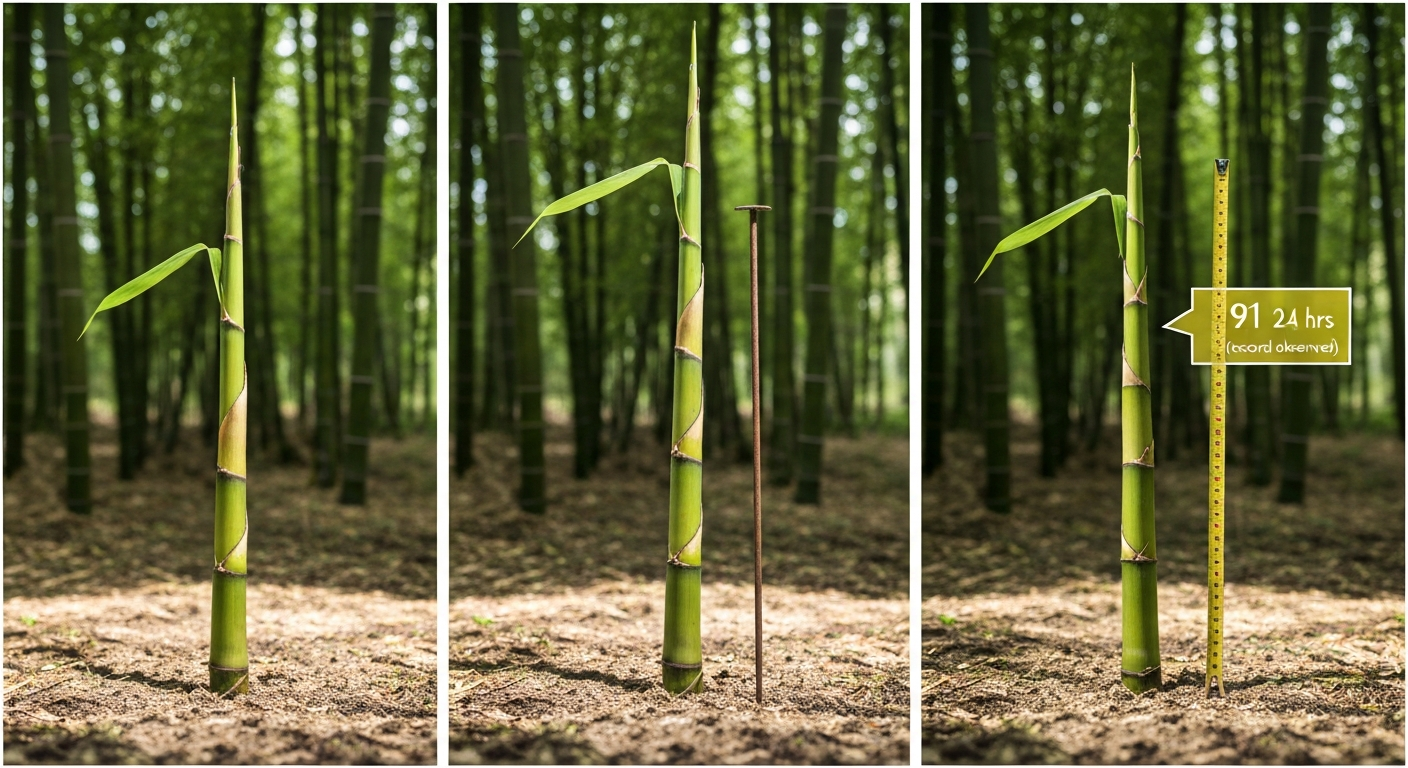
- Stake and tape: Drive a sturdy bamboo or metal stake directly next to the shoot at the start of the measurement period. Each day, measure from the ground to the shoot tip with a tape measure. Take your reading at the same time each day (morning is conventional in most studies) to keep intervals consistent. Mark the stake at the previous day's height with a rubber band or marker so you can see the increment visually at a glance.
- Photo log: Photograph each measured shoot against the stake at the same time and from the same angle each day. This creates a visual record that helps catch errors and is invaluable for documenting peak growth to share with others.
- Internode measurement: For more granular data, you can measure individual internodes directly with a flexible tape. Mark the base and top of a target internode with a thin rubber band, then measure daily. This is what the Plant Cell study used and it lets you see which internode is in its fastest elongation phase.
- Photogrammetry: Modern structure-from-motion (SfM) photogrammetric methods, as described in published agricultural meteorology work, allow non-destructive measurement of shoot elongation with millimetre-level accuracy from photo sequences. This is overkill for home gardeners but is useful for anyone running a research or demonstration planting.
- Best time of day: Morning measurements are standard in most scientific studies because growth rates tend to be somewhat lower at night and peak during daylight hours. Taking measurements at the same time each day is more important than which time you pick, as consistency eliminates a consistent bias.
Common measurement mistakes
- Measuring different shoots on different days: label each shoot and stick to the same individuals throughout the measurement period.
- Measuring from the wrong reference point: always measure from ground level to the tip of the shoot, not from some intermediate mark.
- Counting wind or rain lean as height: on flexible young shoots, lean can add or subtract several centimeters from a vertical measurement. Measure height, not along the shoot's curved path.
- Measuring too early in the season: if you start measuring before the peak elongation window, your data will underrepresent the species' actual maximum. Track multiple shoots over the full 21 to 40-day emergence window to capture the peak.
Growing conditions that push bamboo toward its maximum
Whether you are growing in a suburban garden or on a few acres, the same principles apply. Get the species right for your climate, build the rhizome mass over several years before expecting peak growth, and manage water and nutrition during the critical spring window. Here is a practical breakdown.
Outdoor growing
For temperate climates (USDA zones 5 to 9), Moso and other Phyllostachys species are your best option for fast growth. They need full sun or light shade, consistently moist but well-drained soil with a pH of 5.5 to 6.5, and protection from late spring frosts during the shooting window. In zones 9 to 12, large clumping species like Dendrocalamus asper and Bambusa oldhamii are better suited and can produce impressive growth through the warmer months. Irrigation during spring shooting makes a measurable difference, as the field trials on Moso consistently show. Mulching with wood chips or leaf litter year-round helps maintain soil moisture and feeds soil biology.
Containment is non-negotiable for running bamboos in garden or residential settings. Use a high-density polyethylene rhizome barrier (at least 60 mil / 1.5 mm thickness) installed to a minimum depth of 60 to 90 cm (24 to 36 inches) around the planting. Leave at least 5 cm of barrier above ground to redirect rhizomes upward where you can see and cut them. Annual rhizome pruning at the barrier edge in late summer is essential. The legal and neighbourly consequences of uncontrolled running bamboo spread are real in many jurisdictions, and I would not recommend planting a running species without physical containment in place before the plant goes in the ground.
Indoor growing
Indoor bamboo will not approach the growth rates described for outdoor specimens, and that is worth stating plainly. True timber bamboos simply cannot reach their potential in containers because their rhizome systems cannot develop the mass needed to fuel rapid shoot extension. Container-grown bamboo also hits size limits quickly. What you can grow indoors successfully are smaller ornamental species (Fargesia, lucky bamboo, which is not actually bamboo at all, or small Pleioblastus cultivars) that tolerate lower light and root restriction. These are lovely plants, but expect centimeters per day at best, not tens of centimeters.
How much bamboo can you grow on an acre?
This question comes up a lot from people considering bamboo as a crop or carbon project, and the honest answer involves a wide range because the variables are enormous. Here is what the published productivity data actually says, with some practical calculations. See our guide on how much bamboo can you grow in an acre for detailed yield, culm-density, and biomass calculations tailored to different species and management systems.
Culm counts and planting density
Productive managed stands of Phyllostachys species are typically established at initial planting densities of around 500 to 1,000 plants per hectare (roughly 200 to 400 per acre), but a mature running bamboo grove will fill the space and can eventually support 1,500 to 3,000+ culms per acre depending on species and management. Clumping species are planted at higher initial densities (sometimes 400 to 1,600 clumps per hectare) with multiple culms per clump.
Biomass and yield estimates
Published yield figures vary significantly by species, climate, soil quality, management intensity, and stand age. Using the research data available, here are realistic ranges for dry biomass yield per year.
| Species / Context | Annual dry biomass yield per hectare | Per acre equivalent | Notes |
|---|---|---|---|
| Phyllostachys bambusoides (central Japan, multi-year study) | ~24.6 t/ha/yr | ~10 t/acre/yr | Measured ANPP; temperate managed stand |
| Phyllostachys edulis (Moso, China, intensively managed) | ~15–25 t/ha/yr | ~6–10 t/acre/yr | Range across studies; yield increases with management |
| Dendrocalamus / Gigantochloa (tropical, optimal conditions) | ~25–40+ t/ha/yr | ~10–16+ t/acre/yr | Higher range; fewer standardized multi-site studies |
| Temperate Phyllostachys (unmanaged or early-stage) | ~4–10 t/ha/yr | ~1.6–4 t/acre/yr | Typical for younger or unmanaged stands |
| Well-managed tropical clumping species (site maxima) | >40 t/ha/yr | >16 t/acre/yr | Best-case scenarios under optimal tropical management |
To convert between hectares and acres, divide the per-hectare figure by 2.471. So a well-managed Phyllostachys stand yielding 25 t/ha/yr produces roughly 10.1 tonnes per acre per year. Above-ground carbon storage in productive stands, according to allometric studies of Moso and Indian bamboo species, commonly falls in the range of 34 to 70 Mg of carbon per hectare, equivalent to roughly 125 to 260 tonnes of above-ground biomass per hectare in established stands.
The important caveat is that these yields take time to develop. In the first three to five years after planting, you are building rhizome mass, not harvesting biomass at full productivity. Harvesting can typically begin selectively from year three or four, with full productivity not reached until year seven or eight for most temperate species. Anyone projecting bamboo crop yields from year one is misleading themselves.
Risks and realistic expectations
I want to be direct about risks because the combination of impressive growth rates and enthusiastic online coverage sometimes leads people to plant bamboo without thinking through the consequences. Running bamboos (all Phyllostachys species included) are genuinely invasive outside their native ranges in some climates. In warm, moist regions, an uncontained Phyllostachys grove can spread aggressively onto neighbouring properties within a few years. Several US states and European countries have local ordinances restricting or regulating running bamboo planting, and boundary disputes over bamboo spread are a real and growing legal issue.
Maintenance is ongoing. A bamboo grove does not reach a stable state and then stop. Running species require annual rhizome management, and any grove needs culm thinning to maintain health and productivity. Neglected bamboo becomes difficult and expensive to manage. Removal of an established running bamboo grove is a serious undertaking, typically requiring repeated rhizome excavation or professional intervention over multiple seasons.
- Always use rhizome barriers for running bamboo in garden or residential settings, installed before planting.
- Check local ordinances in your municipality or county before planting any running bamboo species.
- Clumping bamboos (Fargesia, Bambusa, Dendrocalamus) are far lower-risk choices for most garden situations.
- Do not plant running bamboo near fence lines, waterways, or property boundaries without physical containment.
- Build realistic timelines: full productivity on any bamboo planting takes at least five to eight years.
- If growing for commercial biomass, consult regional extension services or forestry specialists for site-specific yield projections rather than relying on global averages.
Species comparison: which bamboo should you grow?
If fast growth is your priority and you are in a temperate zone, Moso (Phyllostachys edulis) is the benchmark species, with the most scientific backing for its growth rates and productivity. If you are in a subtropical or tropical climate, Dendrocalamus asper is a widely grown, high-yielding clumping species with good evidence for strong daily growth and manageable cultivation. If you need a non-invasive option for a garden, Bambusa oldhamii (subtropical) or Fargesia robusta (cool temperate) are sensible choices that will not require the containment infrastructure of running species. For indoor or container growing, skip timber bamboos entirely and look at Fargesia or small ornamental species.
The question of how much bamboo can grow in a day connects directly to which species you choose. Picking the right species for your climate and site is a bigger determinant of the growth you will actually see than any amount of fertilizer or irrigation. If you are in a cool, cloudy maritime climate hoping to replicate Moso's 77 cm/day peak, you will be disappointed. If you are in a warm, humid climate with deep, well-drained soil and can provide spring irrigation, those numbers are not unrealistic for a mature planting.
The bottom line on bamboo's remarkable growth
Bamboo plants can grow 91 centimeters per day, and the science supports it. For more on this claim and the conditions that produce it, see the detailed explainer on why bamboo can grow in a day. For more detail on that specific claim, see can bamboo grow 3 feet in 24 hours which examines the evidence and measurement context. It is not hype. But it is also the top of the range, achieved by the fastest species, at their peak spring shooting window, on mature well-nourished plants in warm and well-watered conditions. For most people growing bamboo, realistic peak daily growth will be somewhere between 10 and 60 cm/day depending on species and management, which is still extraordinary compared to almost any other plant. The key takeaways: choose the right species for your climate, build rhizome mass before expecting peak growth, manage water during spring shooting, contain running bamboos physically, and measure consistently if you want to know what your specific plant is actually doing. Bamboo rewards patience and good management with growth that is genuinely hard to believe until you have watched it happen.
FAQ
Short answer: can bamboo really grow 91 cm (≈3 ft) in a single day?
Yes — but rarely. Guinness World Records and multiple peer‑reviewed studies document that some bamboo shoots (especially large Phyllostachys species such as Moso/Phyllostachys edulis) can reach ~91 cm (≈35 in) in 24 hours under ideal conditions. That figure represents an observed maximum during short peak windows, not an everyday average for a stand or for all species.
What are realistic daily growth ranges for bamboo (typical vs. extreme)?
Typical peak daily elongation for fast temperate/subtropical timber bamboos (e.g., Moso) is roughly 20–80 cm/day during their short rapid‑growth window. Extreme, well‑documented maxima range up to ~77–91 cm/day (and some older, less standardized reports cite larger anecdotal values). Many species and most shoots grow far less: single‑digit to low‑teens cm/day during non‑peak periods or for smaller clumping species.
Which species and conditions produce the fastest 24‑hour growth?
Species: large running Phyllostachys (e.g., P. edulis/Moso, P. bambusoides) and some tropical Dendrocalamus/Gigantochloa can produce the fastest absolute elongation. Conditions favoring peak rates: mid‑season for that species (typically spring in temperate/subtropical zones), young emergent shoots in their peak elongation stage, warm (but not heat‑stressed) temperatures, high soil moisture and transpiration capacity, ample stored carbohydrate reserves in rhizomes/culms, balanced fertility, and intact rhizome connectivity (running rhizomes mobilize reserves quickly).
What biological and environmental factors enable rapid shoot extension?
Key factors: species and rhizome type (running vs. clumping); shoot developmental stage (early internode elongation window); hormones (gibberellins, auxin, brassinosteroids) controlling cell elongation; turgor/water supply and high transpiration; stored carbohydrates remobilized from culms/rhizomes; soil fertility (especially available N) and temperature. Running (leptomorph) rhizomes often support rapid, mobile shoot production; clumping (pachymorph) species grow differently and usually more slowly in absolute terms.
How do researchers measure bamboo growth over 24 hours?
Common methods: daily manual height measurements of marked shoots (measured at the same time each morning), internode‑level anatomical sampling, photogrammetry/Structure‑from‑Motion for non‑destructive height change, and strain/dendrometer sensors for sub‑daily resolution. Best practice for a reliable 24‑hour increment is to mark the shoot and measure at the same clock time each day (e.g., morning) and report the species, exact dates, and local conditions.
How can gardeners manage and maximize healthy rapid growth?
Actionable tips: choose an appropriate fast species for your climate (Phyllostachys for temperate/subtropical; Dendrocalamus/Gigantochloa for tropical). Provide consistent soil moisture (irrigation in dry periods), good drainage, and balanced fertility (avoid excess N without monitoring); maintain healthy parent clumps/culms to supply carbohydrates; plant in full to partial sun as species require; mulch to conserve moisture and moderate soil temperature. For containers/indoors expect much slower growth; outdoors in mature stands you’ll see the fastest, most reliable shoots.
Next Article
Can Bamboo Grow 3 Feet in 24 Hours? Realistic Answer
Learn if bamboo can grow 3 feet in 24 hours, what conditions make it possible, and a checklist to boost growth fast.