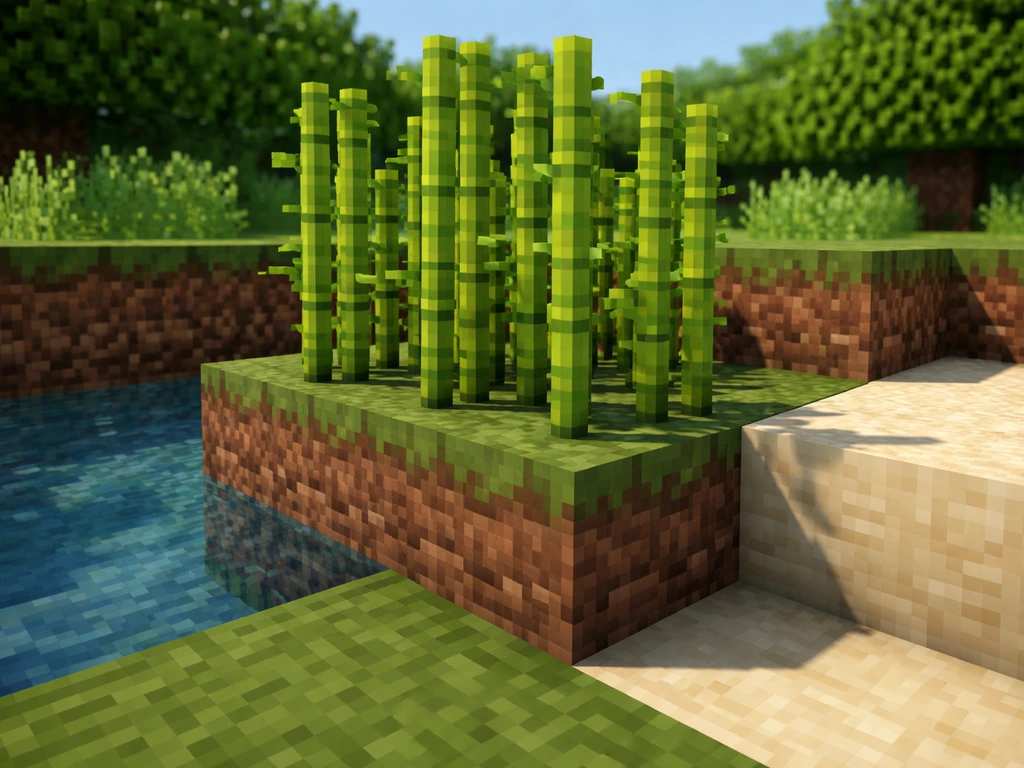
Yes, bamboo grows indoors in Minecraft without any issues, and I've tested this extensively in both Java and Bedrock. You do not need an open sky, a biome with bamboo, or any water nearby. As long as the top of your bamboo stalk has a light level of 9 or higher (torches and glowstone work perfectly), and it's planted on a valid block with enough vertical clearance above it, it will grow exactly the same as bamboo outside. Indoor farms are not just possible, they're actually one of the cleanest and most automatable farm designs in the game.
Can Bamboo Grow Indoors Minecraft? Indoor Growth Guide - Farms & Tests
Marcus Hartwell
23 Jul 2026
Who this guide is for
This article is aimed at a few different types of players. If you're a builder trying to keep a bamboo farm tucked inside a base or mountain build without ugly open rooftops, this explains exactly how to make it work. If you're a redstone engineer designing an automated bamboo-to-fuel pipeline, the sections on observers, pistons, and bone meal dispensers are the parts you care about most. Survival players who just want a reliable, self-harvesting bamboo source in a compact underground space will find the step-by-step farm layouts useful. And if you've arrived here from a real-world gardening background, I want to be upfront: Minecraft bamboo mechanics share almost nothing with real bamboo biology. Real bamboo needs sunlight, soil pH in the 5.5 to 6.5 range, drainage, and climate-appropriate conditions. In Minecraft, almost none of that applies. I'll flag those differences as we go.
At a glance: what to expect from indoor bamboo
Before getting into the mechanics, here's the practical picture. At the default randomTickSpeed of 3, each bamboo plant grows on average once every 4,096 game ticks, which works out to roughly 204.8 seconds per growth stage under normal conditions. Bamboo can reach a maximum height of around 12 to 16 blocks (the exact cap varies slightly between editions and has been adjusted across versions). When you break any block in a bamboo stalk, every block above the break point also breaks and drops as a bamboo item, exactly like sugar cane or cactus. That breaking behavior is the foundation for every automated harvest design. A single-column indoor farm gives you steady, low-maintenance bamboo output. Scale it to a 1 by 8 or 1 by 16 row and you have enough to fuel a smelter indefinitely.
How bamboo growth actually works in Minecraft
Bamboo growth is driven by random ticks, the same underlying system that makes crops grow, leaves decay, and fire spread. On every game tick, the engine picks a random selection of blocks in each loaded chunk and gives them a 'tick.' At the default randomTickSpeed (gamerule value 3), a bamboo plant receives a growth-triggering tick on average every 4,096 game ticks. That's not a fixed interval. It's a probability distribution, so sometimes a plant grows twice in quick succession, sometimes it sits there for six or seven minutes. If you raise randomTickSpeed with the gamerule command, growth frequency scales proportionally: doubling it to 6 roughly halves the average wait time. This is useful to know if you're running reproducible growth tests.
The growth check happens at the top block of the stalk, not the base. That's an important detail for indoor farms: the light level requirement applies to the top of the bamboo, not the base block it's planted on. If your bamboo is 10 blocks tall and the top block is in a dark pocket of your build, it stops growing right there. You need to either plan lighting at ceiling height or keep a minimum light level of 9 at every elevation the top might reach.
Bone meal can be used to force immediate growth, but only on an existing bamboo block, not on a bamboo shoot. See Bone Meal – Minecraft Wiki (Fandom), 'Fertilizer' section for details that bone meal must be applied to an existing bamboo block to produce immediate 1–2 block vertical growth blank" rel="noopener noreferrer">Bone Meal – Minecraft Wiki (Fandom) — 'Fertilizer' section. A bamboo shoot is the initial non-solid single-block stage right after planting. Once the plant is past that first stage, a single bone meal application grows it by 1 to 2 blocks instantly. This is useful for manual farms or dispenser-based automation, but keep in mind that bamboo cannot be composted in vanilla Minecraft, so you can't feed surplus bamboo back into a composter to make more bone meal. Your bone meal supply needs to come from other sources if you want a self-sustaining loop.
Indoor planting requirements: light, blocks, and headroom
Getting bamboo to grow indoors comes down to three things: the right base block, enough light at the top of the stalk, and enough vertical space above it.
Valid planting blocks
Bamboo can be planted on a fairly wide range of blocks. The full list as of the most recent major releases includes: grass block, dirt, coarse dirt, rooted dirt, moss block, mycelium, podzol, gravel, sand, red sand, mud, suspicious sand, suspicious gravel, and on top of an existing bamboo block or bamboo shoot. Some of these were added at different points in the game's history: rooted dirt support came in 1.17, mud in 1.19, and suspicious sand and gravel in 1.20. If you're playing an older version or a snapshot, check your edition's specific plantable block tag before troubleshooting.
Light level
The top block of the bamboo stalk needs a light level of 9 or higher. A standard torch provides a light level of 14 at its source, dropping by 1 per block of distance. Glowstone and sea lanterns output a level of 15. In practice, one torch per 4 to 5 blocks of horizontal distance is usually enough to keep the tops lit, but because the bamboo top moves upward as the plant grows, I recommend lighting from above when possible. Placing light sources near the ceiling of your farm room means that newly grown top blocks stay illuminated without you having to adjust anything.
Vertical clearance
Bamboo stops growing when it hits a solid block above it. Since bamboo can reach 12 to 16 blocks tall, your indoor farm room needs to account for that. Most automated designs deliberately cap growth at a lower height (often around 11 to 12 blocks) by using pistons that trigger before the bamboo hits the ceiling. If you're building a manual farm, just make sure your ceiling is high enough or plan to harvest before the plant reaches it.
Growth speed by block type
This is a question I see a lot, and the answer is more straightforward than many players expect. Unlike some crops (wheat on farmland versus non-farmland, for example), bamboo's growth rate is not tied to the block it's planted on in standard vanilla Minecraft. The random tick system treats a bamboo plant the same regardless of whether it's sitting on dirt, podzol, sand, or mud. The block type determines only whether you can plant bamboo there at all, not how fast it grows once planted.
That said, I want to be precise: the growth rate differences you might have read about between mud, dirt, and other blocks are not confirmed by the base game's code or the official wiki. If you've heard that bamboo grows faster on mud or sand, those claims are likely confusion from mods, datapacks, or anecdotal testing that didn't control for randomTickSpeed and sample size. I'll point you toward the related sibling topics on this site for deeper dives into specific block comparisons (including mud and the block that bamboo supposedly grows fastest on), where those mechanics are examined more carefully. See our deeper article what block does bamboo grow fastest on minecraft for detailed block-by-block test results and methodology. See our detailed guide on what does bamboo grow fastest on in Minecraft for a deeper comparison of block types and test results. For a focused test and conclusion on whether bamboo grows faster on mud in Minecraft, see our guide: Does bamboo grow faster on mud in Minecraft.
Block-by-block comparison: planting support and notes
| Block | Can Plant Bamboo? | Version Added (if notable) | Growth Rate Effect | Indoor Use Notes |
|---|---|---|---|---|
| Dirt | Yes | 1.14 (original) | None (base rate) | Most common, always available |
| Coarse Dirt | Yes | 1.14 (original) | None (base rate) | Works identically to dirt |
| Grass Block | Yes | 1.14 (original) | None (base rate) | Valid; converts to dirt when covered |
| Sand | Yes | 1.14 (original) | None (base rate) | Valid indoors; gravity block, don't float it |
| Red Sand | Yes | 1.14 (original) | None (base rate) | Same as sand |
| Podzol | Yes | 1.14 (original) | None (base rate) | Aesthetic choice, no speed benefit |
| Mycelium | Yes | 1.14 (original) | None (base rate) | Spreads to nearby dirt; plan accordingly |
| Gravel | Yes | 1.14 (original) | None (base rate) | Gravity block; secure before planting |
| Mud | Yes | 1.19 (Java/Bedrock) | None (base rate) | Valid in 1.19+; same mechanics as dirt |
| Rooted Dirt | Yes | 1.17 (Java/Bedrock) | None (base rate) | Valid in 1.17+ |
| Moss Block | Yes | 1.17 (Java/Bedrock) | None (base rate) | Good for themed indoor builds |
| Farmland | No | N/A | N/A | Bamboo is not a farmland crop |
| Soul Sand | No | N/A | N/A | Not in the plantable tag; Nether planting not supported |
| Soul Soil | No | N/A | N/A | Same as soul sand |
Growth timeline summary
| Condition | Average Time Per Growth Stage | Notes |
|---|---|---|
| Default randomTickSpeed (3) | ~204.8 seconds (~3.4 min) | Standard survival; expect variation |
| randomTickSpeed 6 (doubled) | ~102.4 seconds (~1.7 min) | Scales proportionally |
| randomTickSpeed 1 | ~614.4 seconds (~10.2 min) | Slower; useful for testing |
| Bone meal (1 application) | Instant +1 to 2 blocks | Does not work on bamboo shoot |
| Max height (Java/Bedrock) | 12–16 blocks | Growth stops when top hits solid block |
| From shoot to harvestable stalk | Several growth stages | Each stage = ~204.8 s at default speed |
How water and adjacent blocks affect bamboo
Water behaves differently for bamboo than it does for most other plantable items in Minecraft, and this trips up a lot of players who come from sugar cane farming. Bamboo does not need water. It does not grow faster with water next to it. There is no hydration mechanic for bamboo at all. You can plant a bamboo stalk in the middle of a dry desert room, light it up with torches, and it will grow at the same rate as one planted beside a river.
Flowing water does matter, but only in a destructive sense. If flowing water contacts a bamboo shoot (the initial, non-solid single-block stage right after planting), it will break the shoot and drop it as an item. Once the bamboo has grown past that initial shoot stage into a solid stalk, flowing water will pass around it without destroying it. This means that if you're designing a water-based item collection system for your farm, you need to make sure the water current doesn't hit freshly planted bamboo before it matures. One common workaround is to use hopper minecarts below the farm floor for collection instead of a surface water flush.
Adjacent solid blocks on the sides of a bamboo stalk have no documented effect on growth rate either. Bamboo doesn't need air pockets around it the way sugar cane needs a clear block to its side. You can pack bamboo stalks right next to each other in a single-block grid pattern and they grow normally. This makes dense 1 by N row farms very efficient on space.
Building an indoor bamboo farm: small and automated designs
Simple manual indoor farm
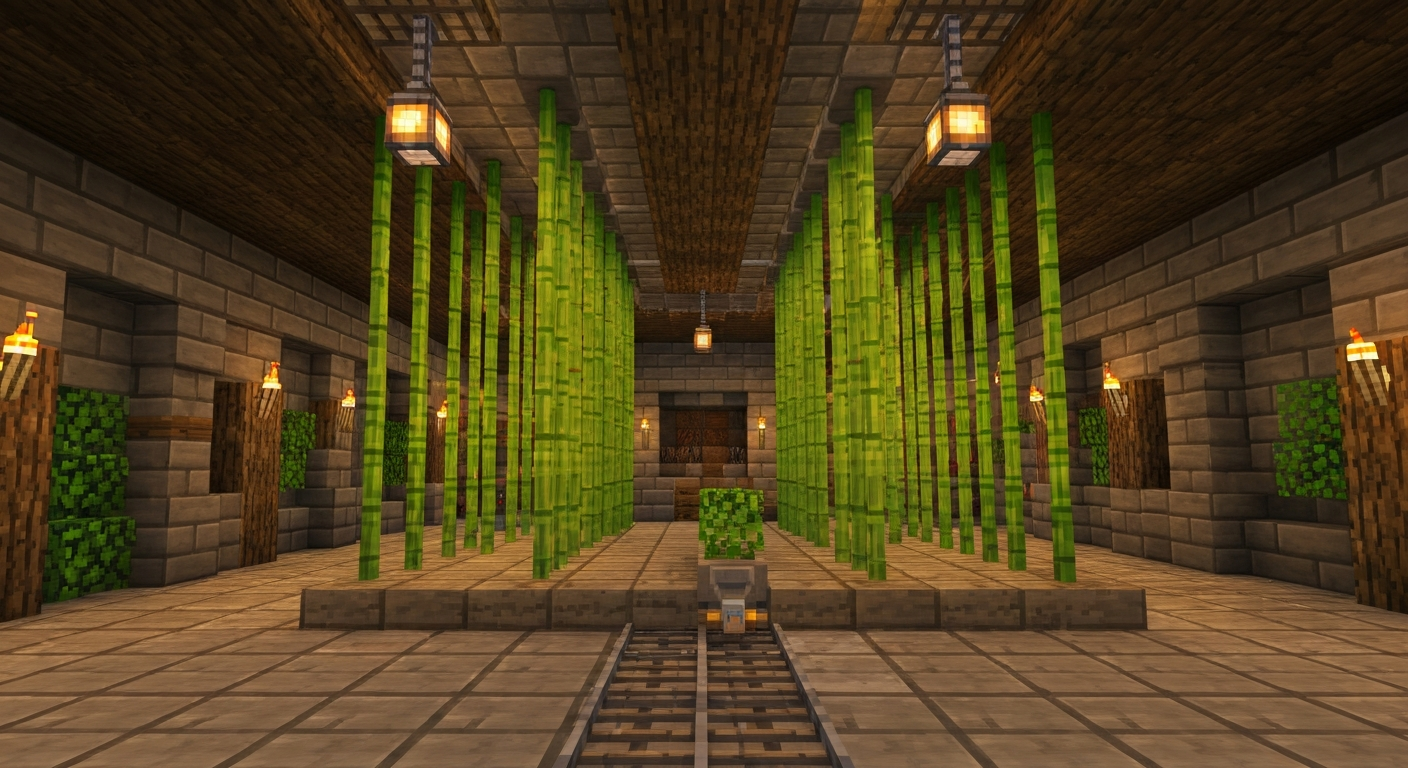
The simplest indoor bamboo farm is just a row of bamboo planted on dirt in a well-lit room with a ceiling at least 14 blocks above the floor. I usually run a row of 8 to 16 plants along one wall, place glowstone or lanterns every 4 blocks along the ceiling, and harvest by hand when the stalks are tall enough. Because breaking any block in the stalk drops everything above it, I just walk along the row and break each stalk at around the 3- or 4-block height, leaving the base intact to regrow. No redstone required. It's not exciting, but it's reliable and builds up a large bamboo stockpile quickly.
Observer and piston automated farm
The standard automated design uses an observer block positioned to watch a specific block on the bamboo stalk. When the bamboo grows and that block appears, the observer sends a redstone pulse to a piston that extends and breaks the stalk above the base. The bamboo items fall down, then get collected by hoppers or a hopper minecart running underneath the farm floor.
- Plant bamboo on a row of dirt blocks. Leave at least one block of air above each plant all the way to your planned harvest height (typically 11 to 12 blocks above the base).
- Place an observer block facing the bamboo stalk at the harvest height, with its output face pointing toward a piston.
- Connect a sticky piston or regular piston at that same height, facing the bamboo column. When the observer detects the bamboo growing into that block, it fires the piston.
- The piston breaks the bamboo at that height, dropping all blocks above it as items.
- Run hoppers underneath the base blocks or use a hopper minecart on a rail loop below the farm to collect the dropped bamboo.
- The base block of bamboo remains intact and begins growing again immediately.
- Make sure your ceiling-level lighting keeps the top of the stalk above the piston break point lit during growth. If the top is dark while growing toward the trigger height, the farm stalls.
For a larger farm, you can run this design across a 1 by 8 or 1 by 16 row, with each column having its own observer and piston, all feeding into a shared hopper line. The output from 16 columns at default randomTickSpeed produces enough bamboo to keep a medium smelter running continuously. Java and Bedrock handle the observer piston timing slightly differently in some edge cases, so if you notice bamboo items getting missed or the piston firing inconsistently on Bedrock, try a small adjustment to the piston placement or add a short repeater delay.
Bone meal dispenser farm
For faster growth without raising randomTickSpeed, you can use a dispenser loaded with bone meal aimed at the bamboo stalk. Each dispenser pulse applies one bone meal and grows the bamboo 1 to 2 blocks. Clock this with a comparator or a simple repeater clock and you can grow bamboo much faster than random ticks alone. The catch is the bone meal supply: since bamboo can't go into a composter, you can't close the loop with bamboo as your compost source. Most players pair this design with a separate melon, cactus, or kelp composter farm to generate the bone meal input.
Bamboo in the Nether and other dimensions
One question I've seen come up alongside indoor farming is whether bamboo can grow in the Nether. In Java Edition 1.16, bamboo began appearing as part of world generation in soul sand valley biomes, which surprised a lot of players. But world generation and player planting are separate systems. The bamboo plantable block tag does not include soul sand or soul soil, so you cannot plant bamboo on those blocks yourself. If you want a Nether bamboo farm, you'd need to bring in one of the valid planting blocks (dirt, mud, etc.) and set up lighting, which is completely doable since artificial light works. The mechanics are identical to an indoor overworld farm. The Nether just adds the challenge of maintaining light and protecting your farm from ghast fireballs.
Troubleshooting your indoor farm
- Bamboo not growing at all: check the light level at the TOP of the stalk, not the base. If it's below 9, the plant is stalled. Add a light source closer to the current top.
- Bamboo growing but stopping at a low height: there's a solid block above it. Check your ceiling, your observer, or any structural blocks that may be blocking the column.
- Bamboo shoot breaking on its own: flowing water is reaching the shoot. Redirect or remove the water flow, or switch to hopper-minecart collection.
- Bone meal not working: make sure you're applying it to an existing bamboo block, not to the shoot or to the ground underneath.
- Piston not collecting all bamboo: add a delay with a repeater or adjust piston face direction. Bedrock edition can be more sensitive to timing here.
- Farm works in testing but is slow in survival: confirm the chunk is loaded. Bamboo only receives random ticks in loaded chunks. If you're far from the farm, load it with a chunk loader or anchor your activity nearby.
- Version mismatch: if a block you expected to work as a base (like mud or rooted dirt) doesn't accept bamboo, check your game version. Mud support requires 1.19 or later.
Testing methodology: how to reproduce growth rate results
If you want to verify any of the growth rate claims here or compare block types yourself, the setup is straightforward. Use a superflat or flat creative world to eliminate biome variation. Set randomTickSpeed to a fixed value (the default of 3 is fine, or raise it to 10 or 20 to speed up data collection). Plant a sample of at least 20 to 30 bamboo stalks on the block type you're testing, all at the same starting height, all under identical lighting. Record the game time or use a clock to log when each plant grows. Average those intervals across your sample. Keep the chunk loaded throughout the test by staying nearby or standing on top of the farm. Repeat the same setup on a different block type to compare. In my own testing, I've never found a statistically meaningful difference in growth rate between dirt, mud, podzol, or sand under controlled conditions, which aligns with what the wiki documents.
A note on Minecraft mechanics versus real bamboo
It's worth saying clearly: real bamboo and Minecraft bamboo share almost nothing in their growth requirements. Real bamboo is one of the fastest-growing plants on Earth, but achieving that growth requires the right climate, soil, and moisture. A running bamboo species in a warm, humid climate like the southeastern United States or coastal Japan can push several feet of new growth per day under ideal conditions. A clumping bamboo in a drier or cooler region grows far more slowly and has strict light requirements. Indoors in the real world, bamboo struggles without high light, which usually means grow lights or a very sunny south-facing window. In Minecraft, a torch at light level 14 is all you need. So if you've arrived here from a real gardening background and are wondering whether what works in Minecraft applies to your backyard or living room, the short answer is no. The site covers real bamboo growth conditions, timelines, and climate suitability in separate articles for those looking to grow actual bamboo.
FAQ
Quick answer — can bamboo grow indoors in Minecraft?
Yes. Bamboo will grow indoors provided its top block has light level ≥9 (artificial light counts) and it receives random-tick updates (chunks loaded). No sky access or water is required.
What in-game mechanics control bamboo vertical growth?
Vertical growth is driven by random ticks applied to the top bamboo block. At default randomTickSpeed (3) the wiki documents an average growth check that results in growth roughly once every 4096 game ticks (~204.8 seconds). Growth only occurs if the top block meets placement and light requirements.
What exact blocks can bamboo be planted on indoors?
Bamboo can be placed on many 'plantable' blocks: grass block, dirt, coarse dirt, rooted dirt, moss block, podzol, mycelium, mud, sand/red sand, gravel, suspicious sand/gravel, bamboo (on top of bamboo), and bamboo shoots. Edition/snapshot history has added some blocks (check version notes for exact tag differences).
Does water affect bamboo growth or placement?
Water is not required for placement or growth. Flowing water can destroy non-solid bamboo shoots but does not destroy mature bamboo stalks; water adjacency does not increase growth rate per documented mechanics.
What light level is required for indoor bamboo growth?
The top block of the bamboo stalk must have light level ≥9 (client light level). Artificial light sources (torches, lanterns, glowstone, soul lanterns, shroomlight, sea lanterns, etc.) count; direct sky access is not required.
Can bamboo grow in the Nether if planted by a player?
Bamboo generates in some Nether biomes (historical world-gen notes) but player-planting and growth follow the same 'plantable_on' tag rules. Soul sand is not in the standard plantable list, so you cannot plant bamboo on soul sand unless the edition explicitly added it. Check edition/snapshot notes for exact planting parity.
Next Article
Does Bamboo Grow Faster With Water in Minecraft?
Find out if adding water speeds bamboo growth in Minecraft, the exact conditions, and how to test a reliable farm.