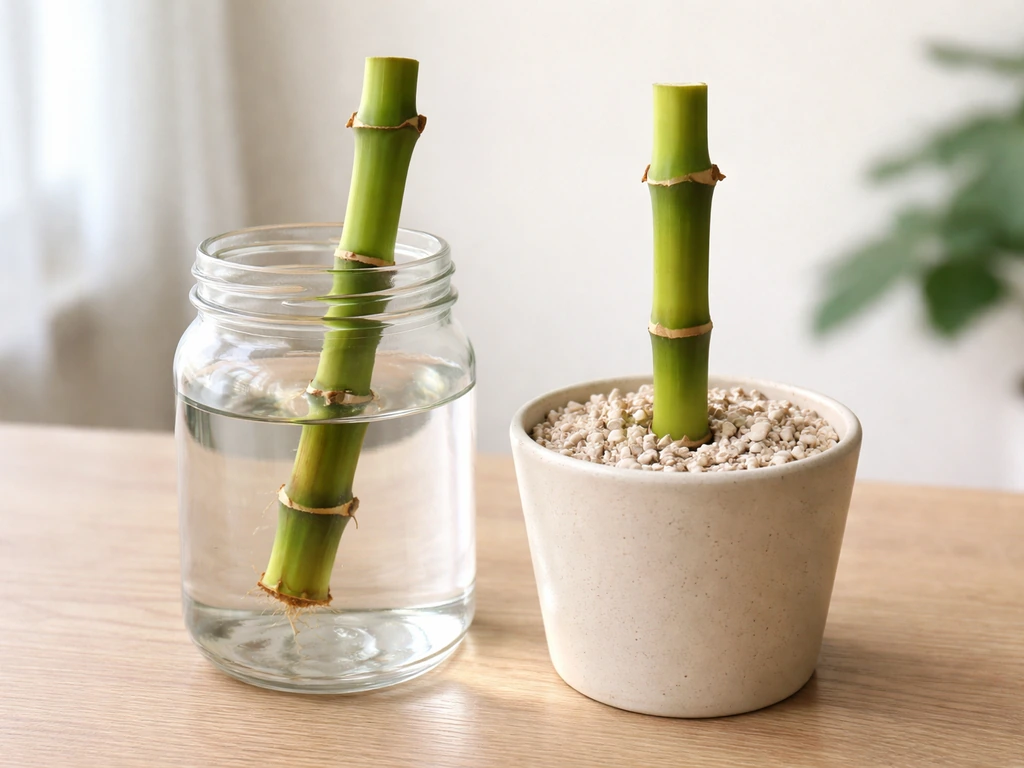
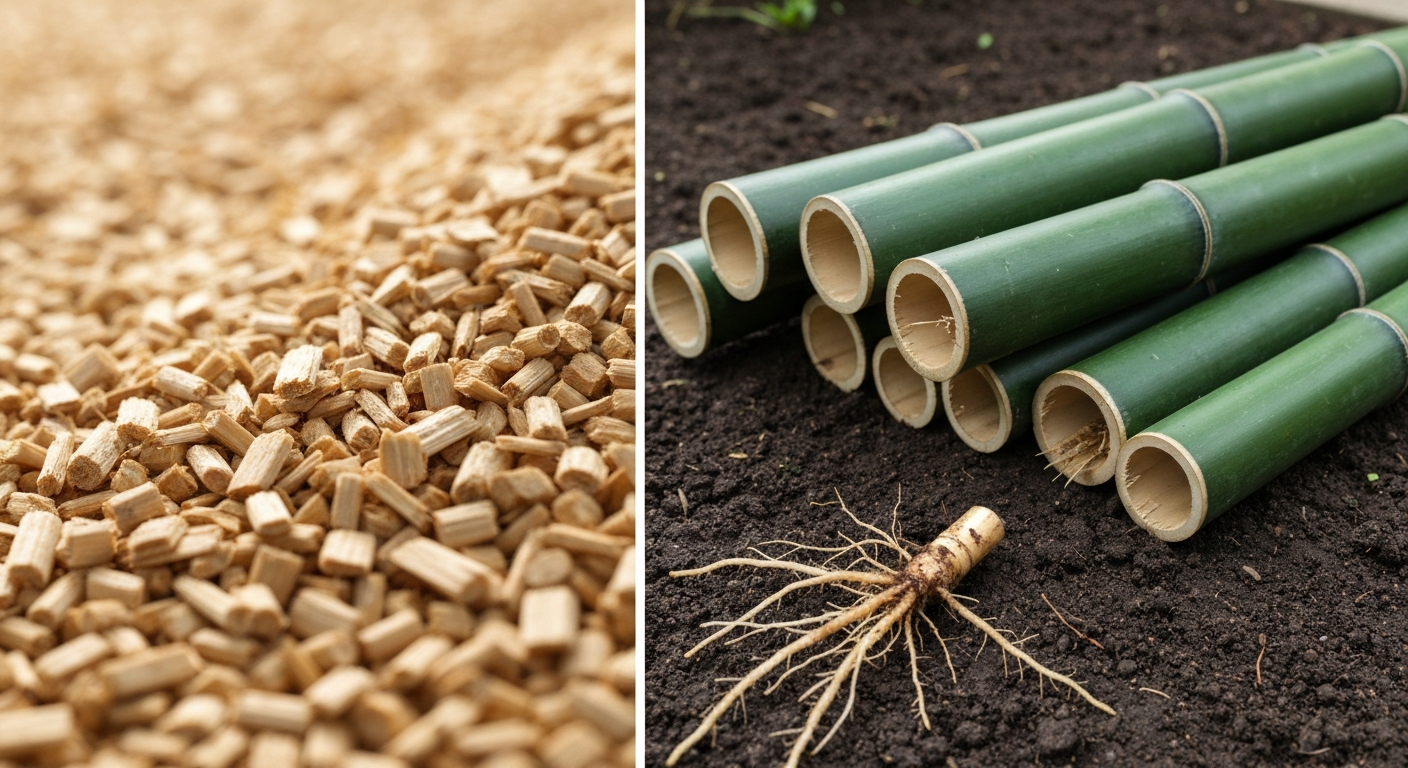
Chipped bamboo, the shredded wood chips or mulch you get from running bamboo culms through a chipper, will not grow back. Once a culm is finely chipped and the nodes are physically destroyed, there is no viable bud tissue left to regenerate. But a freshly cut bamboo culm, a large culm segment with intact nodes, or any piece of rhizome with a living bud absolutely can regrow or be propagated. The difference between "chipped" and "cut" bamboo matters enormously, and getting that distinction right will save you from both accidental spreading and missed propagation opportunities.
Will Chipped Bamboo Grow? Chips, Cut Culms, Propagation Tips

Marcus Hartwell
25 Jul 2026
How bamboo actually regenerates
Bamboo is a perennial grass, not a tree, and its whole reproductive strategy centers on what happens underground. The rhizome, a horizontal underground stem, is the engine of bamboo growth. Rhizomes carry buds that differentiate into new shoots above ground and new roots below. When you cut a bamboo culm at soil level, the plant doesn't "die" at all. The rhizome system is still fully intact, still storing carbohydrates, still ready to push up new shoots the next season.
There are two fundamentally different rhizome architectures, and they behave very differently in a landscape. Understanding which type you're dealing with changes everything about how you propagate, contain, or remove bamboo.
| Type | Rhizome Pattern | Spread Behavior | Examples | Containment Need |
|---|---|---|---|---|
| Running (leptomorph) | Long, horizontal rhizomes spread far from parent | Aggressive; can travel several meters per year | Phyllostachys (most common running types), Pleioblastus | High — barriers and annual monitoring essential |
| Clumping (pachymorph) | Short, curved rhizomes stay close to parent | Slow, predictable expansion from base | Bambusa, Fargesia, Dendrocalamus | Low — well-behaved in most landscapes |
Running bamboos are the ones that end up in neighbors' yards. Clumping bamboos stay in a tidy, expanding clump. University extension services, including those at the University of Maryland and UC IPM, specifically recommend choosing clumping species if you're planting near property lines, and installing rhizome barriers of 60 to 90 cm (24 to 36 inches) depth if you plant any running species. This architecture distinction also matters for propagation, rhizome pieces from running bamboos establish readily, while clumping types are propagated more reliably through offsets.
What happens when you cut bamboo culms
Cutting a bamboo culm does not kill the plant. The culm itself won't regrow from the cut end, bamboo culms don't elongate from the top once they're fully extended. But the rhizome system responds to cutting by redirecting energy toward producing new shoots from existing rhizome buds. In a well-established grove, you'll often see new shoots emerge near cut culms within the same season or the following one. This is actually an important concept covered more deeply when looking at whether cutting bamboo makes it grow faster, because the answer is nuanced and depends on grove maturity and how much you cut. For a more detailed explanation, see the section “does cutting bamboo make it grow faster.”. For a focused answer to the question 'If you cut bamboo, will it grow back?' see the linked guidance on regrowth and propagation. For a deeper discussion, see the article on whether cutting bamboo will make it grow.
As for cut culms regrowing roots on their own: a detached culm lying on the ground, cut cleanly from its rhizome, will not sprout roots from the cut base and establish itself. For more on whether cut bamboo will grow roots, see will cut bamboo grow roots. The cut culm has no root-producing tissue at the base. What can work is deliberately using culm nodes, those visible joints along the culm, as cutting material under controlled conditions, which is a different process altogether and covered in the propagation sections below. If you're wondering whether can bamboo grow without roots, the short answer is no: detached culms without rhizome or viable nodal tissue will not establish.
Will chipped bamboo or rootless culm pieces sprout?
Finely chipped bamboo will not sprout. When you run bamboo through a wood chipper, the mechanical action shreds and destroys the nodes and any axillary bud tissue. No intact bud means no regeneration. I've used chipped bamboo as mulch around garden beds for years without a single sprout from the chips themselves. You're safe to use it as a carbon-rich mulch, and it actually breaks down fairly slowly, which makes it useful for suppressing weeds and retaining moisture.
The risk zone is large, unprocessed culm pieces, especially segments 30 cm or longer with intact nodes, left on moist soil. These retain viable bud tissue at the nodes and, under warm, moist conditions, can produce adventitious shoots and roots. Similarly, any rhizome fragment with a living bud is essentially a propagule waiting to establish. Extension guidance is clear on this: don't leave intact rhizome pieces or large nodal culm segments in garden beds unless you're deliberately trying to propagate them.
Here's a practical rule I follow: if the chip is small enough that you can't see an intact, raised node joint, it's not going to grow. If you can clearly see a nodal joint on a culm segment, treat it like a live plant material, bury it intentionally, compost it in a hot pile, or dispose of it properly.
Propagation methods: which one fits your situation
There are three main methods gardeners use to propagate bamboo from cut material: rhizome division, culm and node cuttings, and water propagation or air-layering. Each has different success rates, timing requirements, and ideal use cases. The table below gives a quick overview before I walk through each in detail.
| Method | Best For | Typical Success Rate | Skill Level | Best Season |
|---|---|---|---|---|
| Rhizome division | Established running or clumping bamboo in your yard | High (80–95% with healthy material) | Beginner | Early spring, just before new shoots emerge |
| Culm/node cuttings | Species where rhizomes are unavailable; research/nursery settings | Variable (40–95% depending on species, auxin, conditions) | Intermediate | Spring to early summer (March–May) |
| Water propagation | Small-scale, indoor, decorative bamboo (especially lucky bamboo) | Moderate for ornamental types; lower for timber species | Beginner | Any season with controlled temps |
| Air-layering | Woody clumping species; propagating while still attached to parent | Moderate to high when done carefully | Intermediate to advanced | Spring to summer |
Rhizome division: the most reliable way to propagate bamboo
Rhizome division is what I always recommend first for home gardeners. It works well for both running and clumping types, it uses material that already has established root and bud tissue, and the success rate with healthy material is consistently high. University of Georgia Extension guidance aligns with this, their bamboo propagation protocols favor rhizome offsets precisely because the material is already physiologically primed.
Step-by-step rhizome division
- Time it right: aim for early spring, just before new shoots emerge. In most temperate and subtropical climates, this means late February through April. The rhizome system is actively preparing for the growing season, so transplanted material establishes quickly.
- Expose the rhizome carefully: use a sharp spade or pruning saw to dig around the edge of the bamboo clump or grove at roughly 30 cm (12 inches) depth. Minimize tearing of the rhizome tissue.
- Select healthy material: look for 2 to 3-year-old rhizome segments (not the newest, most tender growth, and not the oldest, corky tissue). Each segment should be 30 to 40 cm (12 to 14 inches) long and carry at least 1 to 2 visibly viable buds — you'll see them as pointed, scale-covered protrusions.
- Cut cleanly: use a sharp, clean blade. Avoid crushing or bruising the cut ends. Some growers dust cut ends lightly with powdered sulfur or dilute fungicide to reduce rot risk.
- Keep material moist: wrap divisions in damp burlap or a plastic bag with some moist media. Don't let rhizome tissue dry out — even 30 minutes of sun exposure on a dry day can desiccate cut ends.
- Plant promptly: set rhizome divisions horizontally at roughly the same depth they were growing (usually 5 to 15 cm, or 2 to 6 inches, depending on species). Orient buds slightly upward.
- Water in well and mulch: keep consistently moist but not waterlogged. A 5 cm layer of mulch over the planting area helps retain moisture and moderate soil temperature.
- Expect new shoots within 4 to 12 weeks under good conditions. In the first season, don't be alarmed if top growth is modest — the plant is investing in root establishment first.
Expected success rate with healthy material, good timing, and adequate moisture is 80 to 95%. The main failure point I see is letting rhizome divisions dry out between digging and planting, or planting into waterlogged clay soil.
Culm and node cuttings: higher effort, variable results
Culm cuttings, taking segments of bamboo culm with intact nodes and encouraging them to root, are well documented in bamboo macropropagation research, particularly for tropical and subtropical Bambusa and Dendrocalamus species. Experimental trials summarized in Factors affecting macropropagation of bamboo, review (ResearchGate summary of trials) show single-node or short (1–3 node) culm segments placed horizontally in moist, sandy or soilless beds root at higher rates than vertically planted or longer segments Factors affecting macropropagation of bamboo — review (ResearchGate summary of trials). Published propagation trials report rooting percentages ranging from around 65 to 95% for Bambusa species under optimized conditions, though this drops significantly for temperate species or without auxin treatment. This method is used heavily in commercial nursery and forestry settings, and it's worth understanding even if rhizome division is easier.
Step-by-step culm cuttings
- Select your culm: choose culms that are 1 to 3 years old — not the current season's new growth (too soft and high moisture, rots easily) and not old, corky culms (meristems less active). Mid-aged culms have the best carbohydrate reserves and bud viability.
- Cut your segments: single-node cuttings (one intact node per segment, roughly 10 to 15 cm long) or short 1 to 3-node segments both work. Research consistently shows horizontal placement of shorter segments outperforms longer, vertical cuttings.
- Treat with rooting hormone (IBA): applying indole-3-butyric acid (IBA) meaningfully improves rooting percentages in trial after trial. For small single-node cuttings, start at 50 to 200 ppm IBA in solution or powder form. Larger or harder culm segments may benefit from higher doses (up to 500 to 1000 ppm) applied as a cavity treatment or dilute soak. The optimal dose is species-specific — I recommend starting at the lower end and noting your results before scaling up.
- Prepare your rooting medium: use a well-draining, coarse medium — a 50/50 mix of coarse sand and perlite works well, or a dedicated propagation bed with river sand. Avoid heavy potting mix; it retains too much moisture and promotes rot.
- Plant horizontally: lay cuttings flat in the medium with the node(s) in direct contact with or just below the surface. This positioning maximizes bud-to-medium contact and is backed by multiple propagation trials.
- Maintain warmth and humidity: target 25 to 30°C (77 to 86°F) and relative humidity of 70% or higher. In practice, a shaded cold frame with intermittent misting, a humidity tent, or a mist propagation bench all work. Without humidity control, cuttings desiccate before rooting.
- Monitor for rot: check every few days. Remove any segments showing soft, dark, or foul-smelling rot immediately. Good airflow within the canopy of the propagation bed reduces fungal problems.
- Expect results in 4 to 10 weeks: first signs are usually small shoot emergence from the bud, followed by visible root development. Rooting without shooting first is also normal in some species.
Timing matters here too. Most propagation reviews and extension guidance favor taking cuttings in spring to early summer, March through May in the Northern Hemisphere. This aligns with peak meristem activity and gives cuttings the longest warm season to establish before any temperature drop.
Water propagation and air-layering
Water propagation
Water propagation is popular for ornamental and "lucky bamboo" (Dracaena sanderiana, which isn't true bamboo) and occasionally attempted with small culm cuttings of true bamboo species. For true bamboos, results in water are generally less reliable than in a moist, well-draining solid medium. Culm segments placed in water can develop roots at the node under warm conditions, but they're prone to rotting before rooting succeeds, especially for temperate species. If you try this method, use clean water, change it every few days, keep temperatures around 25°C, and place the container in bright but indirect light. Move rooted cuttings into a solid rooting medium promptly, roots adapted to water often struggle to transition to soil.
Air-layering
Air-layering works by encouraging a node on a live, attached culm to produce roots before you detach it from the parent plant. To do this, wound the culm lightly just below a node, apply IBA paste or powder to the wound, pack moist sphagnum moss around the node, and wrap tightly with clear plastic film sealed at both ends. After 4 to 8 weeks (sometimes longer), roots will be visible through the plastic. At that point, cut the culm below the rooted section and pot it up. Air-layering is more successful for clumping types with thick woody culms than for thin, running bamboo species. It's a useful technique when you want to propagate a specific culm without disturbing the root system of an established plant.
Does cutting or pruning make bamboo grow faster?
This is one of the most common misconceptions I encounter. Cutting existing culms does not directly cause bamboo to grow taller or faster. Bamboo culms reach their full height in a single growing season and don't add height after that. What cutting does do is remove above-ground biomass, which can redirect the plant's energy into producing more shoots from the rhizome system, particularly in a mature, well-established grove with abundant carbohydrate reserves. In that sense, selective thinning of old culms can improve the vigor and density of new growth over time.
However, aggressive cutting of a young or newly planted bamboo can actually slow establishment by reducing the plant's photosynthetic area before the root system is strong enough to support rapid new growth. The practical takeaway: in a mature grove, thinning is beneficial and maintains vigor; on a newly planted bamboo, hold off on any significant pruning for the first two to three years.
Ideal conditions for rooting and establishment
Whether you're rooting culm cuttings or establishing rhizome divisions, the environmental conditions that drive success are consistent across species. Getting these right is more important than any single technique.
- Soil: well-draining, slightly acidic to neutral (pH 5.5 to 7.0). Heavy clay slows establishment and promotes root rot. Sandy loam with organic matter amendment is ideal for garden planting; for propagation beds, coarse sand or sand-perlite mixes work better than standard potting soil.
- Moisture: consistently moist, not waterlogged. For propagation, intermittent misting or a humidity enclosure is more effective than overwatering. In the ground, newly planted divisions benefit from mulching to retain moisture without saturating the root zone.
- Temperature: 25 to 30°C (77 to 86°F) is the sweet spot for rooting and shoot development. Rooting slows significantly below 15°C (59°F). If you're propagating in a temperate climate, starting cuttings indoors or in a heated greenhouse in early spring buys you critical warm weeks.
- Light: bright, indirect light for propagation. Direct midday sun on cuttings or newly planted divisions causes desiccation and stress before roots are established. Once a plant is established with active foliage, full sun (with adequate moisture) promotes vigorous growth.
- Humidity: 70% relative humidity or higher accelerates rooting in culm cuttings. A simple humidity tent made from a clear plastic bag over a pot can provide this for small-scale propagation.
- Season: spring to early summer is the most consistently productive window for propagation and transplanting in temperate and subtropical climates. Active meristems and rising soil temperatures align to support rapid establishment.
Troubleshooting when things go wrong
Even with the best setup, propagation failures happen. Here are the most common problems I see and how to address them.
| Problem | Likely Cause | Fix |
|---|---|---|
| Cuttings rot before rooting | Media too wet; insufficient airflow; old or damaged culm material | Switch to coarser, faster-draining media (more perlite or sand); increase airflow; select younger, healthier culm material |
| No roots after 8+ weeks | Temperature too low; IBA dose too low or not used; wrong season | Raise temperature to 25–30°C; apply or increase IBA dose; consider retrying in spring |
| Shoots emerge but no roots (or roots without shoots) | Normal variation; species-dependent sequencing | Continue maintaining conditions — both structures will eventually appear; don't disturb prematurely |
| Rhizome divisions fail to sprout | Material dried out before planting; planted too deep; buds damaged | Keep material moist from dig to planting; check bud orientation; replant at shallower depth |
| Pest damage on new shoots | Slugs, aphids, or cutworms attacking tender growth | Apply physical barriers (copper tape, collars); use targeted organic controls; inspect new shoots daily in early season |
| Low overall survival rate | Species mismatch with climate; late-season propagation; poor water control | Verify species climate zone suitability; time propagation to spring; improve irrigation consistency |
Propagate, compost, or mulch? A practical decision guide
After cutting or chipping bamboo, you have a few sensible options. The right choice depends on what you're working with and what you want to achieve.
- Finely chipped bamboo (nodes destroyed): use freely as mulch. It's a carbon-rich, slow-decomposing mulch that suppresses weeds and improves moisture retention. No regrowth risk.
- Large culm segments with intact nodes: either propagate deliberately (see culm cutting method above), send to hot composting (internal pile temperature must reach thermophilic range, generally 55–65°C or 131–149°F, to destroy bud viability), or chip finely before disposal. Do not bury or leave on moist soil unless you intend to propagate.
- Rhizome fragments with live buds: treat as live plant material. Propagate, deliver to hot compost, or bag and dispose through green waste services. Never leave these in garden beds casually — they will establish and spread.
- Healthy culm material from a species you want to propagate: take single-node or 1 to 3-node cuttings in spring, treat with IBA, and set up a warm, humid propagation environment. Rhizome divisions are easier and faster if you have access to the parent plant's root zone.
- Old, diseased, or dried-out culm material: chip or compost. It lacks viable bud tissue and won't propagate successfully anyway.
Containment and ethical considerations
Bamboo, particularly running types, has real invasive potential in many regions, and gardeners have a genuine responsibility to prevent unintended spread. I don't say this to discourage planting bamboo; I say it because I've seen running bamboos that escaped into neighboring properties cause genuine conflicts and significant remediation costs. The ethical and practical approach is to plan for containment before you plant.
- Choose species deliberately: clumping bamboos (Fargesia, Bambusa, Chusquea) are the lower-risk choice near boundaries. Running bamboos (Phyllostachys, most temperate species) require active management.
- Install rhizome barriers before planting: physical barriers made from 60 mil HDPE or galvanized metal, installed to 60 to 90 cm (24 to 36 inches) depth with a lip turned outward at the top, are the standard recommendation from multiple university extensions. This is not optional for running species near property lines.
- Inspect annually every spring: running rhizomes are easiest to sever when they're actively extending in spring. A sharp spade along your barrier line, once a year, takes 30 minutes and prevents years of remediation effort.
- Communicate with neighbors: if you're planting bamboo near a shared boundary, tell your neighbors what species it is and what containment you've installed. This is a good-neighbor practice and may be required in some municipalities.
- Dispose of removed material properly: large rhizome fragments removed during containment work should be hot-composted or chipped finely — not piled in a corner of the yard where they can re-establish.
Quick action checklist: what to do next
Use this checklist based on your current situation. Pick the column that matches your goal.
| Your Goal | What You Have | Next Step |
|---|---|---|
| Use as mulch | Finely chipped bamboo (nodes destroyed) | Apply directly as mulch — no regrowth risk, safe to use |
| Use as mulch | Large culm pieces or chips with visible nodes | Run through chipper again to destroy nodes, then mulch |
| Propagate more bamboo | Access to parent plant's rhizome system | Dig rhizome divisions in early spring; follow division protocol above |
| Propagate more bamboo | Only cut culm segments with intact nodes | Take single-node cuttings, treat with 50–200 ppm IBA, plant horizontally in warm moist sand/perlite |
| Propagate more bamboo | A live, established culm you want to replicate | Try air-layering in spring to early summer |
| Dispose of cut material safely | Rhizome fragments or nodal culm pieces | Hot compost (55–65°C internally) or chip finely; never bury casually |
| Prevent regrowth after cutting | Running bamboo grove that was cut back | Repeatedly remove new shoots as they emerge over 2–3 seasons, or excavate rhizomes completely |
| Contain an existing plant | Running bamboo near a property line | Install 60–90 cm deep rhizome barrier; inspect and sever escaping rhizomes every spring |
FAQ
Quick answer: will chipped bamboo grow or will cut bamboo regrow?
Finely chipped or shredded bamboo used as mulch or compost will very rarely regrow because the chipping process destroys intact nodes and buds. By contrast, larger cut culm pieces or rhizome fragments that still contain intact nodes, buds, or live rhizome tissue can produce roots and shoots under favorable conditions. In short: chips = very low risk; intact nodes/rhizome pieces = possible to likely regrowth depending on species and condition.
How does bamboo naturally regenerate and spread?
Bamboo is a perennial grass that primarily spreads vegetatively via underground rhizomes. Rhizomes produce buds that differentiate into new shoots (culms) and roots. Two broad rhizome types control landscape behavior: running (leptomorph/monopodial) rhizomes extend far from the parent and can spread aggressively; clumping (pachymorph/sympodial) rhizomes produce new culms close to the parent and expand slowly. Therefore the rhizome system—not above‑ground wood chips—is the main driver of grove formation.
Can detached culm pieces (stem segments) without roots sprout?
Yes, detached culm segments that still include intact nodes and viable axillary/culm buds can produce adventitious roots and shoots when provided appropriate propagation conditions. Success depends on species, age of the culm, how many nodes are present, timing/season, moisture, and whether rooting aids (e.g., auxin) and mist/humidity are used.
Will bamboo wood chips or mulch sprout new bamboo?
Generally no. Commercial or home chippers that finely shred culms destroy the structural integrity of nodes and buds; those fragmented, thermophilic-composted, or dried chips present a very low risk of vegetative regrowth. The remaining (very small) risk applies only if large, freshly cut chunks with intact nodes are left whole and kept moist.
Which bamboo pieces are safe to compost or mulch and which should be handled carefully?
Safe to compost/mulch: finely shredded/chipped material that obliterates nodes and is hot‑composted (thermophilic pile temperatures) or dried. Handle carefully: whole culm sections, large split culm halves, and any rhizome or root fragments — these can resprout if left moist or buried. If disposal methods cannot guarantee destruction of nodes/buds, use industrial chipping or hot composting, or bury deeply with prolonged drying.
Proven propagation methods for bamboo (overview)
The three reliable, science-backed methods are: 1) Rhizome (offset) division — dig and cut rhizome/offset pieces with buds and roots; 2) Culm/node cuttings (macropropagation) — single-node or short multi-node segments planted in a suitable rooting medium; 3) Water propagation of short culm cuttings or branches as a preliminary rooting step for some species. Rhizome division is generally lowest risk and most universally reliable; culm cuttings are effective for many species but show wide variability in success rates.
Next Article
Will Cut Bamboo Grow Roots? How to Propagate Cuttings
Will cut bamboo grow roots? Learn how to root bamboo and lucky bamboo cuttings in water or soil, step by step.