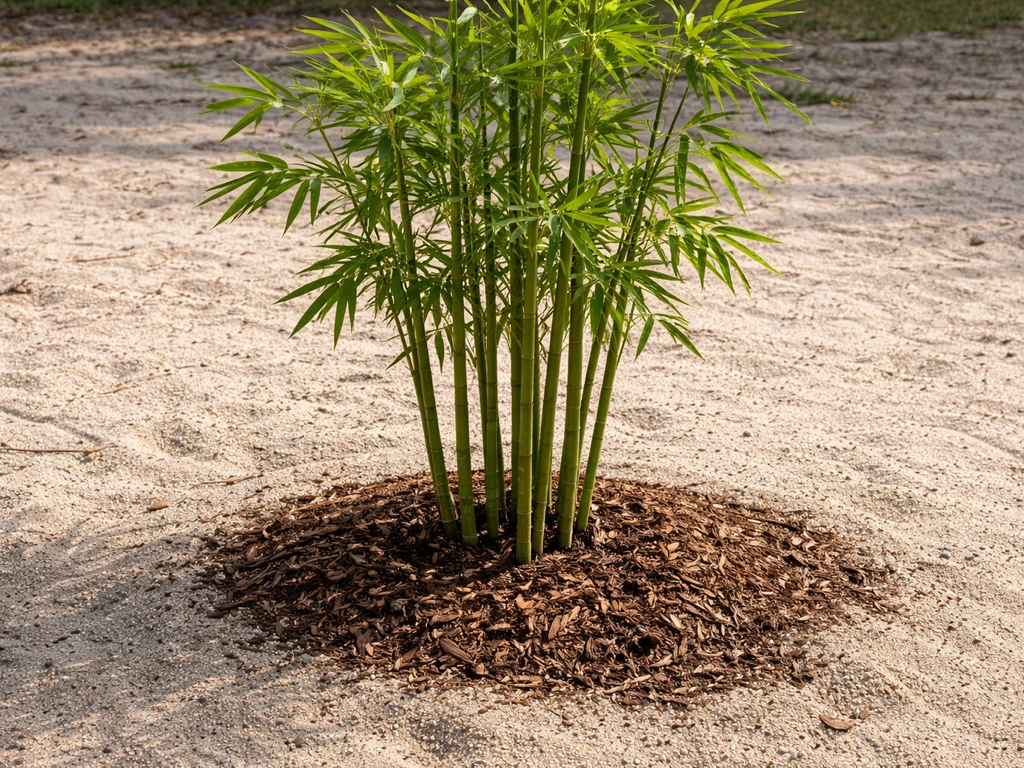
No, bamboo cannot grow on Mars in the open environment. The surface conditions are lethal to bamboo and virtually every other plant: atmospheric pressure sits around 6 mbar (roughly 0.6% of Earth's sea-level pressure), surface temperatures average around -63°C and swing wildly, unshielded radiation doses run 200-300 microgray per day, the soil is laced with toxic perchlorates, and liquid water is essentially absent at the surface. That said, inside a sealed, pressurized, temperature-controlled habitat on Mars, bamboo could theoretically be grown, though doing so would be extraordinarily resource-intensive, and there are far more practical crop choices for a Mars mission.
Can Bamboo Grow on Mars? Science, Methods & Practical Guide
Marcus Hartwell
4 Aug 2026
What bamboo actually needs to grow
Before diving into Mars, it helps to nail down exactly what bamboo requires. I've grown running and clumping bamboo species in a range of conditions, and the checklist is more demanding than most people realize, even on Earth, getting bamboo to thrive in, say, a Texas summer versus a Pacific Northwest garden involves very different management strategies.
- Light: Most bamboo species want full to partial sun — roughly 4 to 8+ hours of direct light. Shade-tolerant species can manage with less, but growth rate and culm diameter drop significantly without adequate light intensity.
- CO2 and oxygen: Like all vascular plants, bamboo needs atmospheric CO2 for photosynthesis and sufficient O2 for respiration. It thrives in Earth's normal ~0.04% CO2 and ~21% O2 mix at roughly 1,013 mbar total pressure.
- Temperature: Most temperate bamboo species grow actively between about 15°C and 35°C (59-95°F). Some cold-hardy species like Phyllostachys nuda tolerate brief dips to -20°C, but prolonged freezing kills rhizomes. Tropical species want 20-35°C consistently.
- Water: Bamboo needs consistent moisture — ideally 100-200 cm of annual rainfall equivalent, or regular irrigation. It dislikes waterlogging but hates drought stress during active shoot production.
- Soil: Bamboo prefers well-draining, loamy soil with a pH of roughly 5.5-7.0 and moderate organic matter. It needs macronutrients (especially nitrogen) and a functional rhizosphere with microbial activity.
- Rooting space and physical support: Bamboo rhizomes spread laterally and need room to expand. Running types can spread meters per year. Container-grown bamboo is possible but root restriction limits maximum culm size and long-term vigor.
One important note before going further: so-called 'lucky bamboo' (Dracaena sanderiana) is not true bamboo at all. It's a completely different plant family that tolerates growing in water and low-light conditions. True bamboo (family Poaceae, subfamily Bambusoideae) is a grass, and its requirements are firmly in the grass family camp, sunlight, gas exchange, and a proper rooting medium.
What Mars actually looks like as a growing environment
Mars is not a cold, dry version of Earth. It's a fundamentally different world, and the numbers make that clear. Here's what current mission data tells us about the Martian surface environment.
| Parameter | Mars Surface | Earth Sea Level (for reference) |
|---|---|---|
| Atmospheric pressure | ~6.36 mbar average (range ~4-9 mbar seasonally) | ~1,013 mbar |
| Atmospheric composition | ~95.3% CO2, ~2.7% N2, ~1.6% Ar, trace O2 | ~78% N2, ~21% O2, ~0.04% CO2 |
| Mean surface temperature | ~-63°C (-81°F) | ~15°C (59°F) |
| Temperature range | -153°C to ~+27°C at equatorial noon | Roughly -88°C to +58°C (extreme records) |
| Surface radiation dose | ~200-300 μGy/day absorbed (Gale Crater, Curiosity RAD) | ~0.3-1 μGy/day at surface |
| Gravity | ~3.72 m/s² (≈0.38 g) | 9.81 m/s² (1.0 g) |
| Liquid water at surface | Essentially none — ice deposits at high latitudes and in subsurface | Abundant |
| Soil perchlorate content | ~0.5-0.7 wt% at Phoenix site; widespread oxychlorines detected | Trace amounts only in some arid regions |
The Curiosity rover's onboard weather station (REMS) has been logging temperature, pressure, and humidity in Gale Crater for over a decade. What it shows is relentless hostility: daily temperature swings of 80°C or more, pressures that never approach the threshold plant tissues need, and not a single moment of liquid water stability at the surface.
Why bamboo would die instantly on the open Martian surface
Let me put the two lists side by side plainly. Bamboo needs at least 15°C to grow and can survive brief cold snaps, but Mars averages -63°C and regularly hits -100°C or below overnight. Bamboo needs atmospheric pressure around 1,000 mbar; Mars offers 6 mbar. At that pressure, plant cell fluids would essentially boil off (a process called cavitation and desiccation), and gas exchange through stomata would be completely non-functional. The high CO2 content of Mars sounds superficially useful for photosynthesis, but it's meaningless without adequate total pressure, the partial pressure of CO2 on Mars is actually only about 5.7 mbar, which is workable in theory, but the total atmospheric gas density is so thin that water vapor loss and cell damage would be catastrophic. Then there's the radiation: Curiosity's RAD instrument recorded absorbed dose rates of 200-300 microgray per day at the surface. On Earth, plant tissues receive a tiny fraction of that. At Martian doses, DNA damage in meristems (the actively dividing growth tissue in bamboo shoots and rhizomes) would halt growth and kill the plant quickly. Finally, Martian regolith contains perchlorates at concentrations around 0.5-0.7 wt%, concentrations that are severely toxic to plant metabolism.
Breaking down the five major obstacles
1. Pressure and the thin CO2 atmosphere
The 6 mbar surface pressure is the single most immediate killer. Research into low-pressure plant growth (hypobaria) has shown that many crops can survive and even produce at 30-40 kPa (300-400 mbar) when gas composition, humidity, and temperature are controlled. Some experiments have pushed into the 10-20 kPa range with acceptable results for specific species. But 6 mbar is orders of magnitude below any threshold at which plant life functions. You'd need to raise the pressure inside a sealed habitat by a factor of roughly 50 to 150 just to reach the low-pressure experiments' minimum ranges. That engineering challenge defines any realistic Mars growing plan.
2. Extreme cold
Even at the equator on Mars, temperatures before sunrise sit around -70°C to -80°C. Yes, equatorial noon can briefly touch +20°C, but that swing happens over a few hours, and nighttime kills any unprotected plant tissue. Cold-hardy bamboo species like Phyllostachys aureosulcata can handle -20°C briefly, but even those would be dead within hours of a Martian night. Heating a sealed habitat to bamboo-friendly temperatures (20-30°C) on Mars requires continuous energy input, since there's essentially no thermal mass in the thin atmosphere to buffer temperature, and any breach in the habitat's insulation would be catastrophic.
3. Radiation and UV
Mars has no significant magnetic field and only that thin atmosphere as shielding. The absorbed dose rate of 200-300 microgray per day measured by Curiosity's RAD on the surface translates to roughly 0.3-0.9 millisieverts per day dose-equivalent. For context, the annual radiation limit for radiation workers in most countries is 20 millisieverts per year, a Mars surface exposure would hit that in weeks. For bamboo, the critical damage happens in the meristematic cells that drive shoot elongation. High ionizing radiation disrupts cell division, causes DNA strand breaks, and at sustained Martian dose rates would prevent any meaningful growth even if everything else were solved. Shielding inside a habitat (regolith overburden, water walls, structural materials) is essential.
4. Perchlorate-laden regolith
The Phoenix lander's in-situ chemistry lab detected perchlorates at roughly 0.5-0.7 wt% at the polar landing site, and subsequent orbital and rover data confirm oxychlorine species are widespread across Mars. On Earth, perchlorates interfere with thyroid function in animals and suppress plant metabolism at surprisingly low concentrations, the levels found on Mars are far above what most plants tolerate. Bamboo's roots absorb what's in the growing medium, so any Mars-grown bamboo using raw regolith as a substrate would be poisoned quickly. Remediation (washing, bioremediation using perchlorate-reducing bacteria, or full hydroponic bypass of the soil entirely) would be required.
5. Water scarcity and reduced gravity
Liquid water is stable at the Martian surface only transiently and in highly saline brines in very limited conditions. The good news is that Mars Odyssey's neutron and gamma-ray spectrometer has mapped substantial near-surface water ice at latitudes above about 60°, and the SHARAD and MARSIS radar instruments on Mars Reconnaissance Orbiter confirm buried ice deposits at mid-latitudes too. That water exists, it just needs to be extracted, purified, and recycled carefully inside a habitat. Bamboo's water demand is high relative to many crops, which is a real resource cost in a Mars scenario. On gravity, Mars offers about 0.38 g. Partial-gravity simulation experiments suggest plant development and gravitropism (how roots grow downward and shoots grow upward) remains broadly functional at 0.38 g, but root water uptake, fluid behavior in growing media, and long-term morphology would all differ from what we see in Earth-grown bamboo.
Controlled habitat approaches: the only realistic path
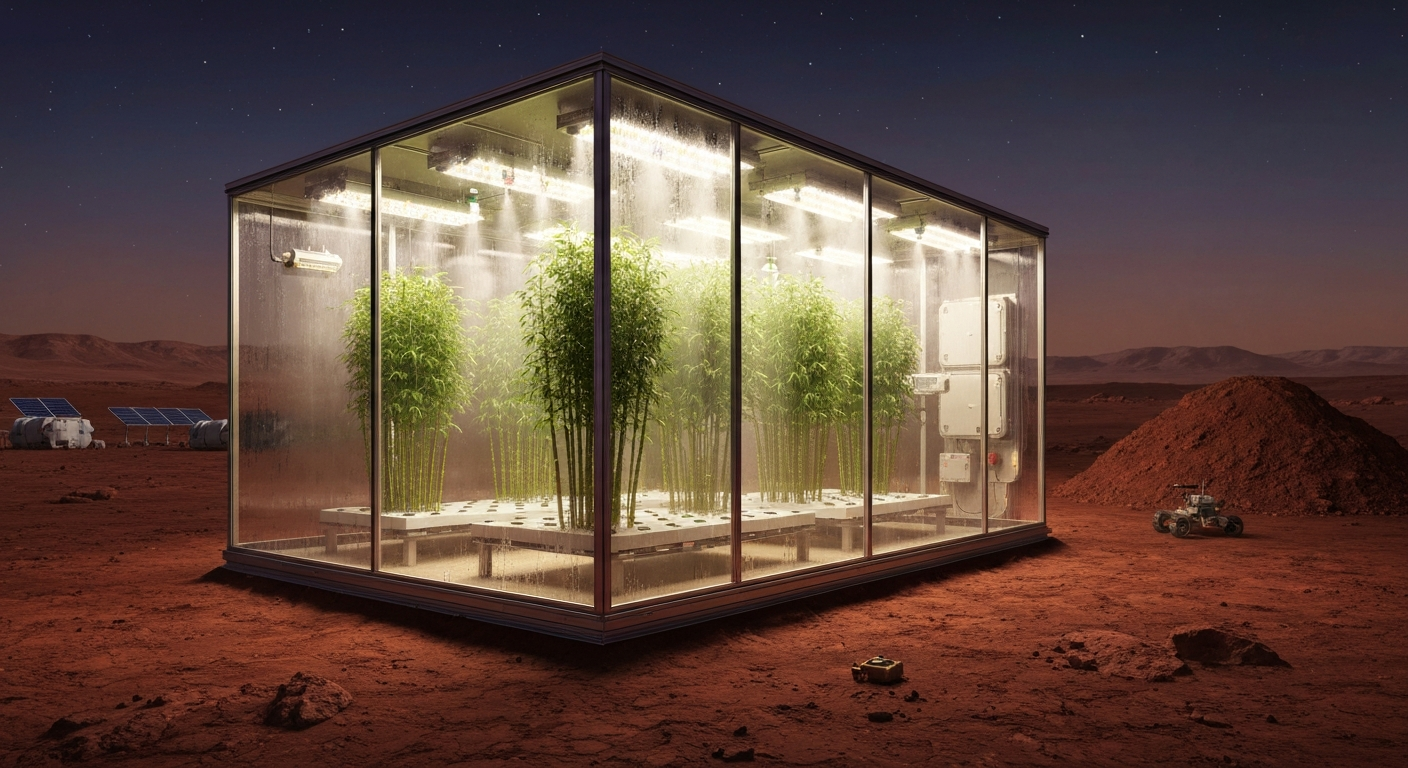
The only viable way to grow bamboo on Mars is inside a controlled, sealed environment. Spaceflight plant growth hardware such as Veggie and the Advanced Plant Habitat, NASA have repeatedly grown edible crops on the ISS under controlled lighting, nutrient delivery and environmental control, demonstrating crop systems can operate in microgravity Advanced Plant Habitat — NASA. Think of it as building a tiny biosphere from scratch. Three main approaches appear in the literature and research proposals, each with different trade-offs in mass, energy, and complexity.
- Sealed pressurized modules (connected to a habitat): Rigid-walled structures, similar to spacecraft modules, that maintain Earth-like or near-Earth-like pressure and atmosphere internally. These are heavy and expensive to launch or construct on Mars, but they offer the most reliable environment control and the lowest radiation exposure (especially if buried under regolith).
- Inflatable greenhouses: Lightweight inflatable structures that can be deployed on the surface and pressurized. These reduce launch mass significantly but require robust materials to resist pressure differentials, UV degradation, and micrometeorite impacts. Partial burial under regolith would add radiation shielding.
- Growth chambers (hydroponic or aeroponic): Small, highly controlled chambers optimized for individual plants or research batches. These would use nutrient-solution delivery (hydroponics) or misted nutrient spray (aeroponics), completely bypassing Martian regolith. ISS experiments in the Veggie and Advanced Plant Habitat programs have demonstrated that edible crops can be grown safely in microgravity with controlled lighting, nutrient delivery, and environmental monitoring — the core engineering concept transfers to Mars habitats.
For bamboo specifically, the rhizome spreading habit makes standard containers a constraint. On Mars, container-grown bamboo (clumping species rather than running types) would be far more manageable. Clumping bamboos like Bambusa oldhamii or smaller Fargesia species would stay within their allotted footprint and wouldn't require meters of horizontal root space. Growth rates would almost certainly be slower than Earth-normal given the energy cost of maintaining ideal conditions and the differences in light delivery.
Designing the habitat: pressure, atmosphere, temperature, and humidity
If you're engineering a Mars greenhouse for bamboo, here are the parameters to target, based on the low-pressure plant growth research and what bamboo actually needs.
| Parameter | Target for Bamboo Growth | Notes |
|---|---|---|
| Total internal pressure | 50-101 kPa (500-1,013 mbar) | Research shows many crops tolerate 30-40 kPa; bamboo's specific threshold is unknown but higher pressure is safer for vigorous growth |
| O2 partial pressure | ~21 kPa (similar to Earth) | Critical for respiration; must be maintained even at reduced total pressure |
| CO2 partial pressure | 0.04-0.1 kPa (400-1,000 ppm) | Elevated CO2 (up to ~1,000-1,500 ppm) can boost photosynthesis in C3 plants |
| N2 or inert buffer gas | Balance of total pressure | N2 from Mars atmosphere (2.7%) or carried supplies; needed to dilute O2 fire risk |
| Air temperature | 20-30°C during growth phase | Drop to 15-18°C at 'night' to mimic natural diel cycles; avoid sustained temps below 10°C |
| Relative humidity | 60-80% | High enough to reduce transpiration water loss but below fungal threshold |
| Radiation shielding | Minimum 50 cm regolith overburden or equivalent | Reduces GCR and secondary neutron dose substantially; water walls also effective |
Water recycling is non-negotiable in this design. Bamboo transpires significant amounts of water, and on Mars every liter is a precious resource. A closed-loop system that captures transpired vapor, condenses it, and returns it to the root zone is the only way to make bamboo cultivation remotely sustainable. The same principle applies to nutrient solutions in a hydroponic setup: recovery and re-dosing rather than discharge.
Perchlorate in the regolith means any soil-based approach needs remediation first. The most practical routes in a Mars habitat would be washing regolith with water (perchlorates are highly soluble) and then either running it through perchlorate-reducing bacterial communities or simply using the cleaned regolith as a mineral substrate while delivering nutrients hydroponically. The washed perchlorate solution would need to be processed, not something you'd dump into your plant water supply.
Lighting bamboo on Mars: the details matter
Mars receives about 43% of the solar irradiance that Earth does at the top of the atmosphere (Mars is roughly 1.52 AU from the Sun versus Earth's 1.0 AU, and irradiance falls with the square of distance). On the surface, dust storms can cut available sunlight dramatically, the 2018 global dust storm that ended the Opportunity rover's mission reduced surface light levels to near-zero for weeks. For any serious plant growth on Mars, artificial lighting is essentially mandatory rather than supplemental.
Spectrum and intensity
Bamboo as a grass uses both blue light (around 450 nm, driving vegetative growth and stomatal opening) and red light (around 660 nm, the primary photosynthetic driver) most efficiently. Far-red light (730 nm) influences flowering and shade-avoidance responses. For a Mars growing environment, LED arrays are the practical choice: they're energy-efficient, tunable to the exact spectrum you want, produce minimal waste heat (less cooling load on the habitat), and have long operational lifespans. The target photosynthetic photon flux density (PPFD) for vigorous bamboo growth is roughly 400-800 μmol/m²/s. Below 200 μmol/m²/s, growth slows substantially, which is a real concern given Mars's energy constraints.
Photoperiod and flowering risk
This is a practical concern many people overlook. Most bamboo species are monocarpic, they flower once, set seed, and die. The flowering trigger is still not fully understood, but photoperiod (day length) and total accumulated growing time are both implicated. On Mars, a Martian sol (day) is 24 hours and 37 minutes, which is close enough to Earth's 24-hour day that your lighting timers would need only minor adjustment. The recommendation for a Mars greenhouse would be to maintain a consistent 14-16 hour photoperiod to maximize vegetative growth and avoid any inadvertent flowering signals. Once a bamboo grove flowers, you lose your entire stand, a catastrophic outcome in a resource-limited Mars habitat.
Energy trade-offs
Powering LEDs at the intensity bamboo needs over a meaningful growing area requires substantial energy. A single square meter of canopy at 600 μmol/m²/s requires roughly 100-150 watts of high-efficiency LED power continuously. Scale that to even a modest 10 m² bamboo plot and you're looking at 1-1.5 kW just for lighting, on top of heating, pressurization, and water recycling loads. On Mars, power comes from solar panels (reduced efficiency at 1.52 AU and subject to dust) or nuclear sources. This energy budget is why most Mars agriculture research focuses on lower-biomass, higher-caloric-density crops like lettuce, potatoes, and legumes rather than bamboo. Bamboo's potential value on Mars would need to justify that energy cost.
What bamboo could actually be used for on Mars
Given how resource-intensive Mars bamboo cultivation would be, it's worth asking: why bother? The honest answer is that bamboo's use case on Mars is narrow but not zero. Bamboo produces significant biomass rapidly compared to many woody plants, and that biomass has structural value, compressed bamboo composites have tensile strength comparable to steel in some configurations. For a Mars settlement trying to reduce reliance on Earth-launched materials, locally grown structural material has real appeal. Bamboo also contributes to atmospheric CO2 scrubbing and O2 generation inside a habitat, though for that purpose, faster-cycling crops and algae systems are more efficient per watt of lighting energy.
What bamboo is not suited for on Mars is food production. While bamboo shoots are edible, they're a minor caloric source compared to grains, legumes, or root vegetables. And bamboo's long establishment period (most species take 3-5 years before producing significant harvestable culms) makes it a terrible choice for a crew with limited growing area and urgent caloric needs. The timeline and resource cost are simply prohibitive compared to alternatives.
Earth analog experiments you can actually run
One of the most practical things about this topic is that you don't need to wait for a Mars mission to test bamboo's resilience. Several of the challenge conditions have direct Earth analogs you can experiment with.
Growing bamboo in water or in aquatic setups is a popular experiment, partly because of the 'lucky bamboo' misconception. True bamboo species cannot survive with their roots permanently submerged in water, the rhizomes need oxygen in the root zone and will rot in anaerobic waterlogged conditions. This parallels the Mars hydroponic challenge: even in a nutrient solution system, you need oxygenated solution (actively bubbled or in an aeroponic mist format) rather than stagnant water. Bamboo in a fish tank? The lucky bamboo sold in pet stores is Dracaena, not bamboo. True bamboo would decline and rot in a fish tank environment.
Growing bamboo in desert or sandy soil conditions is a more useful analog for Mars. Bamboo's water stress response, its performance in low-nutrient substrates, and its reaction to extreme temperature swings all become apparent in arid conditions. Some species, particularly Phyllostachys and Bambusa species with established root systems, can tolerate surprising drought once established, but they never become genuinely xeric plants. If you're testing bamboo in sandy soil (a rough mineral analog to processed Martian regolith with perchlorates removed), focus on supplementing with compost and maintaining consistent irrigation. The results will give you realistic intuition for why Martian regolith alone would fail bamboo even without the perchlorate problem. See our guide "Can bamboo grow in sand" for practical tips on species selection, soil amendments, and irrigation strategies for sandy substrates.
For a more direct Mars analog experiment, researchers have used JSC Mars-1A simulant (a volcanic ash-based soil substitute) and other regolith simulants to test plant growth. These simulants don't replicate perchlorate toxicity (that's usually done by amending with potassium perchlorate at target concentrations separately), but they give a sense of the drainage, nutrient deficiency, and pH challenges involved. If you're growing bamboo in a minimally amended mineral substrate, you'll see nutrient stress (yellowing, poor shoot production) well before anything exotic happens.
Near-term vs long-term timeline for Mars bamboo
| Timeframe | Realistic scenario | Key limiting factor |
|---|---|---|
| 2026-2040 (near term) | No bamboo on Mars; crewed missions still in planning or early execution phase | No crewed Mars habitat exists yet |
| 2040-2060 (early settlement) | Possible small-scale bamboo experiment in a sealed research greenhouse, likely hydroponic clumping species | Energy budget, water availability, radiation shielding of habitat |
| 2060-2100 (established settlement) | Dedicated biomass/construction bamboo plot feasible if nuclear or large-scale solar power available | Resource allocation priority vs. food crops |
| Long-term (terraforming era) | Open-surface growth impossible without radical atmospheric pressure and temperature increase — centuries to millennia away at minimum | Terraforming Mars to Earth-like conditions is speculative and multi-generational |
The honest takeaway from this timeline is that Mars bamboo is a distant possibility, not a near-term reality. Even the most optimistic projections for crewed Mars bases don't include large-scale plant cultivation in the first decade of settlement. When plant cultivation does happen, it will prioritize caloric efficiency, which means lettuce, microgreens, potatoes, soybeans, and similar crops get the grow lights and water budget before bamboo does. Bamboo's case on Mars is strongest as a construction and biomass material in a mature settlement, not as a first-wave crop.
The bottom line
Bamboo cannot grow on Mars in any open or natural sense, the surface conditions fail on every single requirement bamboo has as a plant. Inside a well-engineered sealed habitat with pressurization, heating, LED lighting, hydroponic water and nutrient delivery, radiation shielding, and perchlorate-free growing media, bamboo could theoretically survive and grow, though slowly and at enormous resource cost. The most realistic bamboo-on-Mars scenario is a small research planting of a compact clumping species in a mature, established settlement with surplus energy, not a first-wave crop, not a terraforming tool, and not a food source. If you're fascinated by bamboo's resilience limits, the most useful experiments are right here on Earth: test it in desert conditions, in sandy low-nutrient substrate, in water-logged versus well-drained setups, and in temperature extremes. If you want practical experiments, start with simple trials to answer questions like 'can bamboo grow in the desert' to see how water stress, substrate, and temperature swings affect survival. Those results will tell you more about bamboo's actual toughness than any hypothetical Mars scenario, and they'll deepen your appreciation for how precisely matched bamboo is to Earth's conditions.
FAQ
Can bamboo grow on Mars in the open environment?
No. Mars’ surface environment (very low pressure ≈4–9 mbar, extreme cold, high radiation, thin CO2 atmosphere, perchlorate‑containing regolith and very limited liquid water) is hostile to unprotected terrestrial plants. Bamboo would desiccate, freeze, suffer severe radiation damage and cannot obtain usable water or a suitable gaseous environment without a sealed, engineered habitat.
Which Martian conditions specifically prevent bamboo from growing outdoors?
Key barriers are: (1) atmospheric pressure ~0.4–0.9% of Earth’s — not enough for normal plant gas exchange or liquid water stability; (2) very low and highly variable temperatures with frequent extremes far below freezing; (3) high surface radiation (GCRs and secondary particles) that damages living tissue; (4) regolith chemistry that often includes toxic perchlorates and lacks organic structure and microbiota; (5) scarce accessible liquid water at many sites; and (6) reduced atmospheric nitrogen/oxygen balance critical for long‑term plant metabolism.
Could bamboo grow inside a sealed habitat or greenhouse on Mars?
Yes — but only in a controlled, pressurized, shielded growth system that supplies appropriate temperature, humidity, gas composition, water and nutrients. Controlled approaches include pressurized greenhouses or modules, hydroponic/aeroponic systems, and buried/partially buried structures with radiation shielding. Engineering and life‑support resources are required to sustain bamboo growth.
What environmental targets are realistic for a Martian bamboo greenhouse (pressure, temperature, gases)?
Practical targets: maintain total pressure between ~10–40 kPa (some crops tolerate lower pressures with higher CO2); daytime air temperatures ~18–30 °C (species dependent) with night minima managed to avoid freezing; CO2 enrichment to 800–1,500 ppm (higher can boost growth but requires engineering tradeoffs); O2 controlled for human safety if crewed; and relative humidity ~50–70% with good condensation control. Lower‑pressure greenhouses reduce mass but add complexity for humidity and gas diffusion.
How should lighting be handled for bamboo grown on Mars?
Natural sunlight through greenhouse glazing can be used at near‑equatorial sites, but reduced solar flux (and dust storms) mean supplemental artificial lighting (LEDs) is often necessary for steady growth. Aim for light levels similar to bamboo’s light preference (varies by species — many need moderate to high PAR: 200–800 μmol·m−2·s−1 for good growth). Photoperiod and spectrum (blue/red) should be controlled for biomass production.
What about Martian soil (regolith)? Can bamboo root in it?
Native regolith is basaltic, abrasive, low in organics, often salty and may contain perchlorates that are toxic to plants. Regolith must be amended or avoided: options include using engineered growth media (composted waste, imported topsoil, peat/soilless mixes), hydroponics/aeroponics, or remediating perchlorates (chemical, thermal, biological methods). Mechanical properties and water retention also require modification for root anchorage and hydration.
Next Article
Can Bamboo Grow in Sand? How to Plant and Care
Yes, bamboo can grow in sand with the right amendments. Learn soil prep, best types, planting, watering, and fixes.